A coding school is an unexpected place to start a palmyra-products business. For Yathusha Kulenthiran, it was the place where the idea began to acquire a working future. She developed her Olai project at Uki, the technology school run by Yarl IT Hub, then pitched at the Yarl Geek Challenge, met business people and investors, received temporary workspace and joined an accelerator. The thread running through those steps was a community in Northern Sri Lanka.
Her account, published in TamilCulture in 2021, gives substance to a phrase that startup organizations use rather freely: an ecosystem. Here, it meant having somewhere to take the next question. Kulenthiran described financial and other barriers to university, and a coding course that opened several more doors than its name suggested.
“I would not be who I am today if it wasn’t for Yarl IT Hub.”
Yathusha Kulenthiran · Entrepreneur · 2021
Yarl IT Hub has an expansive ambition: to make Jaffna the next Silicon Valley. Its daily proposition is easier to grasp. Learn a skill. Make something. Explain it to someone who might help. Return with a harder question. That sequence links its school programs, technology training, competitions, business mentoring and shared facilities.
A social network gets somewhere to go
Yarl IT Hub began in 2011 as a social network. An early visitor’s account captures the modest scale: around 50 young people attended a January 2013 meeting at the Institute of Informatics Studies in Jaffna. Gowri Ananthan, identified as a founding member, argued that an industry would require people to work at creating it. The Silicon Valley aspiration was already there.
Another founding member, Balathasan Sayanthan, has described the organization’s work at three levels: schoolchildren, young adults and entrepreneurs. This is a useful way to understand its place in the market. A training provider might serve the second group; an incubator might concentrate on the third. Yarl IT Hub attempts to connect all three within a particular region.
It calls itself a not-for-profit social enterprise, with community ownership and volunteer participation central to its identity. Its published values include transparency, political neutrality and independence from any particular technology or corporation. The practical test of that culture is whether people with useful experience keep turning up for people who need it.
Six months to learn a different future
Uki opened in Jaffna in 2017, targeting young people who had missed higher-education opportunities. Its original six-month, in-class program taught full-stack web development. Kilinochchi followed in 2018; Vavuniya joined in 2023. The geography matters: the school brought another route into technology closer to students across the North.
The curriculum extends beyond programming to project management, business, digital marketing and mentorship. Full-time scholarship programs sit alongside part-time options. For someone who has completed Advanced Level examinations without gaining access to university or vocational training, that is a practical proposition: structured study, actual projects and contact with working professionals.
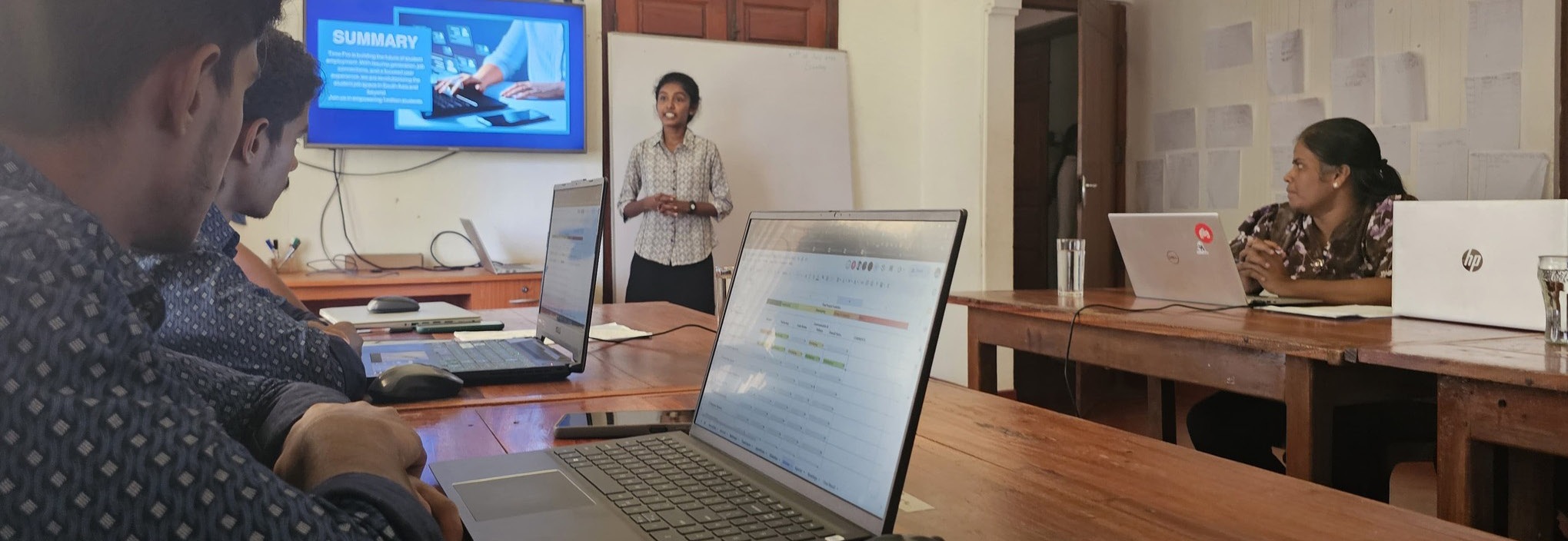
Uki reports more than 1,000 course completers, a 90% internship rate and more than 30 companies run by alumni. Those are the school’s own figures. An internship measures an entry point into work; readers should not treat it as a permanent-job statistic. Still, the reported outcomes explain why this classroom deserves attention.
For a prospective student, the cost calculation includes time. Six months of full-time attendance can compete with paid work and family responsibilities, even with a scholarship. Part-time provision offers another schedule. In 2025, Uki’s offerings included AWS, Python, data science and UI/UX activities; by September 2026, the community portal was advertising AI-enabled full-stack development intakes.
The school club has a chief financial officer
Yarl IT Hub starts well before the school-leaving years. Puthiya Payanangal introduces students aged 11 to 14 to science, technology, engineering, arts and mathematics through projects and game-like activities. The idea is to give children practice at solving problems while they still have plenty of time to discover what interests them.
There is an unusually businesslike companion: school entrepreneurship clubs with student CEOs, CFOs and marketing chiefs, supported by a faculty advisor. Someone has to watch the budget. Hatton National Bank describes its partnership as seed-funding support for clubs in 40 Northern schools. This gives entrepreneurship a small, supervised setting in which money and responsibility have actual meaning.
YGC Junior adds competition and mentorship, including web, mobile, hardware and science projects. Aki provides another route through online secondary and vocational learning materials. Its published offering includes more than 8,000 practice questions. Together, these programs let a student encounter technology through making, competing or studying, rather than requiring an early declaration of a career plan.
Getting introduced is the beginning.
Puthiya Payanangal’s reported participation at each level:
Program-level counts from the 2025 annual report. These figures do not establish why students stopped or whether the same students were tracked throughout.The participation figures above make the work more interesting than an outreach total alone. Each successive level has fewer participants. For anyone adapting this approach, the operational question is what helps a child return: time, teacher attention, encouragement, equipment or a project worth finishing. The numbers make that question visible without pretending to answer it.
After the pitch, open the spreadsheet
The YGC startup accelerator runs for six months, combining individual mentoring, business training, progress checks and opportunities to meet investors. A separate eight-week accelerator serves digital content creators. The startup proposition includes access to people who can question a business model before its owner spends more money pursuing it.
The connection to finance has a history. An August 2014 agreement with the Lankan Angel Network established a route to mentoring and investment access for Jaffna ventures, including businesses outside IT. That breadth helps explain why a palmyra-products enterprise belongs in this story. Technology skills can support a business whose actual product is something you hold.
A July 2026 reflection by mentor Ragu Masilamany shows the work in close-up. He described pricing sessions delivered separately in English and Tamil, and biweekly meetings with an education entrepreneur who submitted monthly financial statements. Other conversations addressed customers who showed interest but did not subscribe. A pitch can win applause while that problem remains painfully intact.
His account also points to what other communities can copy: match practitioners to specific questions, make meetings recurring and work with the founder’s actual numbers. Volunteer goodwill needs scheduling. Advice becomes more useful when the person offering it sees what happened after the previous conversation.
Who pays for an open door?
Yarl IT Hub says most of its programs are free, with nominal material charges for some specialist activities and scholarships to preserve access. Sponsorships, partner projects and volunteer expertise help support provision. This is a community-service model with beneficiaries, sponsors and facility users occupying different roles.
WEHub makes that arrangement tangible. Launched in 2024 with the World University Service of Canada through the GRIT project, its first center was in Kilinochchi. It provides women entrepreneurs with business planning, financial literacy, digital marketing and mentorship. The audience includes people developing ordinary businesses who need practical help reaching customers and keeping records.
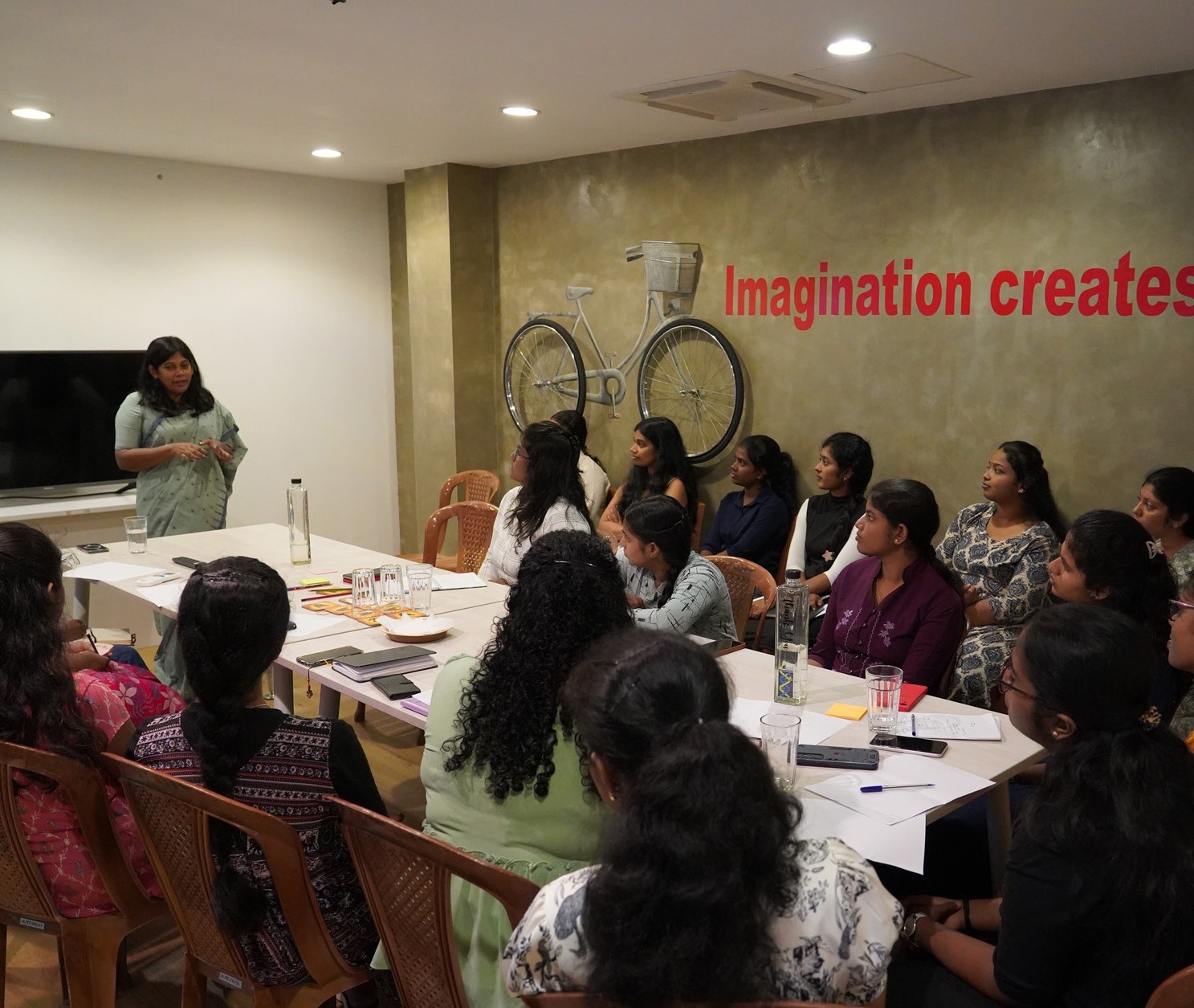
Kalam supplies physical infrastructure: dedicated coworking, meeting and event rooms, maker activities and a content-creation studio. Its current service page invites membership and bookings. A useful comparison is with a standalone workspace: at Yarl IT Hub, a room can sit within a wider collection of teaching and entrepreneurial activities.
Even volunteering has a price. The diaspora summer internship is unpaid, with a minimum four-week commitment for participants aged 15 to 22. Interns pay for flights, local travel and accommodation; Yarl IT Hub provides workspace and lunch during working hours. The offer is specific enough for a family to budget around, rather than mistake for a funded placement.
A room changes jobs
The facilities have changed with circumstances. The 2021 report describes pandemic restrictions pushing many events online and limiting external events at Hatch Kalam, the space developed with Hatch and GIZ. A model built around gathering people had to find ways to work when gathering became difficult.
There was another concrete change in 2025: Kalam discontinued common coworking, and Uki moved into the space. Dedicated coworking continued. The change is worth noticing because it shows that the collection of services is adjustable. A classroom can become the next use for a room previously occupied by freelancers and early-stage founders.
That does not establish why management made the decision. It does underline the conditions behind this approach: usable premises, teaching capacity, dependable coordination and people willing to return. Copying the program names without those commitments would leave little to connect the stages.

The next question needs an address
By September 2026, Yarl IT Hub’s portal was listing applications for accelerator Cohort 12 and using a single member identity and QR code across programs and events. The administrative detail fits the larger idea: participation should be able to continue beyond one visit.
For a student, the starting point is a course or school activity. For a founder, it is a program suited to the business’s stage. For an experienced professional, it may be a recurring mentoring appointment. The Silicon Valley ambition supplies the headline. The more useful promise is having someone to contact when the first project produces the second problem.