A shipment can arrive in perfect condition and still be a financial disaster. The parts are unbroken. The boxes are dry. The delivery has simply missed the moment when somebody needed it. Yann Barbarroux has built a company around that awkward interval between arriving safely and arriving usefully. In the world he works in, a clock can do quite a lot of damage without touching the merchandise.
Barbarroux is the CEO and co-founder of Otonomi, which develops parametric insurance for cargo delays. The premise is unusually easy to explain for a business involving underwriting algorithms and blockchain: agree on a delay threshold, monitor the shipment, and trigger compensation when the insured conditions are met. The difficulty begins after that sentence. Someone must price the risk, secure insurance backing, find customers, and make the machinery work when a shipment actually goes wrong.
He came to the problem through financial risk management. His career had already taken him from France to New York and through several banks before he began trying to change how freight businesses get paid after disruption. The cargo may be moving across an ocean. His subject is the money that stops moving when it gets stuck.
A physicist’s education, a banker’s apprenticeship
His education began with applied physics at Aix-Marseille University, followed by a master’s in computer engineering and information system management at Télécom Paris. That combination puts measurement and systems near the beginning of the story. Long before cargo insurance, he was learning disciplines concerned with how things behave and how information travels.
His banking roles included market risk management at ING, fixed income risk management at Hapoalim Securities, and a director-level global markets risk role at Citi. These were jobs concerned with exposure across financial instruments and markets. A late container looks different from a structured derivative, but both present the same uncomfortable business question: what happens to the balance sheet when events refuse to follow the plan?
Entrepreneurship also entered through the bank. At Citi, he co-founded an emerging-markets digitized lending venture in the D10X incubator. Other ventures in his professional history include Accelerate VI and Flyion. Otonomi therefore followed experience inside both established institutions and smaller ventures. He arrived with an understanding of risk departments and some acquaintance with the business of starting things.
Marseille, New York, and a joke about Mars
Barbarroux was born and raised in Marseille, studied in Paris, and took his first Wall Street job in 2003. By 2021, he was living in Greenpoint, Brooklyn. Asked to describe himself, he chose four words: “Curious. Creative. Sarcastic. Gritty.” A useful collection for a founder selling insurance, particularly the last two.
Asked where he might be in two years, he joked about Mars, then explained the Marseille connection. The answer soon moved toward Asia-Pacific, where he wanted to expand the business. He connected that interest with his Vietnamese background and the personal appeal of working in Asia. Nha Trang appeared in his imagined itinerary.
The same conversation offered a less picturesque account of founding a company: accountability. After corporate life, he had discovered how directly the business depended on his own daily effort. Customers, sales, and product development all demanded attention. There is a certain comic efficiency in this career choice. Having spent years managing financial exposure, he had acquired a business that exposed him to almost every job at once.
Curious. Creative. Sarcastic. Gritty.
Yann Barbarroux, describing himself in 2021
The insurance problem hiding in plain sight
The opportunity became clearer when he examined the treatment of delays in transportation insurance. Traditional cargo protection commonly focuses on physical loss or damage, leaving a business exposed to the costs of time lost. A customer can have insured goods and still face a serious gap in protection. That distinction gave Otonomi its commercial starting point.
In a November 2025 conversation in Singapore, Barbarroux described transit delay as the parameter his product watches. His account put machine learning behind risk pricing and arrival predictions, with blockchain supporting the integrity of the digital process and payments. Those technologies have separate jobs; the customer’s underlying concern remains the shipment’s arrival time.
His shorthand was economical: “We quote in seconds, bind in minutes, and pay in days.” It is a description of Otonomi’s intended operating rhythm, rather than a universal promise for every shipment. Still, it explains his priorities better than a catalogue of software features. He wants buying coverage to fit around freight operations, and compensation to arrive while the disruption still matters to the business.
- 01 / AgreeSet the insured delay threshold.
- 02 / ObserveTrack the shipment against the policy conditions.
- 03 / TriggerCompensate when the insured threshold is met.
A London apprenticeship for a New York startup
Otonomi joined the eighth cohort of Lloyd’s Lab in 2022. For Barbarroux, access mattered. The programme brought the company into contact with underwriters, brokers, syndicates, and other participants in London’s insurance market. An algorithm can calculate a price; it cannot, by itself, create the relationships needed to put an insurance product into circulation.
The Lab helped Otonomi obtain capacity and investment from Greenlight Re. Its first product launched in 2023, providing parametric air freight delay and interruption coverage. Policies used blockchain smart contracts, while quoting, binding, and issuance were digitized. This was a transition from building a proposition to securing the backing required to offer it.
That stage gives his story a useful texture. A founder working with new technology still had to spend time among the institutions that understand insurance risk. The practical achievement was getting a product through that process. For someone with a banking background, the value of institutional access would hardly have been mysterious. Otonomi needed the people willing to stand behind the promise as well as the code that could execute it.
The screen in Times Square
An earlier milestone had offered a more photogenic moment. In February 2022, Otonomi’s air freight insurance index, OTO-USA-1, joined Nasdaq Global Index Data Services. The team celebrated in Times Square, where the company’s logo appeared on the Nasdaq MarketSite tower. For a startup, there are worse places to see your name lit up.
The index combined a basket of blockchain-based air cargo delay insurance policies to give a view of supply-chain performance. OAG flight information reached the system through Chainlink oracles, which connect external data with smart contracts. Beneath the bright screen was a fairly sober technical requirement: a contract responding to a real-world event needs a dependable account of that event.
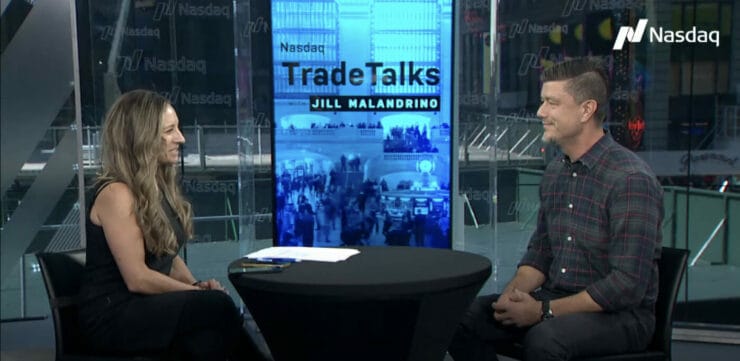
Later that year, Barbarroux sat down with Jill Malandrino for Nasdaq TradeTalks during Chainlink’s SmartCon in New York. He discussed preset compensation and the use of independently triggered policies. The appearance placed him between two audiences, insurance and blockchain, with a translation job to do. His case for the technology rested on a practical application: paying businesses after disruption with less administrative delay.
Capital, cargo, and the difference between a result and a target
In October 2025, Otonomi announced a $5 million Series A. The funding brought together investors including Hivemind, Rothschild & Co Asset Management, Portline Capital, Cyberport, and returning investor ATX Venture Partners. Its stated purpose included expanding the cargo insurance platform and developing its technology. For Barbarroux, financing meant more resources to move beyond the company’s initial markets.
By November 2025, the business had passed 10,000 insured shipments. He said it had launched in ten jurisdictions across the Americas and Asia, and described an ambition to add thirty more countries during 2026. He also set a target of covering 45,000 to 50,000 shipments in 2026. Those figures describe different things: an achieved shipment milestone, an existing footprint, and a plan for the following year.
The range of customers was widening too. The early air cargo business included automotive and aerospace shipments. Maritime coverage brought demand from businesses moving perishables, while electronics and e-commerce offered further possibilities. Across these examples, the commercial thread stays consistent. A component, a box of fruit, and an online order can each lose value when delivery misses a deadline.
October 2025
November 2025
Go where the forwarders already work
In December 2025, Freightos added Otonomi to the WebCargo Services Portal. The partnership put cargo delay protection alongside services used by freight forwarders. For a founder, that is a different distribution problem from persuading every prospective customer to discover a separate insurance website and begin a new routine.
The initial arrangement was a portal listing, with the two businesses planning to explore closer technical connections over time. That distinction matters. A distribution partnership can begin with access and develop toward deeper integration. In this case, the proposed next steps included API alignment and greater use of shipment tracking and visibility data.
Barbarroux’s career helps explain the attraction of that approach. He has worked inside large financial organizations and built ventures. Here, the product has to meet another organization’s workflow. A forwarder is busy arranging transport, managing customers, and dealing with exceptions. Offering protection close to those existing tasks gives the insurance a practical place to live. The sale begins with the customer’s working day.
An Asian chapter, with working capital at its centre
By 2026, Singapore was home to Barbarroux and an important Otonomi hub. His earlier interest in Asia had become part of the company’s daily geography. In September, he described regional ambitions involving freight forwarders, logistics platforms, insurers, reinsurers, and brokers. The list reflects the number of relationships required to move a financial product through global trade.
His account of the work had also become more concrete. The moment he valued was a client receiving an automatic payout during a disruption. In that description, the test of the platform is access to money when a business needs it. Real-time information becomes useful when it produces an operational consequence.
On the programme for a French Chamber of Commerce in Singapore discussion on October 9, 2026, he appeared alongside speakers from GEODIS, Enterprise Singapore, and ESSEC. The subject was operating amid geopolitical uncertainty, including changes to trade routes and ways to protect businesses against disruption. It was familiar territory for a risk manager who had followed his subject from financial markets into freight.
His story now stretches from Marseille and Paris to New York and Singapore. The recurring concern is narrower than the map: the interval between a business suffering a setback and receiving financial relief. Cargo operators already spend their days trying to make things arrive on time. Barbarroux has chosen the other appointment that matters: when the money arrives.