In 2007, Yangbin Wang had a video technology company and no customers. Vobile was two years old. Hollywood’s six major studios were looking for ways to identify pirated films, and they wanted to test the available technology. Wang entered his startup in the competition. For an engineer trying to turn an idea into a business, this was an unusually useful audition: the people with the problem were assembling in one place.
Eleven years later, Vobile received a Technology and Engineering Emmy for video identification. An entertainment award is a pleasing destination for work whose purpose is to notice when somebody else’s entertainment turns up somewhere unexpected. Between the customerless startup and the ceremony sits the question Wang has spent much of his career pursuing: when moving pictures become easy to move, how does their creator keep a claim on their value?
His answer has grown from recognition software into a business spanning protection, monetization and AI creation. Yet the basic tension remains wonderfully stubborn. Audiences want pictures to travel. People who finance and make those pictures want the income to find its way home.
A career in moving pictures
Wang graduated from Zhejiang University with an engineering degree in 1991, then completed a master’s in electrical engineering at the University of Florida in 1993. His early career included research engineering at Compression Labs and General Instrument. Digital video compression was his starting territory: the technical work of making video practical to transmit and store.
The sequence matters. Long before he was talking about the rights attached to an online clip, he was working on the machinery that let pictures circulate. His subsequent jobs stayed close to that problem. He became director of software architecture in Oak Technology’s Broadband Consumer Group, then founded EnjoyWeb, whose work concerned time-shifted delivery of video over broadband.
Another company, YZTECH, took him into internet protocol television. After Onewave acquired that company’s IPTV business in 2004, Wang served as Onewave’s chief technology officer. This was a career built across the unglamorous seams of entertainment: compression, delivery, architecture and distribution. The screen received the applause; the plumbing made the screening possible.
He founded Vobile in 2005, the same year YouTube appeared. The timing put him beside a new kind of distribution problem. A platform could make sharing astonishingly simple. Recognizing the ownership of what was shared required another layer of engineering.
Giving a film a fingerprint
Consider the difference between recognizing a file and recognizing a film. A filename is easy to change. A piece of a movie can circulate separately from the original. The useful question for a rights holder concerns the underlying content, wherever it appears. Vobile’s Video DNA technology takes identifying characteristics from video and compares them with reference material.
Wang’s involvement reaches into the invention itself. He and Jian Lu are named as inventors on a US patent for fingerprinting digital video using spatial and temporal signatures at multiple resolutions and rates. The application was filed in 2007; the patent was granted in 2011. The founder’s engineering credentials extend beyond the biography on the company website.
Vobile’s services use fingerprinting and watermarking to help rights holders protect and monetize their work. Those two aims sit together for a reason. Identifying content can support a decision about removing an unauthorized copy, but recognition also helps establish where value is being generated. A successful match opens a commercial conversation as well as a technical one.
That is an unusual position in the entertainment business. Wang’s company has to understand both the ease of online circulation and the cost of producing what circulates. Its customers include movie studios, television networks and streaming platforms. The work takes place beneath the viewing experience, in the accounting of what belongs to whom.
The business beyond the takedown
By 2014, Wang was extending that work toward publishers trying to earn more from YouTube. Vobile acquired the Los Angeles video analytics startup Blayze. Its two co-founders joined the company and were tasked with establishing an office there. The deal brought content identification closer to audience analysis and the economics of publishing.
Wang described a transaction involving cash and stock, with its eventual value dependent on benchmarks. More interesting than the deal mechanics was the direction of travel. A business associated with finding unlicensed material was buying tools connected to making money from online video. Protection and distribution were becoming parts of the same assignment.
Vobile listed on the main board of the Hong Kong Stock Exchange in 2018. That year also brought the engineering Emmy, recognition for the company’s video identification work. These were different forms of validation: one opened a public market chapter, while the other recognized technology serving an industry that makes its living from attention.
Wang remained chairman and chief executive. The continuity gives his career a distinctive shape. He has followed video through changes in delivery and consumption while keeping responsibility for the business built around it. His subject has kept changing formats; the underlying commercial question has remained remarkably durable.
A circle, and a return to Gainesville
One memory from Florida offers a quieter explanation of his direction. Professor José Príncipe drew a circle for his students. Inside was existing knowledge; outside was what remained unknown. He encouraged them to work beyond that boundary. Wang later recalled the illustration as an encouragement to pursue technologies at the edge of what was established.
Gainesville became what Wang calls his “American hometown.” In April 2022, Vobile announced a research and development and operations center there. His explanation was practical: proximity to the University of Florida’s engineering talent, alongside the university’s investment in AI education and research. The announcement described a plan to create hundreds of jobs, a hiring ambition attached to the new operation.
The connection also took educational forms. Wang sponsored innovation fellowships, served on the engineering college’s advisory boards and became an elected director of the UF Foundation National Board. Vobile offered students opportunities to gain experience locally and on the West Coast. Returning to a university can involve a speech and a photograph. In Wang’s case, the relationship also involved work, students and research.
In 2024, he received UF’s Distinguished Alumnus Award and joined the electrical and computer engineering department’s inaugural Hall of Fame. That December, assistant professor Md Jahidul Islam was named the Yangbin Wang Rising Star Professor. The classroom connection had acquired a longer institutional life.
The engineer who also wrote poems
Wang’s interest in creativity has a personal dimension. He has written poetry and enjoys the work of martial arts novelist Liang Yusheng. He grew up watching Hong Kong television and listening to its music. These details sit comfortably beside a career in compression algorithms: the engineer working on the economics of pictures also has attachments to the stories inside them.
During a September 2025 interview in Hong Kong, he explained that Vobile’s name combines video and mobile. He had anticipated that video consumption would move onto mobile devices, though he had not expected the phone to be the vehicle. It is a useful admission from a technology founder. Reading a direction correctly does not mean predicting the object everyone will eventually hold.
His ambitions include helping Chinese creative work reach audiences abroad, with Hong Kong serving as a bridge. During the same conversation, he showed advertising films made with Vobile’s DreamMaker AI platform. He emphasized the ideas and writing needed to give such tools something worth making. Even a machine that produces pictures needs a reason for the next picture.
Creation gets easier. Ownership gets busier.
At the Asia Video Summit in March 2024, Wang discussed AI with AVIA chief executive Louis Boswell. He connected the new wave of generative tools to the earlier arrival of user-generated video. Both made creation and distribution more accessible. Both sharpened questions about the rights of the people whose work was involved.
His position allows for opportunity and friction in the same sentence. AI can lower production costs and broaden participation, while also giving unauthorized users new tools. In his account, human creativity remains central to entertainment’s commercial value. That makes rights management part of the future he wants to build, alongside the ability to generate more material.
“Our focus should be on building systems that last.”
Yangbin Wang, APEC CEO Summit, 2025
At the 2025 APEC CEO Summit in Gyeongju, he called for cooperation across technology and media. He highlighted questions about copyrighted training material and outputs that might infringe existing work. His preferred historical precedent was the way revenue sharing helped platforms and rights holders develop a commercial relationship. The emphasis was on giving the participants reasons to cooperate over time.
By April 2026, that creation-and-rights argument had reached a student competition. Vobile and UF’s IGNITE Innovation Network hosted an AI video challenge using DreamMaker. Teams worked with AI agents to build repeatable video generation workflows. The exercise tested how their systems handled unseen prompts as well as the videos they produced. Students were being asked to build a process, then show that it could work beyond a single demonstration.
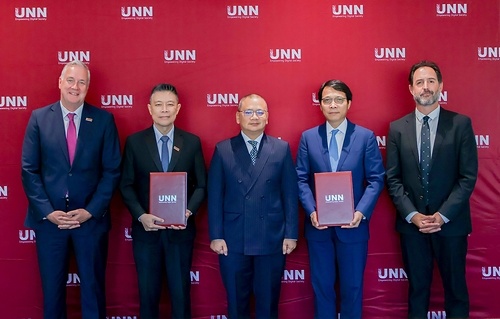
In September 2026, Wang signed agreements with UNN in Brunei to support AI infrastructure for DreamMaker and related services. The arrangement allocated 25 megawatts of planned data center capacity, with another 25 reserved for future expansion. The distinction matters: a reservation describes room to grow, rather than computing capacity already in use.
From video compression to AI infrastructure, his work has repeatedly returned to the conditions that let entertainment circulate. More people can now make pictures, and more machines can help them. Wang has built his career around the next question: how do the people behind those pictures remain part of the transaction?