A film can contain a romance, a fistfight, a comedy and a family quarrel. Delivering it to a phone introduces a less entertaining cast: sign-ins, subscriptions, compression, search and downloads. Vineet Dhawan has spent much of his working life in the company of that second group. The audience remembers the scene. His business depends on the machinery allowing it to arrive.
Dhawan is the founder and CEO of Digital Convergence Technologies, or DCT, and the founder of its streaming platform, dcafé. Based in Ridgewood, New Jersey, he works in a business where the visible product belongs to somebody else: a broadcaster, a filmmaker, a performer. That arrangement gives his career a particular shape. He sells the means of reaching an audience while arguing that the owner should retain the value of the work.
The salesman before the streaming platform
Before DCT, Dhawan worked across sales, training, consulting and business development. His career included Pentasoft Technologies, AccelTree Software, Manford Allianz and Care Principium, followed by a director role in business development and sales at Global Business Services. These are useful beginnings for someone whose later work would require bringing together customers, technology partners and engineers.
There is a practical continuity here. A streaming business has to persuade a content owner to entrust it with something valuable, then coordinate the people who can deliver it. The finished application conceals those negotiations. The service behind it has to make them hold together. Dhawan's earlier commercial roles help explain the work he eventually chose to lead, without turning a job history into a predestination story.
He began leading DCT in 2006. Over the years, the company developed a broader engineering business alongside its media work. Its own milestones place the launch of dcafé in 2019. The interval matters: the product arrived after years of operating a services company, with the accumulated problem of connecting systems already part of the job.
A business model with the owner still in it
In 2020, Dhawan described an approach intended to make launching a streaming service less expensive at the outset. DCT offered a model without upfront capital expenditure, with a stated deployment window of four to six weeks. Content providers would pay according to the hours their audiences consumed. These were the terms he described at that time, a revealing snapshot of how he wanted the commercial relationship to work.
The attraction was understandable. A content owner could have a catalogue and an audience yet still face separate vendors, contracts and technical systems. dcafé brought functions such as ingestion, encoding and distribution into a common workflow, alongside applications for different screens. The promise was partly administrative: fewer pieces for the customer to assemble before showing anything.
Dhawan put his position plainly: The power lies in the content.
His argument gave technology a supporting role, with ownership and the ability to earn remaining central. Even the payment structure followed that reasoning. A platform could take its share as viewing happened. For a seller of infrastructure, it was a commercially useful way to make the customer's success relevant to his own.
“The power lies in the content.”
Vineet Dhawan, 2020
Masala movies meet the settings menu
Dollywood Play gave that approach a concrete setting. In 2020, the service brought Hindi-dubbed entertainment to viewers, with a focus on audiences beyond the major metropolitan centres. Its content partner, WAMINDIA, had the films and the audience ambitions. dcafé supplied the technology needed to turn those assets into a usable viewing service.
Aneesh Dev, WAMINDIA's founder-director, described the appeal of combining technical needs that otherwise required separate solutions. Sign-ins and subscriptions had to coexist with compression, search and offline downloads. The list is a reminder that a streaming service starts working long before the film does. A viewer trying to remember a password is already having an experience of the product.
Dhawan's description of the films was considerably more colourful than the engineering vocabulary. He compared masala cinema to a mixture of spices, moving through romance, comedy, melodrama and action. It is an amusing encounter between subject and supplier: heightened villains on one side, content delivery on the other. His contribution was to help the spectacle survive the journey to the screen.
The partner becomes a board member
Another part of the business took shape through upLynk, the video platform founded by Ralf Jacob. Dhawan described dcafé's early work as building for upLynk. The relationship connected his company to a streaming workflow whose capabilities could be incorporated into the service offered to content owners.
In July 2020, dcafé announced Jacob's appointment to its board. Jacob had previously led Verizon Digital Media Services. In explaining his interest, he singled out the way dcafé exposed features and services through application programming interfaces, allowing other systems to connect. For an operator assembling a service, that kind of compatibility affects what can actually be built.
Dhawan expressed enthusiasm about having Jacob's guidance. The episode is a useful marker in his career because it shows how a technical partnership can develop into a governance relationship. It also gives the story a cast beyond the founder. dcafé's development involved people who brought different parts of the streaming business into the same conversation.
The match is close. The stream has to keep up.
By June 2025, Dhawan was discussing live sports as an engineering problem. Sudden increases in viewers, variable bandwidth and different devices all affected delivery. He described cloud infrastructure, multiple content delivery networks and adaptive bitrate streaming as parts of DCT's approach. In ordinary language, the service needs room to expand and ways to adjust the picture to the connection available.
He also made a precise distinction in an interview framed around IPL streaming: DCT did not manage the IPL. That detail keeps his explanation in proportion. He was discussing the industry's methods and his company's capabilities, rather than claiming responsibility for that tournament.
His broader concern was the balance between viewing and revenue. Advertising can help fund access, but inserting it badly interrupts the event people came to see. Personalisation and monitoring, in his account, had to support both the audience and the operator. The engineering question reaches directly into the commercial one: can a service earn money while preserving the reason anyone opened it?
At The Gorge, another camera angle
A February 2026 announcement supplied a specific example of DCT's place in interactive streaming. VOLTA offered a ticketed replay experience of Dave Matthews Band's 2025 Labor Day performances at The Gorge. Viewers could choose camera angles, making the act of watching more participatory. The performance had already happened; the broadcast experience gave fans another way to revisit it.
DCT/dcafé's role included integrating VOLTA's player and its metadata-controlled viewing system. Other partners supplied encoding, monitoring and distribution. It was a shared technical undertaking, with each company responsible for part of the route from recorded performance to viewer.
Dhawan's comment emphasised preparation and synchronisation. Giving viewers more control raises the expectations placed on the system underneath. Choosing another angle should feel like a musical decision, without requiring the fan to think about bandwidth. For his career, the project provides a concrete continuation of the same commercial theme: build the supporting machinery around someone else's creative work.
A conversation about Indore
Dhawan's public activity also extends to the geography of technology work. At the Global Investors Summit in 2025, he joined DCT colleagues in a discussion with Madhya Pradesh Chief Minister Mohan Yadav. The proposed next step was a Global Capability Centre in Indore, with land exploration under way. It was an expansion plan, rather than an announcement of an operating centre.
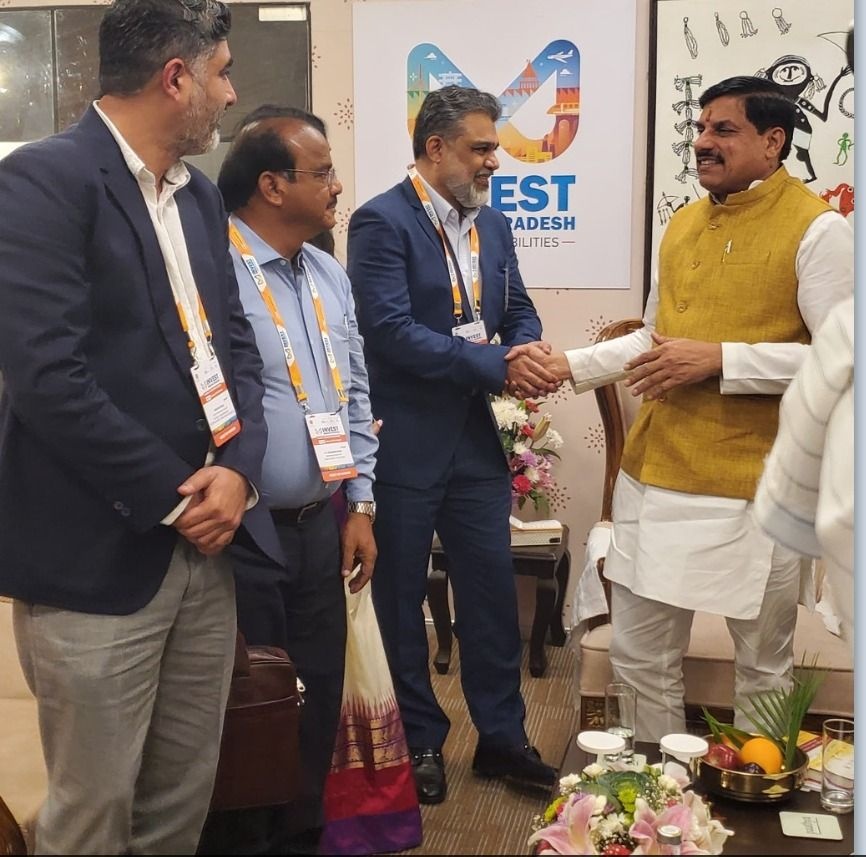
The discussion included COO Anis Nathani and managing director Maushmi Dhawan. It places the founder within a leadership team and a longer process of building delivery capacity. An earlier appearance at a Nagpur technology panel in December 2024 likewise concerned the development of a regional technology hub. Alongside the streaming products sits an interest in where the next groups of technology workers might build their careers.
The work behind the next thing
Dhawan is also an investor in Bharat Carbon, whose platform addresses corporate carbon measurement and reporting. Its leadership includes several names familiar from DCT. The connection adds another business interest to his profile, grounded in an organisation that publicly identifies his investment role.
His statements about artificial intelligence return to the labour of implementation. In 2025, he argued that AI's usefulness depends on engineering, domain knowledge and execution working together. He gave credit to the teams applying it behind the scenes. It is a fitting emphasis for someone whose own business is often experienced through another company's screen.
Across films, sports discussions, concerts and new enterprise interests, Dhawan keeps returning to operational questions. Who holds the rights? How does the system connect? What happens when people arrive? Who earns enough to continue? The play button is pleasantly economical. Building a business behind it requires a rather longer conversation.