Yahoo’s next act may begin with the least glamorous thing on your screen: the inbox you have been meaning to clean out. Or the stock watchlist you check before breakfast. Or the fantasy league whose commissioner still takes the job much too seriously. These are ordinary habits. For a company repeatedly discussed as a relic, they are also a reason to pay attention.
Yahoo now wants artificial intelligence to sit inside those routines. In January 2026, it introduced Scout, an AI answer engine. In March came MyScout, a customizable homepage. The proposition sounds almost quaint: put useful information in one place and help people find what they need. Yahoo has been circling that idea since two Stanford graduate students started organizing websites in 1994.
What makes this attempt interesting is the existing audience. The Associated Press reported roughly 700 million worldwide Yahoo users in March 2026. That is a substantial starting point, but it is not a Scout adoption figure. Yahoo still has to persuade people who arrive for one familiar service to try another.
The inbox survived the portal wars
Calling Yahoo a search company leaves out most of the experience. Calling it a publisher misses the tools. It occupies the space where information becomes a recurring task: read the news, check a price, send a message, follow a team. Its consumer products bring people in; advertising and paid extras help pay for the visit.
Mail illustrates the distinction. An email account is both a communication tool and a filing cabinet for purchases, appointments and things somebody promised to read later. Yahoo’s current Mail help pages describe separate tabs, advanced search, easy unsubscribe and AI message summaries. The practical benefit is less hunting. A cleaner route to a receipt can matter more than an impressive feature name.
Finance serves another recurring need. Users can maintain portfolios and watchlists, read market coverage and examine company information. Its paid plans add research and analysis capabilities, with different features for different levels of involvement. A casual reader and an investor maintaining several portfolios can enter through the same website without requiring the same product.
Sports adds reporting, commentary and fantasy competition. News combines journalism with discovery. Advertisers and agencies are another customer group entirely: they want access to audiences and tools for buying campaigns. Publishers want readers. Yahoo’s balancing act is to make a useful destination for consumers while selling commercial access around it.
A business-model schematic, not a claim about conversion rates.
A directory becomes an expensive portfolio
Jerry Yang and David Filo began with a directory of websites while studying engineering at Stanford. The original Yahoo incorporated in 1995 and went public in April 1996. Its early usefulness was easy to understand: the web was growing, and somebody had arranged the shelves. Mail followed through the RocketMail acquisition in 1997.
The company accumulated services, audiences and a name that became shorthand for the internet. The economics proved less durable. Yahoo’s history is a reminder that being a popular destination does not guarantee control of the technology or advertising markets around it. Its present collection of products is the result of repeated changes in direction.
Verizon paid $4.48 billion for Yahoo’s operating business in 2017, after buying AOL for $4.4 billion in 2015. The plan put media audiences and advertising under a telecom owner. By 2021, Apollo-managed funds were buying Verizon Media for $5 billion. The transaction covered a portfolio, not simply the Yahoo homepage. Verizon retained a 10 percent stake at closing.
Historical transaction values. The portfolios differ; these figures are not a calculation of investment returns.
Jim Lanzone became Yahoo’s CEO in September 2021. The subsequent changes included retrenchment: in 2023, Yahoo planned to cut more than 20 percent of staff and close its supply-side advertising platform. The cost of deciding what to keep was borne partly by employees.
The distinction matters when describing what failed. Yahoo did not suddenly run out of useful products. Its attempt to compete across an expansive advertising operation was being narrowed. A familiar brand could still attract users while parts of the organization behind it needed a different economic arrangement.
Buy the missing piece
That arrangement became unusually explicit in the Taboola deal. Announced in November 2022 and closed in 2023, the agreement made Taboola Yahoo’s exclusive native advertising partner for 30 years. Yahoo received a roughly 25 percent stake on a pro forma basis. Thirty years is a striking commitment in a business that can change its interface before lunch.
The partnership divided the work. Taboola would supply the native advertising machinery; Yahoo would supply valuable distribution and retain its demand-side advertising business. The announcement projected about $1 billion in annual revenue from the partnership. That was a forecast attached to the agreement, not a statement of Yahoo’s profit or a cheque paid upfront.
Artifact supplied a different missing piece. Yahoo acquired the personalized news technology built by Instagram co-founders Kevin Systrom and Mike Krieger in 2024. The standalone Artifact app would disappear, while its underlying capabilities would reach Yahoo products. A revamped Yahoo News app followed that June.
Lanzone told Axios that Artifact initially worried him, then won him over. The acquisition illustrates a useful distinction between a product and its distribution: technology that struggles as an independent destination can have another use inside an established service. It does not follow that every small app deserves a buyer. The fit has to be specific.
For another operator, the copyable move is to identify a missing capability inside an activity customers already repeat. Buying that capability only helps if the integration improves the activity. A clever recommendation engine earns little if readers cannot see why the next recommended story is worth their time.
The homepage comes round again
Scout extends that logic to finding information. Yahoo introduced it in U.S. beta with Anthropic’s Claude as its primary foundational model and Microsoft’s Bing grounding API connecting answers to the web. Yahoo contributes its content, data and product context. It is assembling a consumer experience around partner technology.
“Search is fundamentally changing”
Jim Lanzone · Yahoo Scout launch, January 2026
The competitive field includes Google, Microsoft and AI-native destinations such as ChatGPT and Perplexity. Yahoo’s argument is easiest to understand at the point of use: someone already reading a market story or following a team can ask a question without first adopting an entirely separate information habit.
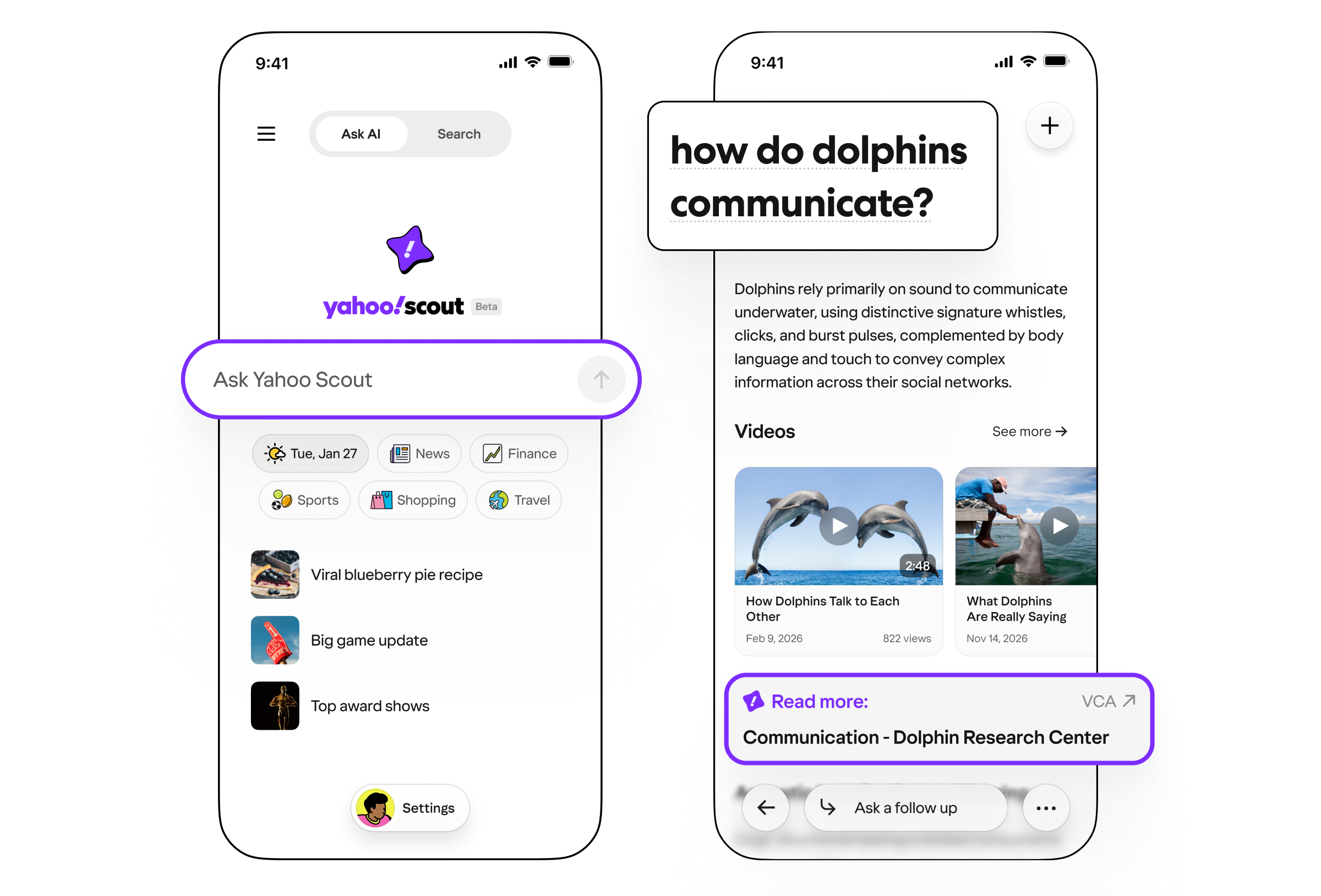
MyScout makes the portal connection more literal. Logged-in users can arrange tiles for subjects they follow, including stocks, sports, weather and inbox snapshots. Some information updates in real time; other tiles refresh throughout the day. A homepage that remembers your interests is an old idea. The new question is how much useful work the answers can do.
The convenience comes with a design challenge. An all-in-one view has to remain readable. Personalization must reduce effort rather than create another dashboard to maintain. The test is mundane and measurable: whether someone finds an answer faster, understands it, and chooses to return tomorrow.
The machinery beneath the purple
Yahoo’s public engineering work offers a glimpse beyond the consumer pages. Its GitHub organization includes Elide, a Java library for building GraphQL and JSON-API services, and CMAK, a tool for managing Kafka clusters. These projects reflect a company that operates software infrastructure as well as publishing headlines and selling advertisements.
Its careers materials emphasize employee resource groups, education support, backup childcare and an annual volunteer day. Those are the employer’s account of working life, rather than an independent verdict. Together with its engineering output, they show the range of work required to keep a large consumer service running.

Then there is the public personality. Pentagram’s 2019 identity tilted the final “y” and exclamation point by 22.5 degrees. Josh Line’s March 2025 appointment as chief marketing officer put a former Paramount brand executive in charge of positioning and engagement. Recognition gives a marketer something to work with; product usefulness gives the recognition somewhere to go.
Yahoo is also extending activities around its established audiences. On September 2, 2026, it announced Apple TV collaborations for selected baseball and soccer alternate broadcasts. The baseball offering covers two innings of selected games; the MLS offering covers full selected matches. Familiar Yahoo commentators provide another reason for sports readers to stay involved.
A second chance has to earn its clicks
Money still imposes discipline. Bloomberg reported a $1.6 billion Yahoo debt refinancing in May 2026. Refinancing is different from new equity backing for product expansion. It should not be counted as proof that consumers want a new service.
The strategy depends on conditions that other businesses may lack: an existing audience, repeat visits and products with enough substance to improve. A company without those advantages cannot simply attach AI to a homepage and expect Yahoo’s distribution. Even Yahoo has to establish that the answers deserve the attention its older products already receive.
The most useful lesson is to start with the unfinished task. Make the inbox easier to sort. Make a portfolio easier to understand. Give a fan something worth watching between games. Yahoo’s future will be decided in these small encounters, where a familiar name gets one more chance to be useful.
Open a useful tab
Yahoo · Try Scout · Yahoo Finance · Explore Mail · Yahoo Sports
Company news · Open-source projects · LinkedIn · X · Instagram · Facebook