A stadium usually stays put. The World Surf League’s playing field arrives in sets, changes shape with the wind and sometimes declines to cooperate at all. That makes professional surfing a peculiar business: the thing people come to watch is also the thing management cannot order. The league can sell sponsorships, produce documentaries and redesign a championship. It still has to wait for a wave.
That tension explains more about WSL than the familiar image of sun, spray and beautiful beaches. This is a private sports and media company organizing a competitive circuit around a sport that also exists perfectly happily without one. Its task is to make surfing legible to spectators, useful to advertisers and viable as a career, while retaining the unpredictability that makes anyone care.
The tour outgrew the surf-shop budget
The circuit’s roots reach back to 1976, when Fred Hemmings and Randy Rarick founded International Professional Surfers. Rarick’s own account describes a lineage running from IPS through the Association of Surfing Professionals to today’s WSL. The founders were connecting contests into something larger: a world circuit in which performances could add up to a championship.
By 2012, the economics needed rebuilding. SURFER’s account of the ZoSea takeover described surf brands struggling to keep financing the tour. The proposal centralized ownership, management and media rights. The board approved it eight votes to two; the new operating model followed in 2014. Paul Speaker and Terry Hardy were the public faces of the bid, backed by Dirk Ziff.
The price deserves careful reading. SURFER reported no purchase payment for the takeover itself, alongside a plan to reduce an event licensee’s cost from roughly $3 million to $1 million. That was a transfer of responsibilities and financial exposure, not a free machine for printing money. Speaker summarized the plan neatly: “Centralized broadcast, centralized management, centralized sponsorship.” The World Surf League name arrived in 2015.
“Centralized broadcast, centralized management, centralized sponsorship.”
Paul Speaker, describing the new model in 2013
One competition, several customers
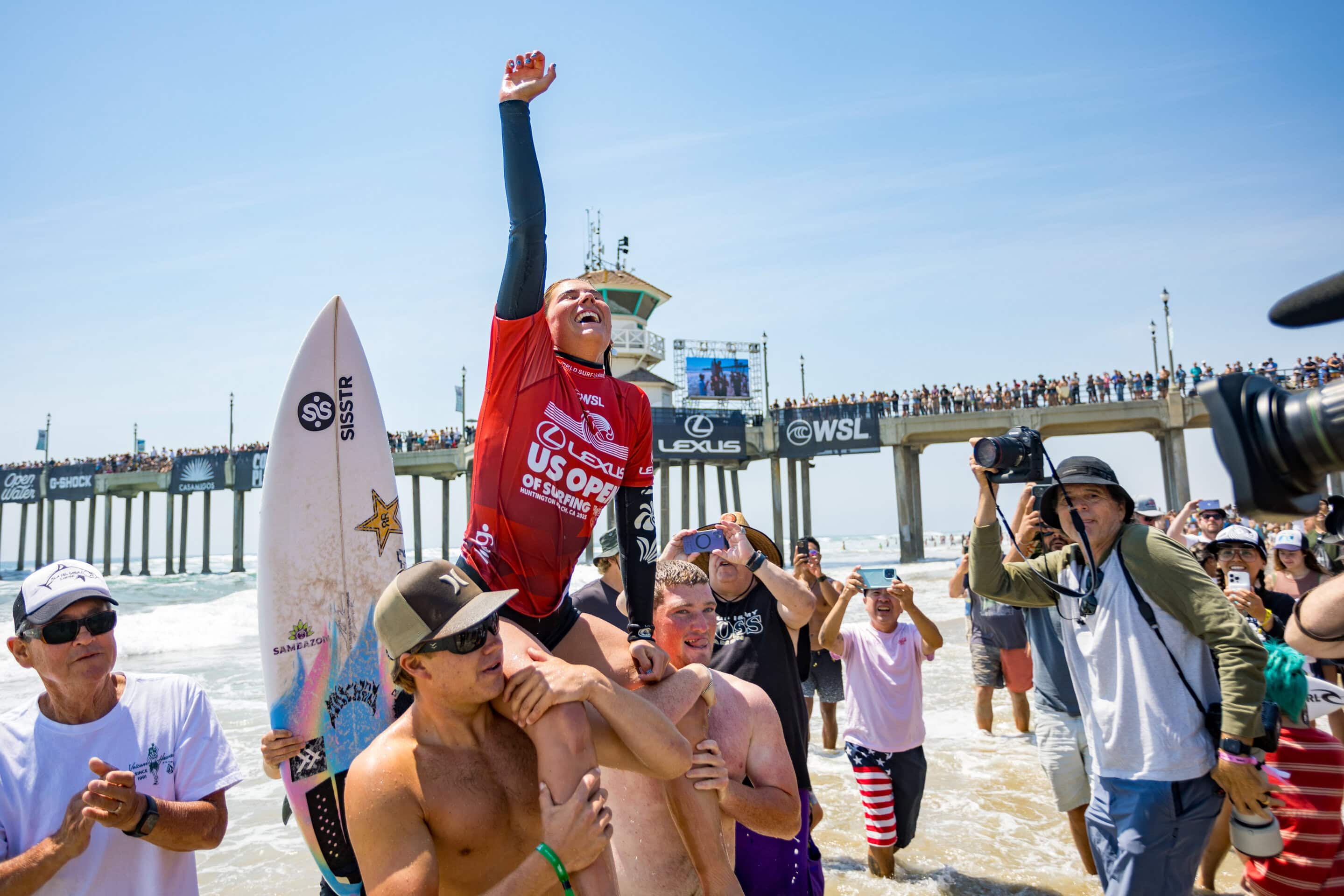
For fans, WSL is a way to follow professional surfing: event schedules, rankings, live coverage, replays, highlights and athlete stories. Its Championship Tour crowns elite men’s and women’s champions. The Qualifying Series and Challenger Series supply routes toward that tour, while longboard, junior and big-wave competitions give the wider organization more than one version of surfing to show.
The commercial buyers want something different. Sponsors buy associations with events, athletes and surf culture. Media partners buy rights and programming. Merchandise gives supporters a physical purchase, and fantasy surfing offers another reason to keep track of a season. A viewer can enter through a short clip and eventually become the person checking the heat draw before breakfast.
WSL’s July 2026 appointment of THE·TEAM as its exclusive global sales agency made that commercial ambition explicit. The assignment includes finding a global entitlement partner, a brand attached to the league itself. The announcement reported 80 million in global linear and broadcast viewership for 2025, up 39%, and 1.5 billion content impressions. Those are different audience measures, not interchangeable totals of devoted fans.
2025 figures reported in the July 2026 commercial partnership announcement. Impressions are exposures, not unique people.
The $30 million lesson in finding the stream
In January 2018, WSL announced a two-year exclusive digital distribution agreement with Facebook. Forbes put the expected value at an estimated $30 million, citing industry insiders. It was a rights-fee estimate, not the league’s annual revenue. For a sport trying to reach people beyond its established following, the attraction was obvious: a large platform, promotional support and money for the rights.
Then the viewing experience got in the way. Digiday reported technical problems at the first contest under the arrangement and the removal of a Facebook login requirement. Serving different languages added complexity. In 2019, the parties ended exclusivity a year early, while keeping Facebook as a distribution partner.
WSL widened its television reach, and then-CEO Sophie Goldschmidt reported live viewership growth of more than 25%. That does not prove exclusivity alone caused the earlier difficulties. It does show why a distribution deal must be judged by what viewers can actually do. The useful lesson for another media business is practical: test access across markets and devices before making one platform the audience’s only door.
Give people a reason to return between swells
A competition produces natural peaks of attention. An entertainment business needs something to put between them. WSL Studios, launched in 2019, supplied an organizational home for original programming. The league could tell the stories surrounding competition instead of relying entirely on the next live heat to bring viewers back.
Make or Break, which premiered on Apple TV+ in April 2022, took that proposition beyond surf diehards. Produced by Box to Box Films in partnership with WSL, its first season followed the 2021 tour through the pandemic. Kelly Slater, Stephanie Gilmore, Gabriel Medina and other competitors appeared as people negotiating careers and pressure, as well as athletes producing scores.
The distinction matters for new viewers. A barrel can impress someone who knows nothing about surfing. Understanding what a loss might cost a particular surfer gives that viewer a reason to watch again. Documentary production turns access to the tour into another product, with a different viewing rhythm and a different route to an audience.
Even the scoreboard has to paddle out
Some partnerships are easier to understand by looking at what changes for the athlete. WSL introduced Apple Watch as official wearable equipment in 2023. The WSL Surfer app brings competition information to the wrist: scores, wave priority and time remaining. The information travels to the competitor instead of requiring the competitor to decipher it from shore.
Apple’s June 2026 film about the partnership shows the watch in this competitive setting. It is an unusually concrete demonstration of a sponsor’s usefulness. The device has a job inside the sport, beyond appearing in the broadcast. For a viewer, the connection between the product and the partnership takes very little explaining.
Less photogenic infrastructure matters too. WSL and eero have described event connectivity supporting judges, production crews and athletes reviewing footage. A beach event needs a temporary working environment as well as a camera pointed at the water. The league’s expertise lies partly in assembling those pieces repeatedly, in places whose appeal comes from being very unlike an office.
A world title is a product decision
The rules determine what fans are being asked to believe about a champion. From 2021 through 2025, WSL used a one-day Finals competition for the leading five men and women. For 2026, it returned to a title decided by season points, with Pipe Masters back at the end of the calendar. The final event awards 15,000 points to its winner, compared with 10,000 at a standard Championship Tour stop.
The published format also expanded the women’s starting field to 24, alongside 36 men, and removed non-elimination rounds. These changes alter opportunity and suspense at the same time. A points race rewards work across the season; a heavily weighted final event preserves a late opportunity to change the standings. There is no purely administrative version of that choice.
Winner’s ranking points. Pipe carries 50% more weight.
The league has changed the financial rules too. In September 2018, it committed to equal prize money for men and women at every WSL-controlled event from 2019 onward. That is a specific, inspectable expression of its stated commitment to equality. Prize parity and the number of available places remain separate questions; a larger women’s field changes the latter.
The ocean is also on the balance sheet
WSL’s public identity includes protecting the place where its competitions happen. Its One Ocean initiative connects the tour with local environmental projects and partners. In its 2024 impact update, the league reported 26.3 tons of trash removed from beaches and rivers, 4,536 volunteers mobilized and 17 local impact projects funded.
Those figures describe reported activities, not a complete environmental accounting of an international sports business. They nevertheless give fans and partners something more tangible than a photograph of clean water. The connection is direct: a league selling access to ocean culture has reason to support the communities and ecosystems that make those events possible.
It also shares the sporting landscape. The International Surfing Association runs a distinct international and Olympic framework. Under the updated LA28 qualification system announced in June 2026, Championship Tour rankings provide one route to Olympic places, alongside ISA and continental competitions. WSL is therefore both a commercial entertainment property and part of a larger sporting pathway.
A manufactured wave cannot fix everything
September 2026 supplied a fresh reminder of the business’s limits. WSL canceled the Surf Abu Dhabi Pro, citing conditions and logistical constraints that prevented it from proceeding. The tour had already added Cloud 9 in the Philippines as a contingency. A controlled wave environment could not insulate a traveling event from disruption outside the pool.
That is where copying the WSL model requires restraint. More distribution helps only if viewers can find a watchable product. Athlete documentaries need access and compelling subjects. Sponsors need a credible connection to the audience. A new competition format needs enough acceptance to keep a title meaningful. Each depends on something a contract alone cannot supply.
For someone discovering the league, the easiest start is modest: watch a heat replay, pick a surfer and follow the next event. WSL puts the sporting context around an experience that can otherwise look like a succession of beautiful waves. Its business lives in that added meaning. The ocean supplies the spectacle, but it never signs the delivery guarantee.