The job was folding T-shirts. Two students, Daniel Barke and Marlon Rosenzweig, thought they could manage that. According to Startup City Hamburg’s account, they were sufficiently unsuited to the task that they soon needed another job. Finding one proved surprisingly difficult. They had skills. Businesses needed help. Somehow, the two sides kept missing each other.
- Start with a mismatch between people and work.
- Buy recruiters, relationships, and specialist knowledge.
- Connect the hiring decision to the paperwork that follows.
In 2012, they launched MyLittleJob in Hamburg to connect students with company assignments. Their starting proposition was pleasantly impolite: for a short piece of work, why spend so much effort on an interview? Test the relevant capabilities instead. In a 2019 interview, Rosenzweig explained that employers also struggled to justify recruitment and training for such brief engagements.
The first failure in this story was wonderfully ordinary: the founders themselves were badly matched to a job. The larger opportunity was making those mismatches less common.
The students grew up. So did the business.
The student label eventually became too small. In 2018, MyLittleJob became WorkGenius, reflecting a talent pool that now included professional freelancers. Its Series A reached $10 million that November, with the money earmarked for American expansion and product development. The name change followed a change in the people doing the work.

Today, WorkGenius sells businesses a connected way to source talent, review candidates, onboard workers, manage assignments, and pay them. It combines AI matching with recruiters who assess context and suitability. The company advertises a network exceeding 500,000 vetted freelancers and coverage across more than 100 countries. Those are company-reported figures, rather than an independent count of people available tomorrow.
Then the software company bought the recruiters
In June 2022, WorkGenius acquired JBC, a New York staffing business with relationships and recruiting experience. Agency WorX followed in January 2023. Berlin’s Expertlead arrived that August. The acquisitions expanded both the customer base and the knowledge available inside the company.
This is the interesting strategic choice. WorkGenius brought established recruiting operations into its business, putting software alongside people who already knew particular markets. JBC contributed expertise in fields including fashion, retail, media, and entertainment. Expertlead brought technical recruiting and peer-to-peer coding assessments.
- 06 / 2022JBCCreative + retail
- 01 / 2023Agency WorXStrategic staffing
- 08 / 2023ExpertleadTech + live assessment
- 09 / 2025FuturepathAutomotive + STEM
By September 2025, WorkGenius had bought the remaining 49 percent of Futurepath from Volkswagen software subsidiary CARIAD. It had obtained the initial 51 percent through Expertlead in 2023. Futurepath added roughly 12,500 specialist candidates and retained its own brand and relationship with Volkswagen and CARIAD.
A résumé can look clever. Can its owner code?
The Expertlead deal addressed a particularly modern problem. AI makes producing a convincing application easier. It also complicates judging who actually did a take-home assessment. Barke explicitly connected the acquisition’s live assessment capability to the rise of AI and ChatGPT.
“we have seen a need for actual live assessments”
Daniel Barke, announcing the Expertlead acquisition, 2023
Live coding gives an evaluator a chance to watch the work happen. It is a concrete reason to combine technology with professional judgment. In his December 2025 essay on recruiting, Barke pushed the argument further: hiring should use evidence from assignments, hours, outcomes, and feedback, giving workers a record that becomes more useful with each engagement.
The unglamorous half of finding talent
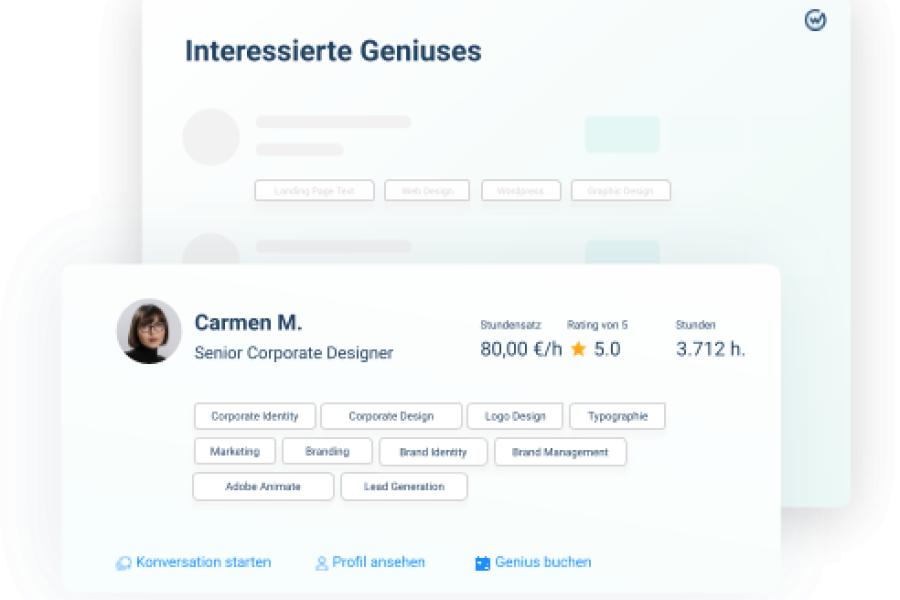
For a hiring manager, the practical workflow begins with a brief: skills, budget, location, timing. Software searches and ranks; a recruiter checks the shortlist; the client selects. WorkGenius says most clients receive vetted candidates within 48 hours. Treat that as its advertised service expectation, rather than a universal delivery guarantee.
AI assists the search. Recruiters check fit. Administration stays connected.
After selection come contracts, worker classification, timesheets, approvals, and payment. WorkGenius offers employer-of-record and agent-of-record arrangements alongside management tools. Its candidate service supports both employee and contractor engagements, with remote, hybrid, or on-site roles depending on the client. The useful product is the whole sequence.
Customers span enterprise teams and growing businesses. WorkGenius’s 2022 announcement named Meta, Axel Springer, and Uber among more than 5,000 customers. Its current site displays brands including Bloomberg, Nestlé, and T-Mobile. Marketing and technology sit alongside finance, operations, and other professional work.
The money has different labels
WorkGenius operates across staffing services and workforce software. Its G2 description presents a consolidated invoice with an all-in markup. Buyers should ask what their quote includes: sourcing, employment administration, payment, and software can create different costs. For candidates, creating a profile and getting matched are advertised as free.
Financing the expansion was another matter. A February 2020 round brought approximately $7 million. The JBC transaction involved equity investors and a debt facility from Investcorp BDC and CION. In August 2023, WorkGenius said the Expertlead acquisition brought group revenue to $150 million. That historical company-reported figure should not be mistaken for current software subscription revenue or a valuation.
Copy the sequence
For buyers, the alternatives include freelance marketplaces, specialist recruiters, and workforce management software. WorkGenius competes by connecting those functions. That is most useful when repeated hiring and administration create enough friction to justify a managed service. A single small assignment may need much less machinery.
The transferable lesson is practical: improve the evidence behind the match, keep judgment close to the decision, and connect the decision to execution. A vague brief, stale skills data, or weak candidate availability will still produce disappointment. Buyers can test the proposition on one role and compare shortlist quality, total cost, and time until work actually starts.
The company’s declared working values include truth-seeking, clear communication, quality, and urgency. For a customer, those values become meaningful in small observable moments: whether a recruiter challenges an unrealistic brief, explains a rejected match, or resolves an approval bottleneck. A pilot can test that working relationship as well as the software.
The T-shirts were an early clue. Having a person and having a task is easy. Getting the fit right takes more work.