Prisma Media had found a way to make video cheaper. This ought to have been the happy ending. The French publisher, whose titles include Voici, had tried a text-to-video tool with simple templates. Production cost fell. But the videos looked generic, the brand suffered, and the financial objectives remained unmet, according to Wochit’s account of the customer’s experience. A machine had learned to produce moving pictures. It had not learned what made those pictures belong to Voici.
- Wochit combines video editing, licensed media, and brand controls.
- Its buyers include publishers, franchises, and software platforms.
- Studio is for creators; Frame embeds an editor; WAVE generates from data.
- The useful lesson: standardize production without standardizing every idea.
That small distinction explains much of Wochit. Any organization can want more video. The difficult question is how to make more without teaching the audience to stop caring. A brand has spent years acquiring a recognizable voice. It would be rather careless to trade it for a convenient export button.
The cheaper video that cost a publisher its identity
Prisma’s next move was to put Wochit in the hands of video specialists and other content creators, pair digital stories with video, and give promising stories additional attention. Wochit’s case study reports a 60% first-year revenue increase at Voici, alongside a 635% rise in video views over 17 months. Those are vendor-reported outcomes from a particular operation, with several changes happening together. They tell us what happened there; they do not promise what will happen elsewhere.
The revealing detail comes from the customer’s explanation of choosing Wochit over a rival. The editor in chief for digital, videos and social says: “It was easy to prove.” The sale hinged on an observable difference in output, after the cheaper approach had disappointed.
“It was easy to prove.”
Voici’s editor in chief for digital, videos and social, on choosing Wochit.
A newsroom problem, built into software
Dror Ginzberg and Ran Oz founded Wochit in 2012. Its early proposition addressed a familiar newsroom mismatch: articles could travel quickly, while video demanded footage, editing, narration, and permission. Publishers with a story to tell could lack either the people or the material to tell it on screen.

Wochit assembled those ingredients into a cloud service. Automation helped locate relevant licensed material; creators could contribute their own assets and shape the result. A 2015 FIPP account named customers including USA Today, Deutsche Welle, and SPIEGEL Online. The attraction was practical: access to footage without negotiating an individual license every time a story required a picture.
That background helps explain its market position. Wochit competes for the work organizations repeatedly need done: article companions, social clips, explainers, promotions, and internal communication. A team comparing it with a general editor should evaluate the whole journey from finding footage to publishing. Editing skill is only one expense along that route.
Three ways to escape the production queue
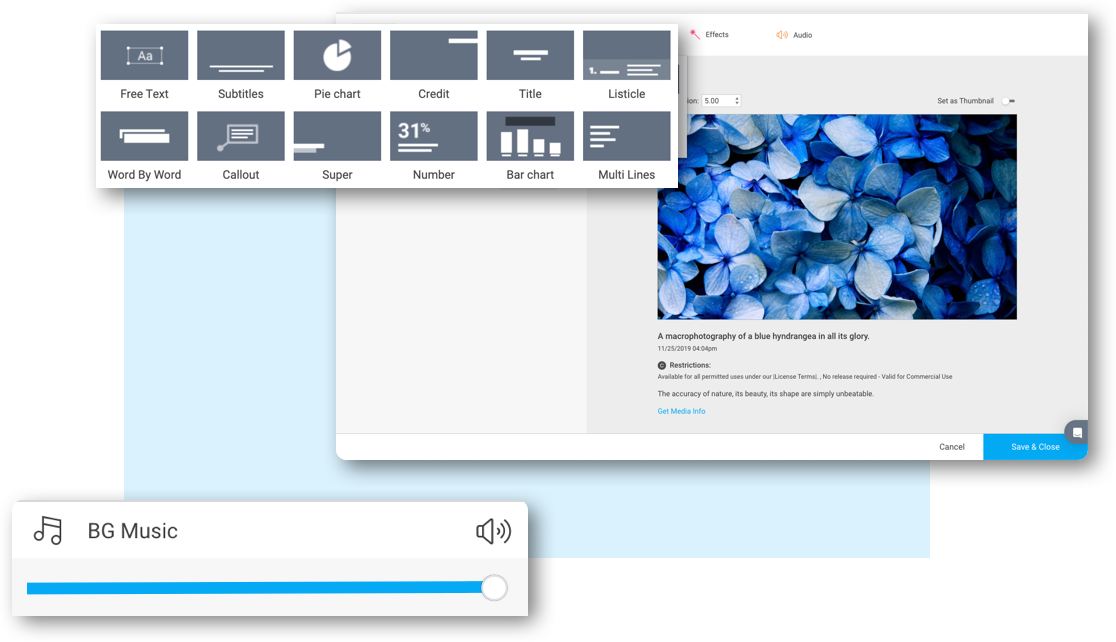
Studio is the direct route. An employee opens a browser-based editor, combines assets and text, applies branding, and produces a video. The service includes licensed content and offers enterprise customization and support. It suits teams that need a shared production environment.
Frame moves the editor inside someone else’s product. In Wochit’s Houzz case study, home professionals create promotional videos using information and images pulled from their profiles. The published account records 50,000 videos in 14 languages. The clever part is where creation begins: with material customers have already supplied, inside a service they already use.
Dogtopia provides a less solemn illustration. Its central marketing team supplied templates that local centers could adapt, including “Dog of the Week.” Wochit’s account describes a rollout beginning with 40 locations and reaching about 110 participating centers. A local dog could enjoy local fame while the company kept control of the typography.
WAVE serves repetition at another scale. It creates videos from templates populated by data, with CSV and API options. A recurring catalogue or set of personalized messages fits this logic: design the pattern, supply the changing fields, generate the variants. The quality of those fields becomes part of production quality.
The price of fewer handoffs
Wochit charges for software and, on some products, usage. At the time of research, Studio Basic listed $1,499 billed monthly, or $999 per month when paid annually: $11,988 upfront, including three seats. Frame Small listed $1,799 monthly plus $3.90 per active user. WAVE Basic listed $2,099 monthly plus $1 per video. Enterprise arrangements require a quote.
For a frequent producer, the comparison is the combined cost of software, asset sourcing, branding, coordination, and review. For an occasional creator, an annual commitment may be difficult to justify. Templates earn their keep through reuse. An organization that cannot identify repeatable work should pause before paying for scale.
AI with a picture editor’s conscience
The current journalism-focused Wochit AI offering builds drafts from articles, scripts, audio, recordings, and footage, then allows editing in Studio. Its stated preference for authentic licensed visuals is especially relevant to news: a convincing invented picture can still be the wrong picture. Translation and changes of format address the less glamorous business of getting one story onto several channels.
Licensing relationships have been central for years. Shutterstock announced a strategic alliance in 2021; Kaltura and Wochit announced an integration partnership in 2020. These connections broaden access to content and video infrastructure. Wochit Go now takes branded creation onto phones, with an August 2026 app update documenting prompts, article links, and captured footage.
Keep the decision, automate the repetition
The copyable idea is to define what must stay consistent before distributing production. Build approved treatments, make useful assets accessible, and let the people closest to a story shape it. Keep a human responsible for accuracy and selection. Faster assembly cannot rescue an unreliable script or create footage nobody captured.

Wochit lists creativity among its values. Its product offers a concrete interpretation: remove some of the work surrounding an idea so someone has time to improve the idea itself. Prisma’s earlier experiment supplies the useful warning. A production system succeeds when the audience still recognizes who is speaking.