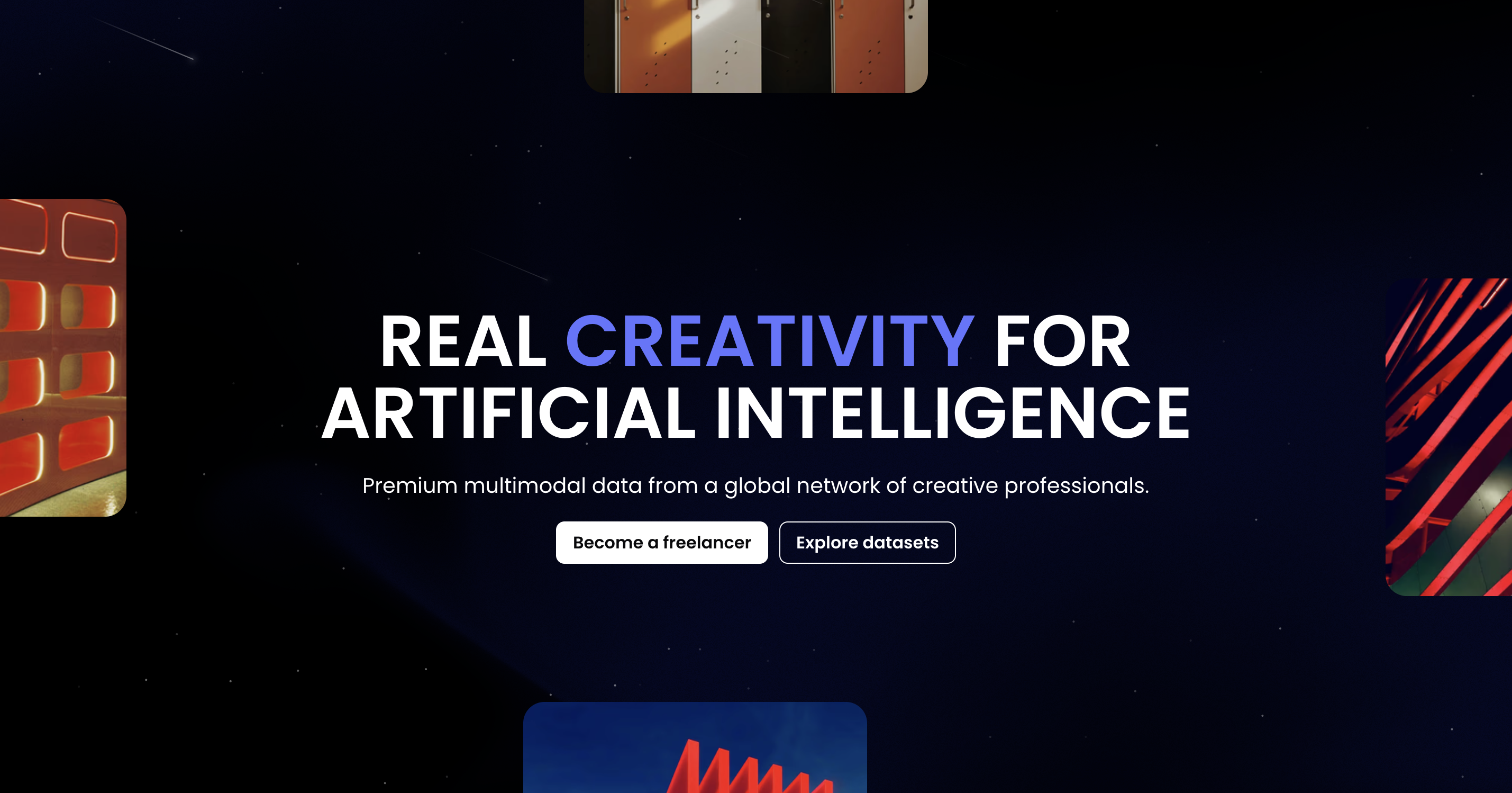
A four-founder team out of Armenia, now headquartered in San Francisco, built the marketplace that quietly became a supplier of training data to six of the largest foundation-model labs in the world.
She will be paid for it. Within thirty days. By name. With a license trail that survives audit.
That sentence would have made no sense five years ago. It would have made no sense to Wirestock five years ago, either. The company that wrote her brief was, until recently, a hardworking utility that uploaded keywords and titles to Shutterstock. Useful, unglamorous, fairly fungible. Then the ground shifted under stock photography, and Wirestock found itself standing on the only patch that turned out to be valuable.
It now runs at roughly a $40 million annual revenue rate, has paid out more than $15 million to creators, signed up over 700,000 of them, and closed a $23 million Series A in May 2026. The check is from investors who are paying for a single bet: that the AI industry is finally past the era of scraping the web and pretending it didn't.
By 2022, generative models had a polite-but-awkward relationship with their training data. They needed enormous, high-quality pools of human creative work. The pools they were drinking from had been gathered, in many cases, without anyone asking. Lawsuits arrived. Licensing pressure arrived. A new line item appeared on the budgets of every major lab: where does this data come from?
The honest answer was uncomfortable. The expensive answer - licensing big stock libraries - solved part of it. The actually useful answer was something nobody had bothered to build: a marketplace where you could brief 700,000 humans to make exactly the kind of content your model was missing, and pay each one of them properly for it.
Wirestock's founders - Mikayel Khachatryan, Ashot Mnatsakanyan, Vladimir Khoetsyan, and Hovhannes Kuloghlyan - had spent four years cataloging the supply side of that equation. They had the keywording pipelines, the contributor network, the payouts plumbing. They knew which kind of email reliably gets a photographer in Manila to deliver on Tuesday. They didn't know they were sitting on AI infrastructure until the AI labs started knocking.
The boring decision would have been to fight harder for shrinking stock-content revenue. The vain decision would have been to become an AI image generator and join the same crowd they were quietly worried about. Wirestock did neither.
Around 2023, the team started writing briefs - not for stock buyers, but for AI teams. The first deals were small, the questions were unfamiliar, and the contributor base needed retraining on what "useful for a foundation model" actually meant. Hint: it is not the same thing as "useful for a magazine cover."
That AI labs would eventually prefer paying creators to defending themselves in court.
That a creator network built for stock photography could pivot to dataset work without losing its base.
That "ethically sourced" would graduate from PR phrase to procurement requirement.
All three bets, three years later, are looking less like bets and more like procurement policy at six of the biggest model makers on earth.
Four engineers in Armenia start a one-click distribution tool for stock photographers.
Wirestock's keywording automation becomes the open secret of the microstock world.
Launches paid briefs for creators - the muscle that later powers AI dataset work.
Generative AI compresses traditional stock pricing. Wirestock starts shipping training data instead.
Becomes a regular supplier of multimodal datasets to leading foundation-model teams.
Network crosses 700,000 contributors and $15M+ in lifetime payouts.
Closes a round to scale operations and dataset infrastructure. Run rate near $40M.
Wirestock is a two-sided marketplace, and like all good ones, it is mostly invisible. The creator sees a brief and a payout. The AI lab sees a dataset and an invoice. The complicated bit - sourcing, vetting, licensing, deduplicating, formatting, paying - sits in the middle.
Photographers, videographers, illustrators, 3D artists, designers, and music creators receive paid project briefs. Submissions are reviewed. Payouts arrive monthly. The work is licensed clearly enough to satisfy a compliance officer who has never met you.
Two flavors. Off-the-shelf, ethically licensed multimodal datasets covering 50M+ existing pieces of content. Or custom briefs, where a model team specifies what they need and the creator network produces it - often within days. Six of the largest foundation-model labs buy one or both.
The footnote that matters: of the 50 million pieces of content in Wirestock's library, more than 10 million have been specifically licensed for AI training use. That is a deliberate, opt-in number. It is also, today, one of the largest such pools in the world.
Mission statements usually deserve to be skipped. This one is operational. "Connect creators and AI teams to build the future of artificial intelligence with ethical, high-quality training data" is a sentence Wirestock has to honor every payout cycle, every brief, every audit-friendly license certificate.
The interesting tension: this is a business that depends on AI getting much, much bigger - and also on AI being made to behave. Wirestock wins when foundation-model teams need more high-quality multimodal data than they can scrape, and when regulators and customers keep asking awkward questions about where that data came from. So far, both trendlines are pointed in the same direction.
Frontier AI is, increasingly, a logistics problem. Compute is the warehouse. Models are the trucks. Data is the inventory. The companies that figured out how to manufacture inventory cleanly - traceably, legally, at scale - will be sitting on a permanent moat.
Wirestock is one of the very few companies on the creator side of that supply chain with both the network and the operational discipline to deliver. It is not loud about it. It does not need to be. Foundation-model procurement teams have a habit of finding their way to whoever actually picks up the phone.
What this means for the average reader: somewhere in the next year, a model you talk to will have learned how to draw, describe, or compose something because Wirestock paid a human in Yerevan, Manila, Lagos, or Lisbon to make that something on a Tuesday afternoon. That, quietly, is the trade Wirestock built.
The photographer uploads the shot. A reviewer accepts it. A license is stamped. A foundation model, eight time zones away, learns what a real kitchen counter looks like under afternoon light. Thirty days later, money lands in her account. The trade is small. It is also, finally, fair. That is Wirestock's whole pitch - and it is starting to sound less like a pitch and more like an industry.