A custom window begins as a promise made across a desk or on a building site. It ends as lengths of profile, panes of glass, hardware, seals and labels moving across a factory floor. Between the two lies a small riot of choices: dimensions, opening styles, colours, glazing, reinforcement, handles, hinges, delivery dates and installation notes. Windowmaker Software makes the system that tries to keep every one of those choices intact.
The London-headquartered company has pursued this narrow brief since 1983. Today it sells a connected suite for designing, quoting, ordering, purchasing, manufacturing, delivering and installing windows and doors. Windowmaker says it serves more than 4,000 customers in over 75 countries; its LinkedIn profile puts the customer count above 5,000. Either number describes a substantial footprint for software most people will never knowingly see.
01 / The jobTranslate the sale without losing a millimetre
The crucial distinction is between drawing a window and defining a buildable product. Windowmaker's configurator uses rules to constrain what can be sold. A salesperson can start with a standard design or construct an arched, angled, bay or bow arrangement. The software then carries the selected profiles, glass, hardware and finishes into costing and production. It supports uPVC, aluminium, wood, steel, fiberglass and composite materials - useful for a manufacturer that would prefer one system to six material-specific islands.
This is where Windowmaker's age matters. Forty years in one trade produces a peculiar library of exceptions. Recent release notes concern Georgian-bar corrections in thermal calculations, mixed glazing specifications, mechanically welded joins, oversize glass, reusable offcuts and the sequence in which a saw should cut profiles. None makes for glamorous software copy. Each can decide whether a quoted margin survives contact with the workshop.
Different users meet the same order at different angles. A dealer wants current products and prices without phoning the supplier. A surveyor wants the sold design, a place for site measurements and photographic evidence. Purchasing needs components and dates. Production wants batches, labels and accurate work instructions. The delivery crew needs the right units on the right vehicle; the installer needs an address, a schedule, notes and a customer sign-off. Windowmaker's promise is not that these jobs become identical. It is that they stop maintaining contradictory versions of the same job.
The factory does not manufacture the quotation. It manufactures Windowmaker's translation of it.
What fails first in the old workflow is usually the handoff. A surveyor writes a dimension; someone at the office types it again. A dealer chooses a product option; the manufacturer re-enters the order. A status changes on the factory system; sales phones production to discover it. Windowmaker's answer is not mysterious: keep the order in one data model, apply product rules early and give each participant the part of the record they need.
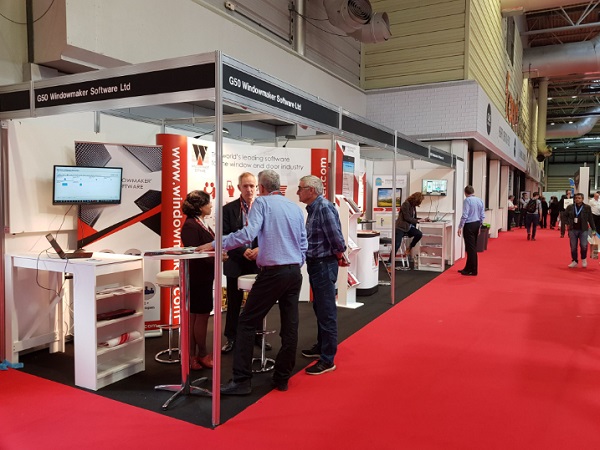
02 / The productsA browser at the front, machines at the back
Windowmaker now presents its platform in several forms. Windowmaker Web is the light browser interface for sales and dealer work. Windowmaker Cloud packages functions in subscription tiers. Windowmaker Measure gives surveyors and salespeople a mobile tool for dimensions, notes and annotated photographs, including connections to selected laser measures. The mature desktop and SQL-based products remain part of the estate, while profile eCatalogs reduce the labour of setting up product systems.
At the other end, machine links send information to saws, machining centres, welders, glass optimisers and cutting tables. APIs and webhooks connect customer details, quote status, line items and stock consumption with CRM, accounting and ERP tools. The company names SAP, Microsoft Dynamics, Zoho, QuickBooks, Sage, AutoCAD and Orgadata among the systems in this orbit. This is less a monolith than a translator with opinions about windows.
The 2026 releases make the direction unusually clear. Smarter Quote sends an interactive web link rather than a static PDF, with price, product detail and a 3D view. The customer can confirm it online. The same link can travel through WhatsApp. Measurements taken in Measure can return to the order with room references and installation notes. U-values and g-values can be calculated and printed. New interfaces and new machine connections continue to arrive beside the less photogenic fixes.
03 / The economicsThe visible price, and the hidden bill
Windowmaker promoted its browser-based Cloud product at this price in 2025. Its India-facing page lists three rupee-priced tiers; implementation, customization and enterprise integrations depend on a proposal.
The business model mixes subscription or licence revenue with maintenance, support and professional services. The formal terms describe consulting, implementation, configuration, customization, training and project management. That services layer is not incidental. A fabricator's catalogue may contain years of product rules and local practice. Migrating it is closer to moving a factory's memory than installing a fresh calendar app.
Cloud delivery changes the ownership of some chores. The browser version avoids a local installation for each salesperson and promises current software across devices. It can make a dealer network easier to connect and a remote quotation easier to retrieve. Yet the factory edge remains stubbornly physical. Printers, scanners, databases and CNC machines do not disappear because the order screen moved online. Windowmaker's hybrid expertise - modern web interfaces in front of long-established production systems - is therefore more important than the word “cloud” on the price card.
This also explains what changes a buyer's mind. The immediate alternative - spreadsheets, paper, a basic quoting package and an accounting system - appears cheap because its integration bill is paid in staff time, corrections and delay. Windowmaker's own 2025 messaging targeted businesses still using spreadsheets or restrictive legacy systems. The persuasive moment comes when the buyer stops comparing software licences and starts counting re-entry, remakes, missed options and calls asking where an order has gone.
Vertical software earns its keep in the exceptions: the arched frame, the unusual join, the leftover profile worth saving.
04 / The marketA narrow moat with several neighbours
Windowmaker sits in vertical ERP and manufacturing software, alongside specialist alternatives such as Cyncly's FeneVision, A+W Cantor, Orgadata LogiKal and Paradigm. Generic ERP vendors compete for finance and operations; standalone configurators compete at the sales edge. The homemade stack - spreadsheets plus experience - remains the stubborn incumbent.
Its difference is breadth inside a narrow domain. A small fabricator can start with sales and quotations. A larger operator can add purchasing, bar optimisation, stock, multi-site production, delivery and installation. Dealers can send orders to manufacturers without retyping. Surveyors can work from a phone. A multi-material factory can retain one product model. Windowmaker says the software is available in multiple languages; historical company material puts the count at 18.
The company is privately held and does not publish funding or valuation. Public head-count descriptions vary: LinkedIn places it in the 51-200 band, while Windowmaker describes 85-plus professionals, including more than 60 people focused on development. The team spans the UK, India, Canada and Australia. Alok Tayal returned as chief technology officer in 2025; director Goronwy Jones has spoken of expanding the UK operation. The public culture is engineering-heavy, international and fond of the webinar - appropriate for a product whose value lives in details users have to learn.
Its certifications tell a similar story. Windowmaker identifies itself as a Microsoft Partner, and historical material says its quality system has conformed to ISO 9001 TickIT standards since 1994. Those badges do not prove that an implementation will succeed. They do explain the company's bias toward controlled releases, technical requirements and documented upgrades. The release archive stretches through operating-system changes, SQL Server generations and database schemas - institutional housekeeping that matters when today's quote must still be intelligible after the next update.
05 / The transferable lessonCopy the continuity, not the feature list
A practical playbook for another vertical SaaS company
- Choose the handoff where information is re-entered and errors compound.
- Encode the industry's constraints before polishing the dashboard.
- Let small customers enter through one job, then add adjacent operations.
- Connect to the general tools and physical machines customers already own.
- Ship the unglamorous fixes; in manufacturing, they are often the product.
There are limits. An integrated suite works poorly when a company refuses to standardise product data, cannot assign people to migration and training, or expects software to repair an undefined production process. It is also a questionable fit for an occasional reseller that needs only simple estimates, or for a manufacturer whose unusual machinery and catalogue demand more customization than the avoided rework can justify. Browser access removes servers; it does not remove implementation.
Windowmaker's longevity is the more interesting achievement. It began when personal computing was young, survived the client-server decades and is now moving an old, intricate domain into browsers, APIs and mobile workflows. The company has not escaped legacy - no 1983 software firm does - but it has kept the legacy worth owning: thousands of decisions about how windows and doors are actually sold and made.