On a Friday in London, Bill Rinehart had a problem waiting for him in Phoenix. He needed to get home, unpack, get his clothes cleaned and pack again. On Monday, he was due in New York. The flights were arranged. His wardrobe, apparently, required its own project manager.
For someone who had spent years helping information move around the world, this was an irritatingly physical obstacle. Video could travel through networks his companies helped build. A clean shirt still demanded a detour through the house. Rinehart began looking for a service that would take care of the whole business. Luggage forwarding covered only part of it. He wanted the cleaning, storage and packing handled too.
That complaint became DUFL, launched in 2015. It also supplies an unusually useful entrance into the career of William H. Rinehart, the Limelight Networks co-founder generally known as Bill. His businesses have dealt with different cargo. Again and again, the interesting work has happened between the customer’s request and the moment something arrives.
Learning to sell the invisible
Rinehart’s early training was in sales. He worked for E&J Gallo Winery, then sold network services at Infonet. Later came a joint venture involving IBM and Motorola, helping enterprises communicate wirelessly with their field organizations. The products became less tangible as the career advanced: connectivity, hosting, the infrastructure that lets another company operate.
He earned a business administration degree at Ball State University. By the middle of the 1990s, his career ran through MFS Communications, Genuity and GlobalCenter. His background joined commercial responsibility to the emerging machinery of the internet. A website might look weightless to its visitor. Hosting it was a business with equipment, customers and obligations.
Limelight began in June 2001. Rinehart served as president and chief executive through October 2006. The company’s focus on delivering digital media made sense alongside that earlier hosting experience. As media traveled online, the quality of the journey became part of the product: customers wanted their content to reach an audience without making that audience wait.
There was a serious complication in his career. In 2002, the SEC alleged that Rinehart had participated in inflating revenue and earnings at his former employer, Critical Path. He settled without admitting or denying the allegations, accepted a fine and was barred from serving as a public-company officer or director through August 2007. The episode belongs in the account alongside the companies he built.
“I learned to never watch anyone take a shortcut, let alone take one yourself.”
Bill Rinehart, reflecting in 2017
In November 2006, Limelight announced Jeffrey Lunsford as its next CEO and chairman. Rinehart would continue working with customers and partners as a co-founder. His welcome to Lunsford emphasized the incoming executive’s experience managing growth. The handover preceded Limelight’s June 2007 public offering.
- 2001Limelight
Digital media - 2007Unicorn Media
Video advertising - 2014Two acquisitions
Unicorn / Octoblu - 2015DUFL
Travel wardrobes
A commercial break without the break
Rinehart founded Unicorn Media in 2007. Online video was spreading across a growing assortment of screens, each bringing its own practical demands. Delivering the program was one job. Delivering the advertising that helped pay for it introduced another set of difficulties.
Unicorn’s Once service stitched video and advertising together in the cloud. It addressed a particularly awkward experience: playback interrupted while a player moved between a program and an advertisement. Buffering gave viewers another reason to abandon what they were watching. A commercial break already asks for patience; adding a technical delay is rather pressing one’s luck.
The approach reduced dependence on separate advertising technology for each platform. For media businesses, it offered a way to deliver customized advertising across devices while keeping the viewing experience together. The viewer saw a sequence. Behind it sat decisions about content, advertising and the device receiving both.
Brightcove announced its agreement to acquire substantially all of Unicorn’s assets on January 6, 2014, initially valuing the transaction at about $49 million. Its annual report later recorded approximately $39.7 million in consideration when the acquisition closed on January 31. The distinction matters: an announced stock-based valuation and the accounting value at closing need not be identical.
That same year brought another transaction. Octoblu, which Rinehart co-founded and chaired, was acquired by Citrix in December. Its work concerned connections and communications between machines. His next company would move the story into a warehouse, where the connected objects included socks.
The cloud still needed a laundry
DUFL’s premise was easy to explain. Send the company the clothes you use on business trips. Its team would inventory, photograph, clean and store them. Before traveling, select the items in an app and provide the destination and arrival date. A packed suitcase would meet you at the hotel.
Afterward, leave the bag at the front desk for its return journey. The clothes would be cleaned and prepared for another trip. In an August 2015 demonstration, Rinehart described choosing individual shirts, trousers and shoes on a screen. Warehouse workers then assembled the real bag. The digital closet had a physical address.
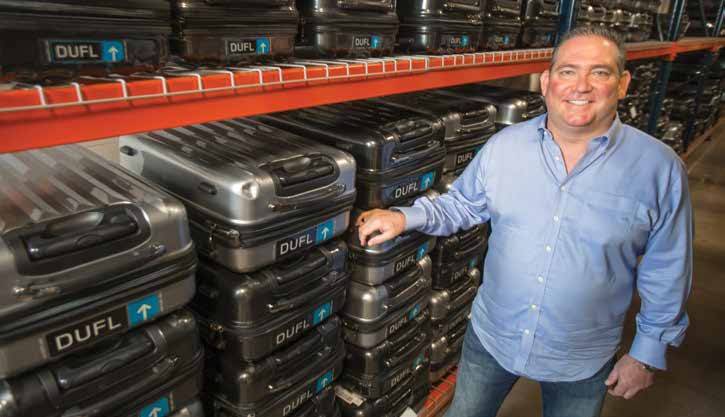
At the time, the standard domestic service cost $99 per round trip, including shipping in both directions and cleaning, with a separate monthly storage charge. Expedited shipping cost extra. Those were the terms of a particular service at a particular time. The underlying calculation was whether a frequent traveler would pay to remove a recurring chore from an already crowded calendar.
The details went beyond freight. Clothes were handled under a QR-code identifier, with the customer’s name associated with the shipment when its label was attached. The arrangement had to accommodate belongings people knew intimately. Losing a generic box is one problem. Losing the shirt someone selected for tomorrow’s meeting makes the problem personal.
- 01 / StoreInventory, photograph and clean the wardrobe.
- 02 / SelectChoose clothes and a destination in the app.
- 03 / DeliverPack the suitcase and ship it to the hotel.
- 04 / ResetReturn, clean and prepare for the next trip.
Rinehart had plenty of experience launching technology businesses. He had never worked in the travel industry. He later described a four-month effort to understand logistics, warehousing, laundering and packing before launch. Familiarity with airports had supplied the complaint. It did not supply the operating manual.
His advice for crossing into an unfamiliar industry was practical: acknowledge the gaps, ask for help and hire people able to solve the immediate problems. That gives the DUFL story some welcome texture. The founder could imagine traveling without luggage; the team still had to learn what to do with the luggage.
There were everyday contingencies too. Someone might need a favorite item returned home. A delivery could fail. Rinehart described a promise to buy comparable replacement items if a bag did not arrive. Even the most attractive screen leaves awkward questions waiting in the warehouse. Those questions determine whether a customer trusts the next trip to the service.
Golf clubs join the queue
Once DUFL had a way to store and route belongings, the potential cargo expanded. In February 2016, it introduced DUFL Sports, covering equipment for activities including golf, skiing, cycling and fishing. The company announced the service after a $5 million funding round. Its pitch followed the original wardrobe idea: let equipment travel without requiring its owner to carry it through an airport.
By March 2017, DUFL announced new storage facilities in New Jersey and Japan. A partnership with Golf Digest Online supported a Japanese golf service. DUFL Business handled items such as trade-show equipment and product samples. A store let customers add travel essentials to their stored inventory.
Rinehart described the business in terms of data, logistics and commerce. That broader ambition followed naturally from the operations already in place. Once an item was inventoried and stored, a customer could ask for it elsewhere. The hard part was honoring the request. Each additional kind of object brought its own packing and handling requirements.
The expansion makes the suitcase story more revealing. A traveler wanted a better weekend. Building the service required a system that could also make sense for a golf bag or a trade-show shipment. The customer’s small inconvenience had opened a much larger operational question.
A different container, a familiar question
In January 2024, Rinehart was discussing another business as founder and CEO of BOLD Carts, a manufacturer of cartridges, batteries and related hardware for plant-based extracts. His account emphasized customer feedback, manufacturing relationships and adapting products to different materials. He appeared the following month on the Apartment 113 podcast.
The setting had changed again. The questions remained recognizably commercial: what customers needed, which designs would meet those needs and how manufacturing partners could deliver them. He described tests involving temperature, transport and pressure. A company’s promise would eventually encounter a physical object in somebody else’s hands.
Meanwhile, Limelight’s corporate history continued on its own course. It adopted the Edgio name in June 2022, following the Edgecast acquisition, and filed for Chapter 11 in September 2024. Rinehart’s founding CEO tenure had ended many years earlier. Keeping those chapters separate gives his actual work a clearer outline.
There is an appealingly modest object at the center of this story. The suitcase carried no grand theory. It carried clothes, and it kept consuming a weekend. Rinehart had spent years working on delivery before wondering whether his own belongings could make the trip without him. For once, the founder wanted the system to do the traveling.
Follow the next connection
- Bill Rinehart on LinkedIn ↗
- The DUFL founder interview ↗
- Rinehart’s essay on entering an unfamiliar industry ↗
- Listen: Apartment 113, episode 53 ↗
- The 2024 BOLD Carts conversation ↗
- Limelight’s 2007 prospectus ↗
- Brightcove’s Unicorn Media announcement ↗
- Brightcove’s 2014 annual report ↗
- Inside Unicorn’s video stitching technology ↗
- Watch: DUFL’s virtual closet demonstration ↗
- The early DUFL service and its practical details ↗
- DUFL’s 2017 international expansion ↗
- The 2022 Edgio name change ↗
- Edgio’s September 2024 restructuring announcement ↗