A beauty brand had a problem familiar to anyone who has bought advertising: the money was moving, but the explanation was standing still. In founder Sima Mosbacher’s account, its agency communicated slowly and supplied vague reports. High Scale offered a month to try another approach. What followed involved fixing the sales funnel, reorganizing the Meta account, repairing tracking, and running more than 100 creative tests in three weeks.
- High Scale combines video production, creative testing, and paid advertising.
- Its public offer fronts production costs; clients pay when they use the ads.
- The practical lesson: build enough production capacity to learn, then give people permission to act.
Mosbacher reported that the unnamed brand’s return on ad spend rose from 1.7 to 4.3 times, while monthly ad spending increased from $10,000 to $200,000. Those are founder-reported results, rather than an independently audited experiment. Several things changed together. Still, the episode poses an interesting question: what if the scarce resource in advertising is the ability to keep trying?
A factory for the first few seconds
High Scale describes itself as a creative supply chain. That phrase is unusually helpful. A supply chain has to deliver repeatedly, even after the exciting launch meeting has ended. Here, the deliveries are videos for social feeds, YouTube, and television, tailored to different audiences and stages of a purchase.
Its audience is primarily brands buying measurable growth: direct-to-consumer businesses in beauty, fashion, lifestyle, and wellness, alongside enterprise advertisers. The company’s careers site names clothing brand Jack Archer in an employee account. The problem it sells against is specific: an internal creative team may be good at making ads and still struggle to supply enough fresh ones for continual testing.
That requires more than changing captions. A product demonstration, an unboxing, a try-on, and a customer objection answered on camera are different ways into the same purchase. High Scale’s creator brief asks for precisely those formats. An actor may need to sound spontaneous while following a script. Authenticity, in this workshop, comes with talking points.

The bill arrives after the choice
The company’s public proposition is blunt: it fronts production costs, and clients pay when they use its ads. That changes the moment at which a customer must commit. A marketer can consider finished creative rather than buying every idea before seeing it.
The distinction matters when comparing alternatives. An internal team buys capacity through salaries. A freelance production crew supplies a project. A software generator supplies tools someone still has to operate. High Scale bundles creative work and production with performance advertising expertise, offering an external team that can keep supplying material.
For a buyer, the useful calculation extends beyond an individual video’s price. Count the time spent briefing, reviewing, requesting revisions, and organizing tests. Then ask what the agreement charges when an asset goes live. Paying for use is a purchasing rule; a profitable campaign still depends on the product, the offer, and what happens after the click.
“We front all costs. Don’t pay unless you use our ads.”High Scale’s public production offer
The cockpit became the bottleneck
Mosbacher was a pilot before becoming a founder. It is tempting to turn that into a story about boldness. Her account offers something more useful: checklists, communication, and anticipating trouble. Flying is a business of making repeatable decisions under pressure. A busy advertising operation has plenty of those.
Her early difficulties were operational. Hiring came too late. She reviewed too much herself. Work lived in scattered messages and pages until the arrangement stopped coping. The response was to hire, document quality checks, and introduce clearer project management and dashboards. The transferable lesson is mundane enough to be valuable: a growing workload needs an explicit owner and a repeatable handoff.
In a September 2025 essay, Mosbacher described another adjustment: moving from departmental silos to autonomous groups combining different specialties. Teams received AI tools for generating creative, analyzing performance, and planning. She also described seeing campaign variations she had dismissed outperform strategies she trusted. Evidence changed the decision.
Results return to the next brief.
AI still needs an editing desk
The recruiting notices supply a useful corrective to the initials in HighScale.ai. Creators need lighting, framing, audio, and reliable delivery. Editors need storytelling, color correction, file management, and fluency in Premiere Pro. The work has physical and administrative weight.
The company’s stated culture emphasizes autonomy and promotion based on results. Its open roles span Los Angeles production and remote editing and content work in places including Manila, Bogotá, and Buenos Aires. That arrangement puts a particular demand on the system: footage and feedback must travel clearly enough that distance does not turn every revision into another meeting.
A campaign desk inside Shopify
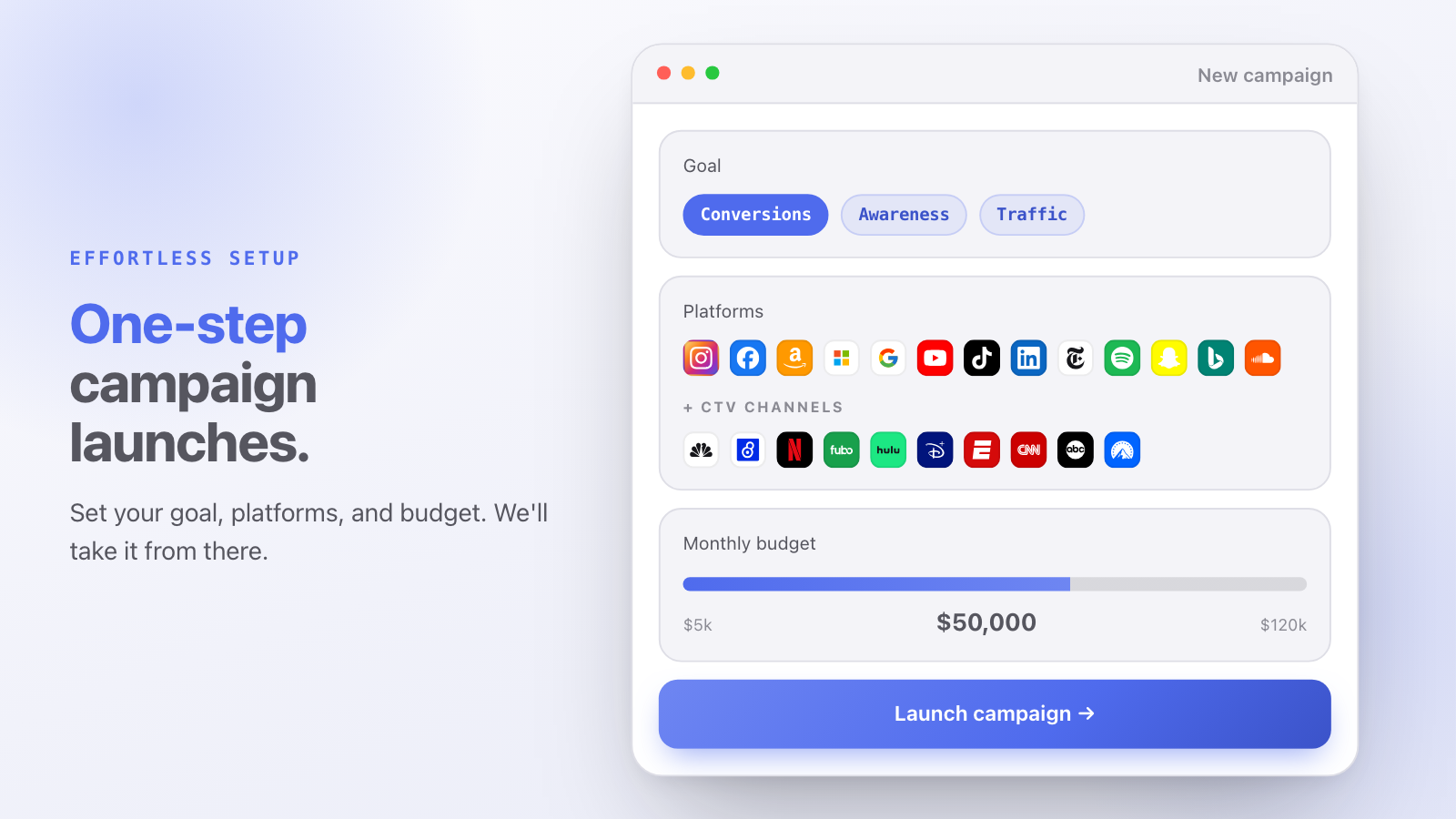
High Scale Self Serve, launched on Shopify on June 17, 2026, adds a software entrance to the service. Merchants can request campaigns and monitor performance. Its listing includes cross-platform campaigns, audience tools, conversion tracking, and dashboards, with connections listed for Meta, Google, TikTok, Pinterest, and connected television.
The app is free to install, with external charges potentially billed separately. Installation therefore should not be confused with the total cost of advertising. For merchants, the appeal is having a place to request work and see what campaigns are doing.
Borrow the loop
The useful thing to copy is the connection between production and observation. Start with a distinct customer question. Make several ways of answering it. Decide beforehand what would justify another test. Keep the result close to the person writing the next brief. Buying more output without that connection merely fills a folder faster.
This approach asks something of the customer, too. A business needs enough advertising activity to learn from comparisons, a product people want, and the ability to approve new material. Slow approvals can strand a fast production line. Broken tracking can reward the wrong idea. High Scale’s proposition is most interesting where a brand already has demand and the next constraint is keeping its advertising supplied with fresh, testable work.