The operating system hospitals actually need.
Healthcare has a $500 billion back-office problem. Wedge is the platform that fixes it - deploying AI agents inside hospitals and health plans that automate records retrieval, claims management, and payment reconciliation. Not a dashboard. Not a chatbot. A full trust layer for AI, built Palantir-style: engineers embedded on-site, products monitored permanently.
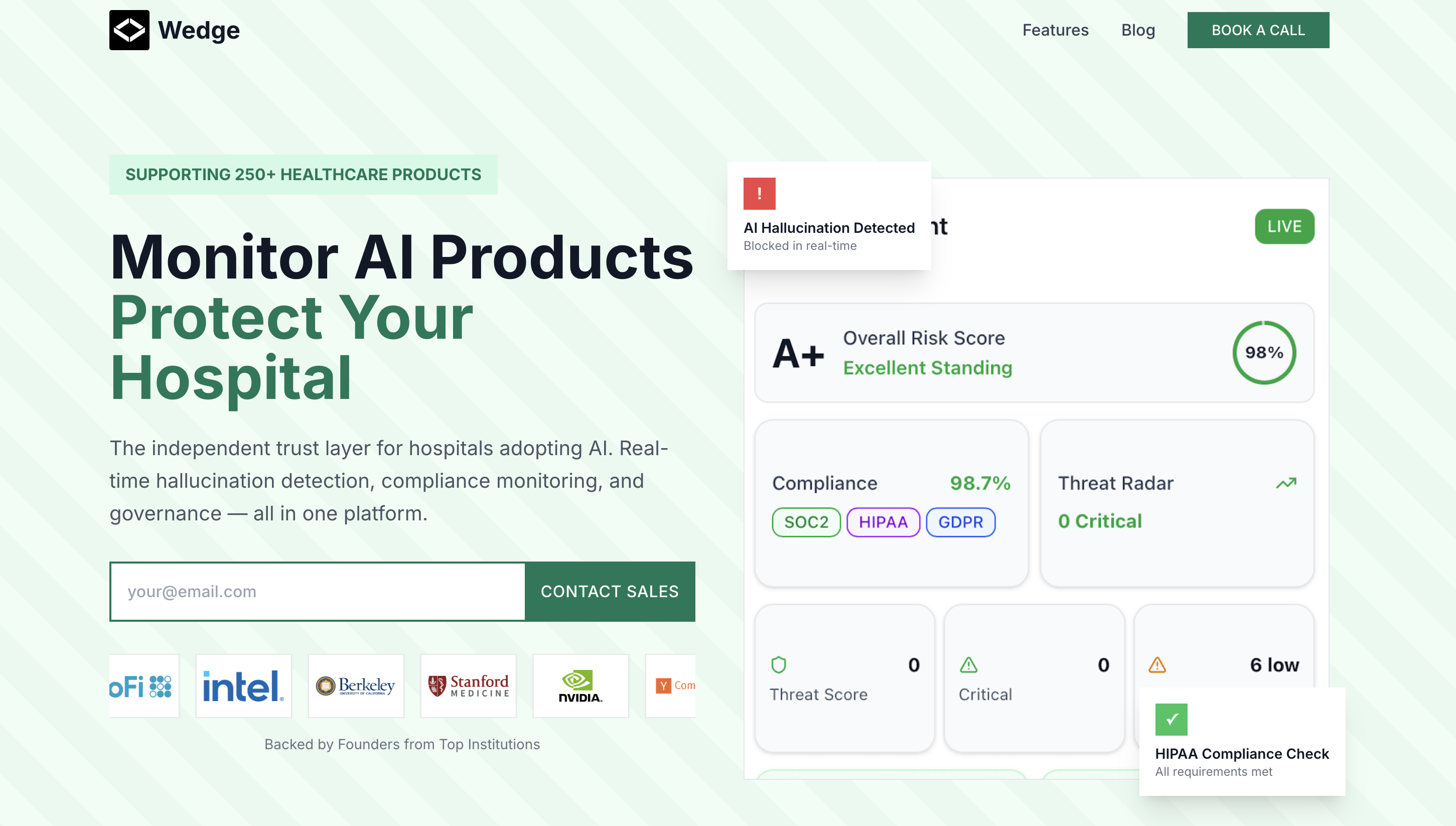
The platform hospitals use to govern their AI
The Problem
Every hospital in America employs rooms full of people doing the same thing: chasing down medical records, resubmitting denied claims, manually reconciling payments that don't match. It's not waste - it's survival. The administrative machinery of healthcare consumes roughly a third of all spending in the US system.
AI has been promised as the fix for years. The problem is, most healthcare AI looks like a feature, not an operating layer. A billing tool here. A coding assistant there. No governance. No oversight. No way to know whether the AI is doing what it's supposed to do - or quietly breaking things at scale.
Wedge was built to solve the second problem. The founders - a Stanford AI researcher and a former NVIDIA ML scientist - didn't start by building another point solution. They looked at how Palantir transformed defense and intelligence analytics and asked: what does that model look like for healthcare AI agents?
The answer is a platform that doesn't just deploy AI - it governs it. Every agent Wedge ships comes with monitoring, maintenance, and a team of engineers who stay embedded inside the institution. The product doesn't leave. It matures.
"Wedge helps hospitals discover, implement, and monitor AI products. They are the first platform for hospitals to safeguard their AI products."
- Y Combinator on Wedge's S25 launchThe Product Suite
Each agent targets a different broken workflow in the healthcare back office. Together, they form the first integrated AI automation layer designed specifically for hospitals and health plans.
Automates medical record requests and securely retrieves records from EHRs. No more manual fax chains. No more lost requests. Records arrive when they need to.
Processes remittances and flags discrepancies in real time to prevent revenue leakage. Hospitals often don't know how much they're losing until this agent shows them.
Automates claim submission and identifies - then resolves - denials before they become write-offs. Revenue cycle management without the five-person team.
Assigns ICD codes with machine consistency, reducing human coding errors that lead to claim denials and compliance risk. Faster throughput, cleaner records.
The platform underneath all the agents. Deploys, monitors, and maintains every AI product running inside a health institution. The trust layer that makes the rest possible.
The Model
Palantir didn't win defense contracts by selling software licenses. They deployed engineers inside agencies, built custom software on-site, and never left. The relationship made the product. The permanence made it indispensable. Wedge applies this exact model to hospitals - and the parallels are precise.
| Dimension | Palantir (Defense/Intel) | Wedge (Healthcare) |
|---|---|---|
| Deployment model | Forward-deployed engineers inside agencies | Forward-deployed engineers inside hospitals |
| Core product | Data integration + analytics platform | AI agent deployment + governance platform |
| Customer relationship | Long-term embedded partnership | Permanent monitoring and maintenance |
| Problem complexity | Fragmented intelligence data silos | Fragmented EHR systems and billing workflows |
| Trust requirement | National security-grade data handling | HIPAA-grade patient data handling |
| End state | Mission-critical infrastructure | Mission-critical revenue and care infrastructure |
The Team
The founding team brings together the two things healthcare AI usually lacks: domain-specific research depth and production-grade ML engineering. One came from the labs at Stanford and Hopkins. The other came from NVIDIA's training infrastructure. Both knew the industry needed something that actually stayed inside the machine - not software that gets installed and forgotten.
Ex-Stanford AI researcher who focused on health AI at both Stanford and Johns Hopkins Medical School. Gopal came to Wedge having seen firsthand how hospitals adopt (and fail to adopt) AI tools - which gave him a specific vision for what governance and trust infrastructure actually needed to look like.
Former Lead ML Data Scientist at NVIDIA, with additional ML engineering stints at Rivian, SoFi, and Intel. Segawa brings production ML experience across both consumer and industrial AI - including LLM fine-tuning - which makes him one of the few healthcare AI CTOs who has actually shipped models at scale.
Funding & Backers
Wedge raised a $500,000 pre-seed round from a focused group of investors who specialize in backing early-stage technical founders. The Y Combinator acceptance is the headline - but the investor lineup includes funds with specific expertise in frontier tech and enterprise software.
The Case
Hospitals are under pressure to adopt AI from every direction. Most don't have internal tools to evaluate, monitor, or manage what those AI systems are doing. Wedge fills that gap before the regulatory wave arrives.
Medical coding, claims management, and payment reconciliation are among the highest-friction administrative workflows in any industry. They're also the areas where AI can deliver measurable ROI in weeks, not years.
When your vendor's engineers live inside your systems and permanently maintain the software, leaving means starting over. Wedge isn't selling a subscription - it's building infrastructure.
Epic, Cerner, Meditech - every hospital runs different systems. The ability to build agents that work across EHR environments is a genuine technical moat. It takes both ML depth and healthcare domain knowledge to pull it off.
"The first platform for hospitals to safeguard their AI products - not just deploy them."
- Wedge's core product positioningThe Story So Far
Devraj Gopal conducts AI research at Stanford and Johns Hopkins Medical School, developing expertise in how health institutions interact with (and often fail to operationalize) AI technology.
Steven Segawa serves as Lead ML Data Scientist at NVIDIA, building and fine-tuning large language models at scale, while also shipping production ML at Rivian, SoFi, and Intel.
Wedge is founded in San Francisco. The company is built around a single thesis: healthcare AI needs an operating layer, not just more point solutions.
Raises $500K pre-seed from Berkeley Frontier Fund, J20 Ventures, Pioneer Fund, Skarlo, and Valia Ventures.
Accepted into Y Combinator's Summer 2025 batch. YC describes them as "Palantir for Healthcare AI Agents" - shorthand that sticks.
Public launch of the Trust Layer for Healthcare AI, with five active AI agent products covering records, claims, coding, payments, and governance.
The founding story of Wedge is not a pivot. It's a convergence. Two people who spent years at the intersection of AI research and production ML - one inside hospital systems, one inside chip architectures - arrived at the same conclusion: healthcare doesn't have a shortage of AI tools. It has a shortage of infrastructure to run them safely.
The idea of "Palantir for healthcare" wasn't chosen as a brand strategy. It was the most precise description of what the product actually does: forward-deployed engineers, permanent monitoring, long-term institutional relationships. The comparison earns its credibility because the operational model matches.
What makes Wedge interesting to watch - beyond the technical depth of its founders - is that it entered YC at exactly the moment when hospital systems are under regulatory and competitive pressure to show they're managing their AI responsibly. Wedge is the answer that showed up at the right time.
Achievements
For a company that launched in 2025, the list of early milestones is tight but meaningful. YC acceptance is the most visible signal - Y Combinator funds less than 1% of applicants, and S25 was a competitive batch. The pre-seed round, closed before YC, shows the founding team could raise on the thesis alone.
The five-agent product suite represents a complete coverage of healthcare back-office automation: records, claims, coding, payments, and governance. That breadth, at this stage, suggests the founders built with a clear architecture in mind - not by patching together features as customers asked for them.
And the YC launch framing - "the trust layer for healthcare AI" rather than just "AI for healthcare" - is precise. Wedge is not trying to be another vendor in the crowded health tech space. It's trying to be the infrastructure layer that all the other vendors run on top of.