The trouble with buying corporate technology is that the invoice arrives before the outcome. The laptop is tangible. The licence count is tidy. The consulting deck has arrows. Whether anybody works faster six months later is harder to see. WBM Technologies has spent 75 years learning to live in that gap.
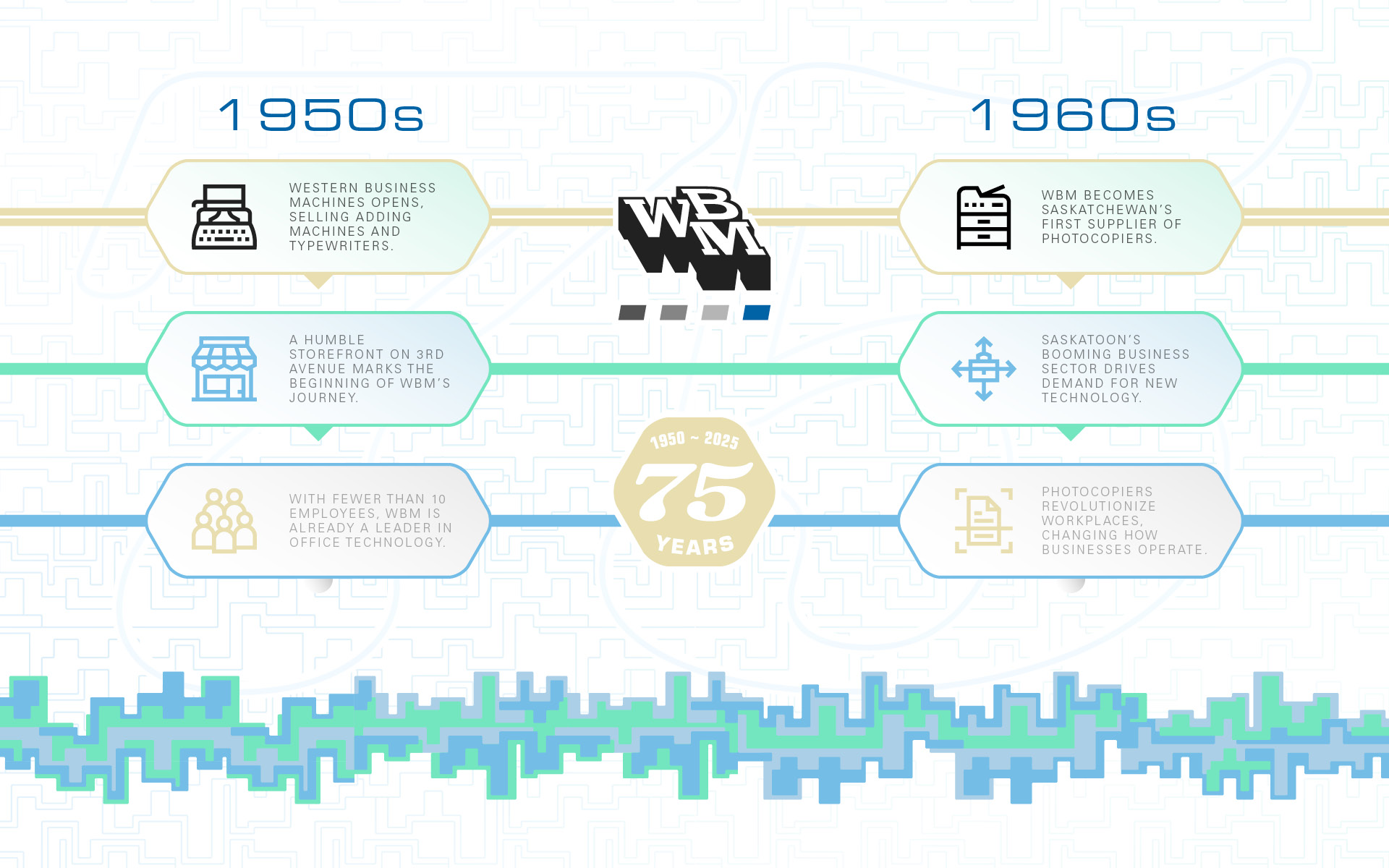
The Saskatoon company opened on May 1, 1950 as Western Business Machines, a storefront selling typewriters and adding machines. It later supplied photocopiers, electronic cash registers, personal computers and networks. It became an internet service provider. Today, WBM manages cybersecurity operations, employee devices, Microsoft 365 adoption, meeting rooms, printers, procurement and a 24-hour enterprise service desk. The inventory changed so completely that the old name now sounds like a museum label. The customer problem did not: a business bought a machine and needed it to make work easier.
“If we had clung to being experts in typewriters, we wouldn't be here today.”JoeAnne Hardy, Executive Chair
That is the clean version of reinvention. The more useful version has a bit of prairie dirt under its nails. WBM survived by refusing to let a product category become its identity. Its current pitch is “outcomes-driven IT,” a phrase that could dissolve into consultancy fog. The proof is in the numbers it is willing to print next to customer names.
The product is not the product
WBM sits between a hardware reseller, a systems integrator and an outsourced IT department. It buys devices and licences, configures and deploys them, watches their health, answers users, trains staff, secures the environment, manages refreshes and reports the result. Its patent-pending Enterprise Experience Platform is the connective tissue - a service model joining people, process, technology and governance rather than another app customers must admire from a dashboard.
One accountable lifecycle
The differentiator is the closed loop. A one-time reseller can ship step three. WBM tries to own what happens before and after it.
The menu is broad because enterprise friction is promiscuous. A printer failure can be a parts problem, a network problem or a remote-site problem. A Microsoft 365 rollout can be technically correct and practically unused. A service desk can answer calls while trapping the internal IT team in repetitive work. WBM sells managed IT and infrastructure, cybersecurity and threat response, end-user computing, service desk operations, modern workplace and AI enablement, managed print, and procurement with warehousing and logistics.
Its customers tend to have enough scale or geographic sprawl to make those handoffs expensive: provincial government, Crown corporations, mines, energy producers, utilities, co-operatives, credit unions, construction firms and nonprofits. Public customer stories name the Government of Saskatchewan, Cameco, SaskPower, Federated Co-operatives Limited, Vermilion Energy, Radius Credit Union and Victoria Foundation. This is not technology for a three-person design studio. It is technology for 61 government locations, a remote mine, 1,600 co-op sites or a service desk that cannot close for the night.
What they did, what broke first
For the Government of Saskatchewan, the starting condition was fragmentation: multiple vendors, contracts and financing structures made device management rigid and administratively heavy. WBM helped turn procurement, deployment, support and refresh into one scheduled service. In the first eight months, the program refreshed 3,025 devices across 61 locations, at peaks of 540 devices a month. WBM reports $530,618 in first-year hardware savings and an average install time of 26 minutes, with satisfaction between 87 and 92 percent.
The important failure was not an exploding server. It was the transaction model itself. Buying boxes from several suppliers made service levels harder to standardize and long-term costs harder to optimize. The repair was operational: publish a multi-year refresh calendar, consolidate accountability and measure the installation experience. In other words, the spreadsheet changed before the laptop did.
Cameco: adoption
Thousands of employee enablement touchpoints, live help inside Teams, 94 percent reporting proficiency improvement and an NPS of 86.
Vermilion: capacity
A partner-led service desk unified seven knowledge sources, reached 89 percent first-call resolution and freed internal IT for strategic work.
Radius: security
A baseline audit led to 24/7 threat response, 100 percent endpoint monitoring and a reported 97 percent phishing-detection rate.
Victoria: usefulness
Endpoint health reached 100 percent while Microsoft 365 proficiency rose 24 percent and staff reported 1,430 hours reclaimed.
Cameco shows the other common failure: software arrived before behaviour. During the 2020 move to remote work, WBM and Cameco put a “Power Bar” inside Microsoft Teams, giving employees one-click access to live experts and scheduled training. The intervention sounds almost quaint beside an AI copilot. It worked because the help appeared where the hesitation happened. WBM reports 5,208 enablement touchpoints, 94 percent of surveyed users improving proficiency, 87 percent of questions resolved on the first call and an NPS of 86.
“We're not doing technology for technology's sake; we are doing it with a very specific outcome in mind.”Mark Leach, Cameco
What changed minds in these cases was pressure made visible. The pandemic exposed a service desk that needed more scale and a workforce that needed immediate remote support. A credit union's previous provider could not keep pace. A nonprofit lost time to unreliable systems and manual workarounds. WBM's discovery process turned diffuse irritation into baselines: endpoint coverage, comfort with software, room uptime, ticket resolution, deployment speed. Once the baseline exists, a technology decision stops being a faith purchase.
What it costs - and who gets paid
A useful public price marker exists: in 2016, the Government of Saskatchewan awarded WBM a five-year, $38 million end-user-computing contract. Current engagements do not come with a public rate card because pricing depends on users, devices, locations, coverage hours, security requirements and transition work. Revenue comes from recurring managed-service contracts, support and service-desk operations, projects, device and software sales, licensing, managed print, deployment, warehousing and lifecycle management. The supplied company dataset estimates annual revenue at $178.5 million, with currency unspecified; the privately held company does not publish audited sales.
The commercial idea is to collect margin across a longer chain while giving the customer fewer throats to choke. That can beat the cheapest line-item bid if fewer tickets, shorter installs and better adoption produce enough value. It can also lose if a buyer only wants commodity hardware or already has excellent internal operations. Outcome pricing still needs honest baselines. Without good inventory, ticket and user data, a scorecard becomes decorative arithmetic.
Competitors include national integrators and resellers such as Compugen, Long View Systems, Softchoice, CDW Canada and Insight Canada, plus regional MSPs and internal IT teams. WBM's distinction is not a secret technology stack; many rivals sell Microsoft, HP, security monitoring and support. It is the combination of a Western Canadian field footprint, multiple service lines, local relationships and quantified customer governance. Five infrastructure operations centres - Vancouver, Calgary, Regina, Saskatoon and Winnipeg - give it a regional density that a remote-only provider cannot easily imitate.
The better the business did, the worse life got
WBM's most revealing transformation was managerial, not technical. In 2008, JoeAnne Hardy, Brett Bailey, Bob Hardy and another partner completed a management buyout just before the financial crisis. The buyout required personal equity, supplier confidence and financing from Roynat. Later, the owners confronted an uglier metric: business success was making their lives worse. They redesigned the company around the idea that growth should improve life for the people creating it, not consume every available hour.
That moment explains some of WBM's culture language, which can otherwise sound suspiciously polished. The company emphasizes internal careers, community relationships and local operations. In 2012, it sold its 17-person telecom division to Telebyte, sharpening focus on IT solutions. In later years it bought capabilities that fit the operating loop: Ricoh Canada's Manitoba operations, Celero's procurement business, Carlyle Printers and selected managed-IT operations from Vancouver's Site Technology. The pattern is subtraction followed by deliberate adjacency.

Current WBM pages describe more than 550 technology professionals. Its awards cabinet now includes HDI's 2024 Global Best Service and Support Organization, HP Canada's 2024 Managed Print Services Partner of the Year, Logitech's 2025 Canadian Partner of the Year, a 2026 Cyber Verify AAA audit rating and HDI's 2026 Best Use of AI award. Awards do not prove a customer outcome, but they do reveal where WBM keeps placing its bets: service quality, predictive operations, meeting rooms, security and automation.
The playbook readers can copy
Count tickets, endpoint health, install time, proficiency and wasted hours before proposing a tool.
Put the expert inside Teams, the meeting room or the device-refresh moment - not behind a portal hunt.
Connect procurement, deployment, support, adoption and refresh so nobody can blame the seam.
Replace capability claims with a small set of customer measures that executives and users both understand.
The model will not work everywhere. A tiny company will not need five operations centres and formal governance. A sophisticated enterprise may prefer best-of-breed specialists and retain integration internally. A customer unwilling to share data, change workflows or appoint an executive owner will turn “outcomes-driven” into a quarterly meeting with coloured arrows. And regional density is an asset only where the provider has technicians, parts and decision-makers close enough to matter.
WBM's transferable advantage is not longevity. It is the habit that created longevity: treat every technology category as temporary and every customer outcome as the permanent job.
That habit also explains the company's recent AI work. WBM can add automation to its service desk without pretending the human service desk has vanished. It can monitor hardware supply pressure created by AI infrastructure demand while still holding Canadian inventory for customers. The shiny object enters an existing operating system and has to earn its place.
The old storefront on Saskatoon's Third Avenue had typewriters in the window. Seventy-five years later, WBM sells an invisible bundle of availability, security, adoption and accountability. It is harder to photograph, but easier to judge. The machine will change again. The scorecard should survive it.