A company can offer its people an overseas trip, a flexible working day or a haircut. Wayne Underwood and Ben Riley had already tried such things at CSG. In February 2018, they announced something with a longer horizon: a plan to put 10% of their recruitment business into employees’ hands. The invitation to share the success would come with a stake in it.
It is a useful place to begin with Underwood, the Leeds-based co-founder and CEO of CSG Talent. Recruitment is his trade; the organisation around the recruiters is an abiding interest. His career has taken him from placing senior candidates to bringing businesses together, supporting other founders and asking how colleagues might benefit from what they build. Even the office perks eventually acquired a capital structure.
of the business earmarked for employees
The announced allocation, shown as a share of the whole business. Historical plan, not a statement of current ownership.
Six businesses, fewer introductions
Underwood studied law before joining Ellis Fairbank in 1998. He worked in senior recruitment, including electronics and facilities management, and progressed into management. In 2003, he and colleague Ben Riley established Rilwood Associates. Core Consulting followed a year later. The partnership eventually encompassed six specialist recruitment businesses.
In 2015, those businesses came together as CSG. The practical aims included shared working methods, stronger support functions, international offices and a group share option scheme. It was a change in the machinery of the business as well as the name on the door. For a founder, combining companies means deciding which freedoms to preserve and which duplicated efforts to retire.
The launch explanation described overlapping operations and a wish to make the combined offering easier to understand. Underwood and Riley remained the majority owners. A collection of specialist firms would now introduce itself through a single identity. There is a certain courtesy in this: clients have quite enough organisational charts of their own to decipher.
Putting a number beside belonging
The employee ownership announcement made the ambition unusually concrete. The founders set out a staged allocation: 6% released on 1 February 2018, with another 4% scheduled for July 2019. They used an Enterprise Management Incentive scheme. Underwood described the possibility of employees receiving a meaningful financial benefit if the business later went through a sale or transaction.
Those terms matter. The announcement concerned participation in a possible future outcome, rather than a promise of immediate cash. Yet the underlying choice was clear enough: the people doing the work should have an opportunity to benefit from the value it created. An incentive trip ends when the plane lands. An interest in a business asks its holder to look further ahead.
For a recruiter, the decision also carries an interesting symmetry. CSG helps other companies persuade people to join and stay. Its founders were applying that question to their own workplace. Underwood’s stated ambition includes colleagues feeling proud of their employer. Ownership gave that sentiment a financial expression, alongside the everyday experience of working there.
The competitor gets a coffee invitation
A smaller episode offers a more revealing glimpse of how he thinks about learning. In March 2021, CSG colleague Steph Rae recalled Underwood encouraging her to speak with people doing similar jobs at competing recruitment firms. She could learn from their successes, he suggested, and share some of CSG’s experience in return.
Rae was surprised. She had not expected a chief executive to recommend giving rivals a view into practices that helped his own business. Underwood even suggested a specific person, Chloe Robinson, as someone to meet for coffee. Rae already knew Robinson from a previous role, which made the proposed conversation rather less daunting.
The detail saves this from becoming a vague sermon about collaboration. There was a colleague, a named peer and a proposed meeting. Underwood’s advice, as Rae described it, treated knowledge as something that could circulate usefully between competitors. The coffee invitation is a modest scene, but an instructive one. Commercial confidence can sometimes afford to leave the notebook open.
Helping a business grow up and leave
Later in 2021, another company supplied a different test of the same generosity of outlook. Clear Edge Search & Selection’s founders, Terry Batty and Tom Fox, completed a management buyout of CSG’s shareholding. They became the business’s sole owners. CSG had supported its establishment with investment, training, technology and back-office services.
By the time of the buyout, Clear Edge had developed its own accountancy, finance and compliance capabilities. Underwood said the business was ready to stand independently under Batty and Fox. His account emphasised the foundations CSG had helped provide and his pride in the company’s progress. Riley also expressed support for its next stage.
There is a pleasing absence of possessiveness in that public farewell. The practical story was a business acquiring the functions it needed to operate on its own. The personal interest is in Underwood’s response: he framed independence as a successful result of the support. A founder can have something to show for an investment even when the next chapter carries somebody else’s signature.
“I wish the popcorn bags were bigger”
Wayne Underwood · May 2026
A twenty-year career, told by the person leaving
In January 2024, Mark Beattie announced his departure after twenty years with CSG and its earlier businesses. He thanked Underwood and Riley for taking a chance on him after university in 2003. His recollection supplied something more useful than a general compliment: a list of opportunities he had actually taken.
Beattie described building a recruitment team in his second year, setting up the London office, growing the Manchester office, taking on a new division and travelling internationally. He credited those changes with keeping him interested and challenged. He was leaving to establish his own recruitment company.
One departing colleague’s account cannot describe every employee’s experience. It can, however, put detail beside a founder’s stated intentions. The opportunity to develop had meant new responsibilities and new places for Beattie. His farewell also catches an awkward truth for any employer who takes development seriously: people may become capable enough to want a business of their own. In his case, gratitude accompanied the departure.
His advice to job candidates gives that idea another angle. In an April 2018 article about interview questions, Underwood recommended asking what had happened to the previous holder of a role. Their next move could reveal more about progression than a blunt request to know how quickly a promotion might arrive.
It is an observant question from somebody whose business depends on understanding careers. An employer’s promises become easier to assess when there is a person’s journey to examine. Beattie’s account offers precisely that kind of detail: responsibility increased, locations changed and the work acquired new dimensions. The interview advice also encourages candidates to investigate a role’s daily demands and challenges. The attractive job title still has to survive an encounter with the actual job.
The chief executive is still a student
Underwood’s writing returns repeatedly to the work of becoming more useful. His November 2022 article on personal development recommends assessing existing strengths, choosing realistic goals and building habits that make progress possible. Learning remains relevant for experienced leaders, in his account. Seniority does not confer an exemption from homework, however attractive that exemption might sound.
There is a practical modesty to this advice. It leaves room for gradual improvement and for skills acquired outside one’s immediate job. The implied challenge for an employer is to make development possible inside the organisation. Otherwise, an ambitious employee may reasonably seek the next lesson elsewhere.
His September 2025 writing on retention extends that concern to managers. He argues for clear communication, recognition, career conversations and greater autonomy. Leadership, in this view, helps determine whether talented people can imagine staying. The recommendations invite a very ordinary test: what would a colleague encounter on a working Tuesday? A useful conversation, some room to decide, a next step they can see.
He had addressed another uncomfortable leadership subject back in February 2018: succession. His advice included writing plans down, reviewing them regularly and preparing potential replacements before a vacancy becomes urgent. For an executive search leader, it is a consequential subject. Hiring begins to look different when the future departure is your own.

That succession advice sits interestingly beside the employee share plan announced in the same month. Both ask a business to consider a future beyond its current arrangements. Who will run it? Who will benefit from its value? Who is being prepared for greater responsibility? The questions concern different mechanisms, but they share an unwillingness to leave the future entirely to chance.
Ambition, with a popcorn allowance
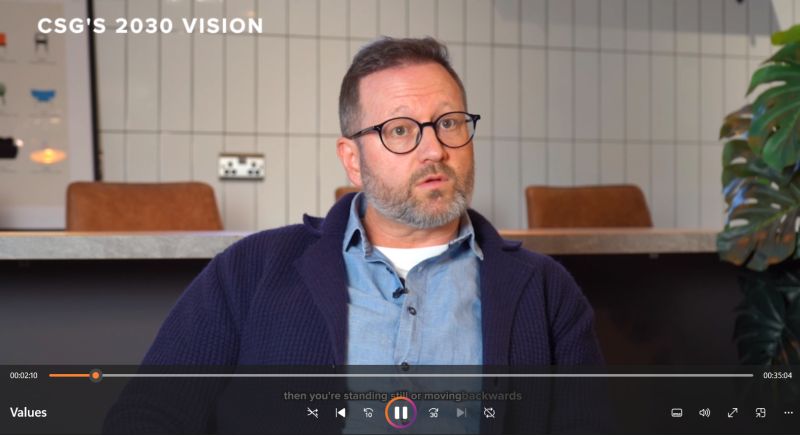
In May 2026, Underwood described watching the marketing team’s roughly forty-minute film at CSG’s Back in Focus event. It brought together interviews from different offices and functions around the company’s values and 2030 vision. He described the intention as improving a little each day while keeping the organisation’s underlying purpose.
He also reported another sales record, two months after the previous one. The post gave the achievement a collective explanation and moved on to recruitment for the internal talent acquisition team. These were his account of the business and its ambitions, rather than published financial results.
Then came the popcorn complaint. It is a welcome bit of scale in a discussion of global growth: a chief executive considering the next several years can still notice a bag that has emptied too soon. Across his career, the more substantial question has been how to give people reasons to commit to the enterprise. A share, an opportunity, a conversation, permission to learn from somebody outside. The portion sizes remain open to negotiation.