In January 2011, Wasim Khaled was preparing to make a phone part of its owner’s wardrobe. His company, LuxMobile Group, was showing accessories at the Consumer Electronics Show in Las Vegas. There were fashion licenses, signature designs and a new brand called Protekto. One line let the phone itself become part of the design. The object in your pocket was becoming an announcement about the person carrying it.
Today, Khaled runs Blackbird.AI, which investigates how online narratives spread and what risks they create. He has moved from dressing a communications device to examining the conversations running through it. The distance between those businesses is considerable. The common ingredient is people: what catches their attention, what they pass along, and how something acquires meaning once other people start looking.
A phone case at least gives its buyer a choice of colors. An information campaign rarely announces who picked the palette.
The phone case years
Khaled began as an entrepreneur during his sophomore year of college. By the time he appeared on the VentureFizz podcast in 2023, he had spent years building companies. Blackbird arrived with that accumulated experience behind it, rather than as a first experiment conducted in the excitement around generative AI.
LuxMobile’s 2011 announcement captures a different commercial world. It sold the meeting of engineering and fashion, with products meant to be useful and conspicuous. Khaled’s official biography records that the company reached the Inc. 500 and that he received Asian Entrepreneur of the Year recognition associated with it. He had already had to turn an idea into something customers would buy.
The contrast makes his later choice interesting. There are more obvious next steps for someone who has learned consumer accessories than a company studying computational propaganda. Yet his background was in computer science, and his interests extended into information operations and behavioral science. He also calls himself a gearhead. The appetite for understanding how a mechanism works survived the change in machinery.
Follow the distribution
In 2017, Khaled co-founded Blackbird.AI with Naushad UzZaman, an AI researcher who became its chief technology officer. They were working on information manipulation years before the current rush to put a chatbot into every available rectangle. Their problem already existed. New tools would make producing and distributing misleading material cheaper.
The company began in national security and expanded into enterprise work. In an interview published in January 2021, Khaled described a familiar sequence: a polarizing story appears, influential accounts promote it, and other people carry it further. The success of the operation depends on getting an audience to participate in distribution. Every willing share gives the original message another pair of legs.
That perspective helps explain his emphasis on narratives and networks. Checking a claim addresses one part of the problem. Understanding the people pushing it, the communities receiving it and the pattern of amplification addresses another. An organization watching only the loudest post may miss the route by which it became loud.
There is a difficult judgment tucked into that approach. A chorus of criticism can be authentic. People can reach the same conclusion without receiving instructions. Treating every unwelcome conversation as an operation would make the software comforting and the conclusions useless. The work requires evidence of how a narrative travels, along with restraint about what that evidence establishes.
Khaled has also recognized the complications of policing speech. In a 2021 discussion of platform rules, he described the risk that sweeping changes could protect large incumbents while leaving smaller companies vulnerable. His argument acknowledged unintended consequences. An intervention can solve one problem and quietly furnish another with office space.
A Sherpa with a calendar
His language about leadership is less combative than the language of information warfare. In a 2020 leadership conversation, he described setting a direction for employees and then helping them obtain the resources to reach it. He compared his role to a Sherpa’s. Having the title and paying the salaries, in his account, did not settle the question of authority.
“I have to earn the respect of my team through example.”
Wasim Khaled · on leadership
He emphasized clarity of purpose, vision and instruction. He also distinguished Blackbird’s mission from his earlier businesses, saying he had wanted an organization whose work carried a larger purpose. Such statements become more interesting when somebody else describes the working relationship behind them.
Radhika Shah-Meade joined Blackbird in November 2021 as an executive assistant. Her background included fashion studies and international business; AI startups were unfamiliar territory. She describes taking on work involving policies, employee connections and company culture, then growing into the chief of staff role. In her account, Khaled treated her professional development as an investment in the business.
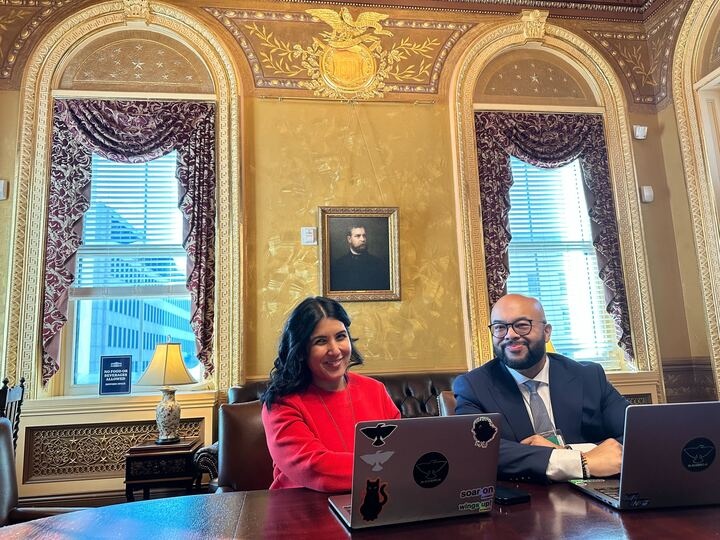
The relationship matters because the founder’s attention is itself a scarce resource. A chief of staff can help turn a stream of requests into decisions, responsibilities and work that actually gets finished. Shah-Meade’s story offers a practical example of how that partnership can grow beyond its original job description.
By February 2026, Khaled was describing a weekly review of his time with his chief of staff, including a pie chart of where it went. He protected Thursdays from routine meetings and used agents to prepare information and follow up on actions. For an executive selling tools to understand the competition for attention, this is a pleasingly literal concern: even his own calendar gets investigated.
The boardroom discovers the feed
The commercial problem grew around him. A security team might see a threat. A communications team might see a reputational crisis. An executive might encounter the resulting confusion only after customers, employees or investors had begun responding. Khaled’s work brought those different professional concerns into the same conversation.
His 2024 paper in the Journal of Brand Strategy considered the collision between political polarization and synthetic media. Brands seeking closer relationships with consumers through social positions could also become targets for ideological opposition. Meanwhile, synthetic content made impersonation more convincing. The paper argued for a combination of analysis, cultural understanding and human judgment. A machine can assemble signals; deciding what they mean remains a demanding task.
That combination also places a burden on the people buying the tools. They have to distinguish an inaccurate claim from an opinion they dislike, a sudden rush of attention from coordinated amplification, and an urgent warning from something that can wait. Those distinctions affect the response. Answering every criticism as though it were a security incident would be an expensive way to misunderstand the audience a company hopes to reach.
In November 2023, Khaled discussed less visible online spaces with DarkOwl co-founder Mark Turnage. Their companies’ partnership extended Blackbird’s access to darknet information. The discussion covered services that could manipulate online reputation and the movement of activity through channels such as Telegram and Discord. The public feed is only one place to look when trying to understand the origins of a campaign.
These connections give Khaled a working world that crosses several professions. He advises government agencies and large companies, and his official biography lists affiliations with the Weber Shandwick Collective and Social Intelligence Lab. The technical questions arrive attached to communications decisions, business incentives and human behavior. A network graph cannot make those competing considerations disappear.
Series B announced in June 2023, led by Ten Eleven Ventures.
New strategic funding announced in January 2026.
Separate funding announcements. These figures describe Blackbird.AI’s financing, not Khaled’s personal wealth.
Investors began backing the proposition at greater scale. Blackbird announced a $20 million Series B in June 2023, led by Ten Eleven Ventures. Later that year, the company received Fortune IMPACT 20 recognition. Those milestones made the business easier to describe, although the underlying challenge remained stubbornly hard to compress into a funding headline.
In January 2026, Blackbird announced $28 million in new strategic funding and reported 118 percent year-over-year growth in annual recurring revenue. Participating investors included Ten Eleven Ventures, Dorilton Ventures and cybersecurity executives Dave DeWalt and Chris Young. The numbers were the company’s account of its progress. They indicated commercial momentum without answering every question about how well a particular investigation would perform.
A warning in the work chat
The latest chapter is concerned with getting the analysis somewhere useful. On October 14, 2026, Blackbird introduced RAV3N Radar, a product delivering narrative intelligence into Slack. Its briefs describe the claims, the networks carrying them, the audiences involved and changes since the previous update. Supporting context travels with the alert.
The destination is revealing. Employees already have plenty of dashboards asking for a visit. A warning that enters an existing work conversation has a better chance of being discussed by the people who must act on it. Khaled’s stated ambition is to give those teams context and help them coordinate a response. Seeing the problem is an early stage of the job.
His September 2026 return to All Quiet on the Second Front explored the same practical gap between monitoring and action. AI had changed the economics of producing influence campaigns. Organizations needed ways to make decisions about the resulting risks. The founder who had spent years explaining why the problem deserved attention was now explaining what should happen after attention arrived.
Across these different businesses, Khaled keeps encountering the consequences of perception. At LuxMobile, a designed object invited people to see themselves a certain way. At Blackbird, he examines how stories invite people to see the world, and how organized actors can help those stories travel. His task now is to make that process visible enough for someone to make a considered decision before passing the story along.