The revealing thing about Warrior Plus is a button. In a 2021 interview introduction, founder Mike Lantz’s early idea is described as connecting PayPal to sales pages so buyers could pay sellers more easily. It is a modest beginning for an affiliate marketplace. It also identifies the problem precisely: a digital product may be easy to copy, but the transaction around it still needs engineering.
- Vendors bring digital products; affiliates bring potential buyers.
- The standard vendor fee is 4.9% plus $0.10 per sale.
- Commission earned and cash available are different things.
Founded in 2006, Warrior Plus, branded WarriorPlus, operates where software, ebooks, courses and digital marketing meet. Its customers include the people creating those products, the promoters selling them, and the buyers purchasing them. The useful question is what happens between a promising sales page and a completed purchase. That is where this company does its work.
A file becomes an offer
Start with the vocabulary. In Warrior Plus, a product is the thing delivered: perhaps a PDF, software access or training videos. An offer is the selling arrangement around it. A product must be added to an offer before it can be sold. That distinction sounds administrative until a buyer encounters several choices in succession.
A basic purchase can lead to an upgrade, an alternative license or a lower-priced option. Warrior Plus organizes those upsells and downsells into a funnel. The affiliate applies to promote the offer, and approval covers its products. A promoter does not need a separate agreement for every stop along the buyer’s route. Vendors control those approvals and commission settings.
Attribution uses the last affiliate click for that offer. Later purchases within the funnel can still earn the referring affiliate a commission, provided that affiliate remains the last referrer. The machinery is designed for a sale that can unfold across multiple decisions. For a vendor, it reduces the bookkeeping needed to give someone else a financial reason to promote the product.
The price of recruiting a salesperson
Warrior Plus has no recurring platform subscription for an account, and listing products is free. Its standard vendor charge is 4.9% plus ten cents per transaction. On a hypothetical $100 sale, that is $5. The remaining $95 is not the vendor’s profit: affiliate commissions, payment processing, delivery costs and any refunds still matter.
Illustration only. Excludes processor fees, affiliate commissions, taxes and refunds.
The platform’s incentives are easy to read. It earns when the vendor sells. Its published volume discounts reward qualifying sellers, with a vendor score of at least 60 and an account in good standing among the conditions. Lower platform costs can help a repeat seller’s margin; they cannot rescue a product whose acquisition costs already exceed what customers spend.
The commission itself is another design choice. Commission Rules let vendors increase an affiliate’s rate for a limited period, after sales milestones, or following a qualifying purchase. A launch can therefore reward speed, volume or participation. The practical lesson is to calculate the offer’s economics before recruiting promoters. A generous percentage is an expense as well as an invitation.
The money has a waiting room
Here the cheerful simplicity of an affiliate dashboard meets a less cheerful fact: a recorded sale can be reversed. Warrior Plus stores affiliate and joint-venture commissions in its Wallet. Available and pending balances are separate. Refunds and chargebacks can reduce the available balance, sometimes taking it below zero.
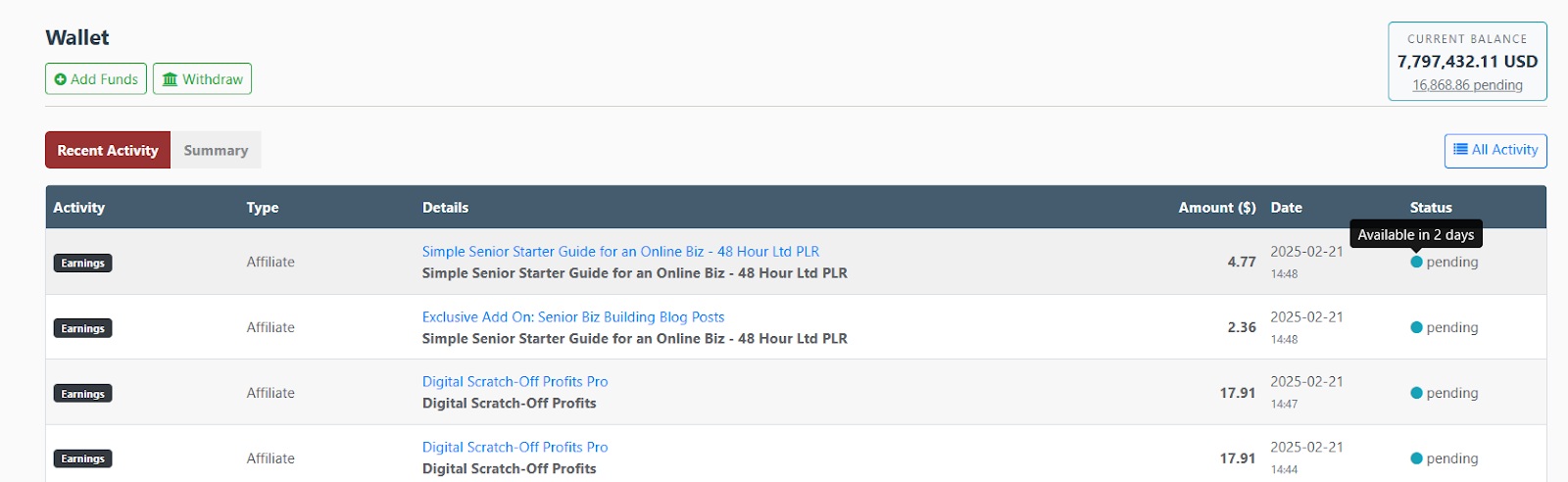
Current guidance puts commission delays between three and 90 days, with affiliates starting at 30. The interval changes with account statistics, including refund and chargeback rates. Withdrawal processing is a further step, generally described as within 72 hours on working days. The affiliate application also involves identity verification and a one-time $5 processing fee.
“Your Profit is Our Business”WarriorPlus company tagline
For anyone paying for traffic, that timetable matters. Advertising can consume cash before commissions become withdrawable. The dashboard may show progress while the bank account still finances it. A sensible experiment needs enough working capital for the wait, and enough margin to tolerate reversals. Counting pending earnings as spendable money would make the experiment look healthier than it is.
A marketplace needs rules, too
The platform’s compliance guidelines prohibit fake proof, require real scarcity and reject misleading income claims. A countdown timer must connect to an actual pricing change. Resold private-label-rights material must be labelled accurately. These are specific responses to the temptations of a marketplace where the sales pitch can be more visible than the deliverable.
Responsibility also has boundaries. Warrior Plus’s support guidance directs product questions and refund requests to the vendor. Its transaction tools do not remove the seller’s obligation to deliver and support the purchase. For an affiliate, choosing what to promote therefore includes assessing the vendor. A commission rate says little about how useful the software is or how promptly support replies.
Distribution is the product around the product
Warrior Plus sits alongside affiliate-led alternatives such as JVZoo, ClickBank and Digistore24. Its emphasis is digital marketing, with offer funnels and promoter relationships built into the workflow. Membership integrations, email connections and sale notifications extend the transaction into delivery and follow-up. Sellers still have to configure those connections; automation depends on the pieces being joined correctly.
Shared Products makes the distribution idea particularly concrete. Eligible vendors can request permission to include another vendor’s product inside their own offer. The product can travel through someone else’s selling system. Access depends on vendor eligibility and approval, so a new account cannot assume every collaboration feature is immediately available.
That is the part another business can copy: build a useful product, specify the offer, give a suitable partner a reason to sell it, and agree how the transaction will be credited. It works only if buyers value the result and the arithmetic survives commissions, support and refunds. Warrior Plus supplies much of the transaction machinery. The reason to buy still belongs to the seller.