A city can announce its growth with a crane, a subdivision, or a photograph of people holding shovels. Waller, Texas, has offered a more revealing signal: another utility billing cycle. Effective October 1, 2026, the city introduced a second cycle because residential properties were increasing. Somewhere behind the promise of another front door is the work of reading, billing, collecting, and answering questions. Waller’s expansion has reached the desk.
- Water, sewer, and natural gas are city services.
- Utility bills can be paid online; opening or closing an account requires a visit.
- Growth is changing administration as well as infrastructure.
This is the City of Waller, the municipal organization serving a community that straddles Harris and Waller counties, about 45 miles west of Houston. Its users include households, shopkeepers, builders, and people borrowing books. Thinking about it as an operating organization makes something visible that the word “government” can obscure: a remarkable variety of ordinary tasks must fit together before a place becomes easy to live in.
The chickens came before the billing system
Waller’s municipal history has a pleasingly practical beginning. Following incorporation in 1947, officials set about establishing a jail, a dump, and a water system. Early ordinances addressed wandering fowl and prohibited hogs within city limits. The questions were close to the ground: where waste went, where animals belonged, and how people obtained water.
That sequence matters. A town can exist before it has the machinery to manage the consequences of people living together. Waller’s earliest municipal priorities suggest that shared nuisances and shared necessities supplied the agenda. Today’s utility office is a descendant of that work, with more forms and fewer loose chickens.
The organizational reach is wider now. Public Works monitors construction, works with engineers on streets and drainage, and plans utility infrastructure. Animal services sit within its responsibilities too. A developer sees a project; the city must also see the connections around it. The distinction becomes especially useful when several projects arrive together.
A house needs more than an address
Consider the steps around a move. Waller offers an online utility payment link, but its published account rules require new accounts and terminations to be handled in person at City Hall. That is a consequential distinction for anyone planning a move remotely. A payment portal solves one transaction; it does not complete the entire relationship.
The same attention to boundaries helps a business owner. The permitting department handles construction, signs, plats, and occupancy changes, among other permissions. Contractors must register and provide current liability insurance. Commercial and residential inspections are scheduled through Bureau Veritas, while civil and site inspections go through the city. Knowing which door to use can prevent a project from waiting at the wrong one.
The department says updated building codes took effect October 1, 2026. For a builder, yesterday’s checklist deserves another look. For a resident, this office addresses a less visible problem: one person’s construction can affect somebody else’s safety, drainage, or surroundings. Permitting is where a private plan encounters obligations to the surrounding place.
The bill behind the welcome
Municipal services have prices. Waller’s published schedule effective October 1, 2025, lists a $150 deposit and a $25 connection fee for new water, sewer, and garbage service. Gas has its own $150 deposit and $25 connection fee. The schedule also distinguishes meter sizes, consumption, and services outside city limits. A single headline price would conceal more than it explained.
Governmental services and utility operations also follow different financial paths. Taxes and fees support general municipal functions; water, sewer, and gas appear as business-type activities in the financial statements. The practical implication is that an expanding city has several balances to manage at once. More customers can bring revenue while requiring infrastructure, staff time, and maintenance.
Infrastructure and other capital assets, after accumulated depreciation. An asset balance, not an annual spending figure.
The city’s 2025 annual financial report records approximately $31.9 million in net capital assets and $17.9 million in bonds, certificates of obligation, and lease liabilities. Those numbers put physical weight behind the service menu. Buildings and networks must be financed and maintained even when residents experience them mainly as something that works when needed.
A September 2026 budget-hearing notice projected $1,770,227 more property-tax revenue than the prior budget, including $768,182 from new property. That comparison describes revenue across the tax base. It does not say every household’s bill rises by the same percentage. Reading the distinction is part of understanding the cost of growth.
Growth has an administrative footprint
The second billing cycle supplies a documented explanation for an operational change: more residential properties. It would be a mistake to turn that announcement into a tale of collapse. The notice reports an adjustment to workload. By October 2026, Water Plant No. 6 was also out for bid, with an October 29 deadline. Billing and building were advancing on separate, related tracks.
The useful lesson for another small organization is to watch the administrative load alongside the visible expansion. Another customer, property, or project produces follow-up work. Waller’s notice makes that work explicit. The lesson has limits: changing a billing schedule cannot create treatment capacity or remove a construction bottleneck. Each constraint needs its own response.
“We encourage creative problem-solving and decision-making”
Waller Police Department · organizational values
Leave room for the people
Waller’s operating life extends beyond permits and pipes. The Melanee Smith Memorial Library provides internet computers alongside children’s books, Spanish titles, and large-print reading. Volunteer firefighters have brought fire-safety lessons to preschool children, complete with junior badges and coloring books. These are small encounters through which an institution becomes recognizable.
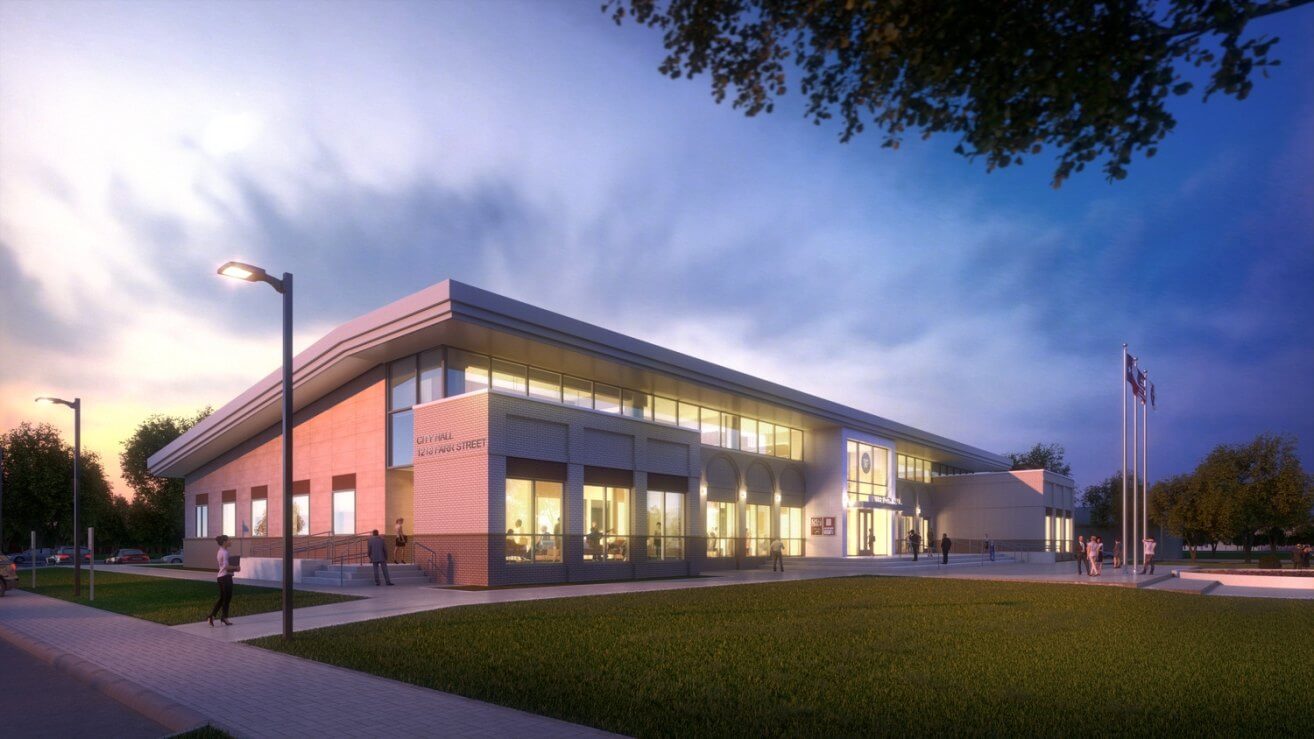
There is a spatial version of that idea at City Hall. Corgan describes recommending that a street be vacated so the building could connect to a two-block civic plaza. The design joined city business with places for gatherings. A practical change in the street plan made room for another kind of public use.
Residents can begin with a utility account, a service request, or a council agenda. Businesses can begin with the permit requirements. The point of these entry points is concrete: get the connection made, the question routed, the proposed decision understood. Waller’s next chapter will be experienced through those transactions, one address and one water bill at a time.