In 1957, a Wisconsin businessman named Bob Nourse noticed something uncomfortable about the top job. The people who run companies make the biggest, loneliest decisions with the least honest feedback. Employees tell them what they want to hear. Spouses get the anxiety, not the balance sheet. Boards show up quarterly. So Nourse tried a fix that sounds almost too simple: gather a handful of chief executives from businesses that do not compete, put them in a confidential room, and let them work on each other's problems. He called it The Executive Committee.
Sixty-eight years later, that room has multiplied. The organization is now called Vistage Worldwide, it is headquartered in San Diego, and it counts more than 45,000 members across roughly 40 countries. It is, by its own description and most outside accounts, the largest CEO coaching and peer advisory organization for small and midsize businesses in the world. The product has barely changed. What changed is the scale, and the fact that a business built on candor turned out to be worth acquiring - twice.
01 / The FormatWhat Vistage actually sells
Strip away the brochures and Vistage sells one thing: a room. Specifically, a group of roughly 12 to 16 non-competing CEOs and business owners who meet once a month, usually for the better part of a day. The meeting is confidential. The members bring real, unresolved problems - a co-founder who has to go, a plant that is bleeding cash, an acquisition that looks too good. The group interrogates the problem instead of applauding the person. Between meetings, members get one-to-one coaching. And a few times a year, an expert speaker comes in to teach something specific, from pricing to AI adoption.
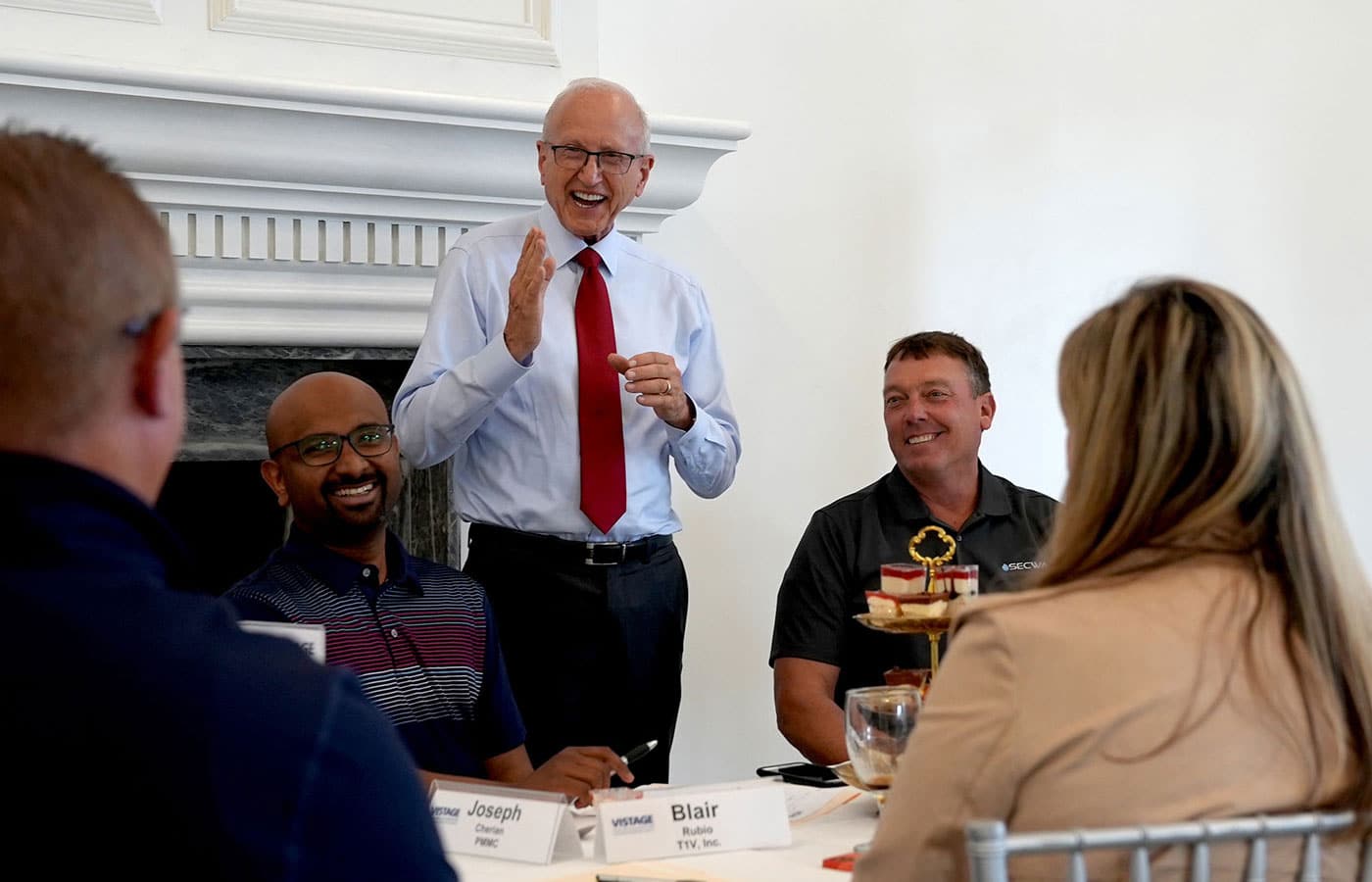
The engine that makes this work is a role Vistage calls the Chair. A Chair is typically a former CEO or senior executive who builds and runs a group - recruiting members, facilitating the monthly meeting, refereeing the dynamics, and delivering private coaching on the side. There are more than 1,300 of them. This is the detail that separates Vistage from the member-led forums of its rivals: someone is paid, trained, and responsible for making sure the room does its job instead of drifting into a networking lunch.
Join a group
12-16 non-competing leaders, matched by size and stage, not by industry.
Meet monthly
A full day of processing real issues, led by a Chair who keeps it honest.
Coach 1:1
Private sessions with the Chair between meetings to work the hard stuff.
Learn from experts
Vetted speakers deliver workshops on strategy, finance, hiring and AI.
The whole thing rests on a single rule that is easy to miss: no one in your group is allowed to compete with you. That constraint is the product. It is why a member will describe their margins out loud, admit a hire was a disaster, or ask whether they should sell - things they would never say to a peer who could use it against them. Vistage did not invent honesty. It manufactured the conditions where honesty is safe, and then it charged for the room.
02 / The CustomerWho pays to be challenged
Vistage's members are the CEOs, presidents, owners and rising executives of small and midmarket companies - the layer of the economy that is too big to wing it and too small to have a bench of internal advisors. These are not first-week founders. Vistage member companies average more than 21 years in business. They have survived long enough to hit the problems that no book quite covers, and to feel the specific isolation of being the person everyone else looks to for the answer.
Membership is organized into programs so the room stays useful: a Chief Executive Program for CEOs of larger companies, a Small Business Program for owners at an earlier revenue stage, a Key Executive Program for the leaders who report to them, and Advancing and Emerging Leader tracks for people on the way up. There is even a Trusted Advisor program for the accountants and consultants who serve this world. The logic is consistent: peers advise best when they are roughly at the same altitude.
03 / The BusinessHonesty, on a subscription
Vistage runs on a subscription-membership model, and it is a good one. Members pay recurring dues - third-party estimates put the flagship CEO program in the neighborhood of $1,380 a month plus a one-time initiation fee - in exchange for their group, their Chair's coaching, the speakers, and the research. Chairs, in turn, operate like independent practice-builders: they recruit their own members and earn from the dues, while Vistage supplies the training, the content library, and the speaker network. Growth for Vistage is, in large part, a function of how good its Chairs are and how long members stay.
That recurring-revenue quality has not been lost on investors. Vistage was owned by Providence Equity Partners before its management team partnered with Gridiron Capital to buy the company in June 2022. Peer advisory, it turns out, is not the soft, unscalable business it might sound like. It is memberships that renew, run by people who are hard to replace.
A single group caps at roughly 12-16 members so no one can hide and everyone gets airtime. Multiply that by 1,300+ Chairs and you arrive at 45,000+ members - a network built not by one big platform, but by thousands of small, deliberately capped rooms.
04 / The ResearchA mood ring for Main Street
Since 2003, Vistage has surveyed its members every quarter and published the Vistage CEO Confidence Index - a read on how small and midsize business leaders feel about the economy, hiring and profitability. Because it draws on thousands of operators rather than Wall Street forecasters, journalists and economists treat it as an early signal from the real economy. Through 2025 the index climbed back, closing the year at 88.9 in the fourth quarter, its strongest reading of the year.

05 / The FieldHow Vistage differs from the alternatives
Vistage is not the only place a CEO can find peers. The Entrepreneurs' Organization (EO) and YPO both run large, respected communities; there are also boutiques and newer networks such as Chief and Hampton, plus faith-based and regional groups like C12 and The Alternative Board. The categories overlap, but the dividing line is who runs the room. EO and YPO forums are largely member-led. Vistage's rooms are run by paid, trained Chairs whose entire job is the quality of the meeting.
| Model | Who leads the room | Typical member |
|---|---|---|
| Vistage | Paid, trained Chair (former CEO) | SMB & midmarket CEOs, owners, execs |
| YPO | Member-led forum | Leaders of larger companies |
| EO | Member-led forum | Entrepreneurs from ~$1M revenue |
| The Alternative Board | Facilitator-led | Small business owners |
That difference is the whole pitch. A member-led forum lives or dies on the luck of who else joined. A Chair-led group has someone accountable for keeping the conversation useful, the confidentiality intact, and the quiet member talking. It is more expensive and more structured on purpose. For a certain kind of operator - one who wants a professional running the process rather than a rotating volunteer - that structure is exactly the point.
06 / The ReachThe same idea, in more places
Under CEO Sam Reese, who has led the company since 2016 after running the sales-training firm Miller Heiman, Vistage has spent recent years bringing its network in-house market by market. It acquired its Australia and New Zealand operation in 2024, launched peer advisory boards in Denmark in 2025, and in 2026 absorbed its longtime Canadian licensee, TEC Canada, adding more than 1,600 members and 75-plus Chairs. The name over the door changes; the room inside does not.

What can a reader actually take from this? The format is not proprietary. Find a handful of peers who cannot compete with you. Meet on a real cadence, not when it is convenient. Put someone blunt and trusted in charge of the room, and protect the confidentiality as if it were the entire value - because, at Vistage, it is. The parts that are hard to copy are the ones Vistage has spent 68 years building: 1,300 credible Chairs, a research spine, and the boring discipline of running the same good meeting tens of thousands of times.
It would not work for everyone. A leader who only wants applause will not last a quarter. Someone who cannot spare a day a month, or cannot be honest in front of peers, gets little from it. And the value scales with candor - a room where no one admits anything real is just an expensive lunch. But for the operator willing to be challenged, Vistage sells the one thing a consultant, a board deck, or an AI assistant cannot: a table of peers with no agenda except to help you make the next call better.