Before Vision Club could sell access to a circle of entrepreneurs in Dubai, its founders had to persuade people that the circle would exist. Aleksey Nakaznyi recalls arriving on February 5, 2021, without an established local reputation. Prospective members liked the idea. Their response, as he remembers it, was essentially: open first; we will see. It is a wonderfully awkward beginning for a business built around introductions. The people you need want proof that the other people have already arrived.
Nakaznyi and co-founder Dariia Nakazna went ahead. Vision became a Russian-speaking business club for owners and senior executives, with paid membership, organized encounters and a staff responsible for helping members find one another. A company that sells belonging still has to do the unromantic work: interview applicants, arrange meetings, remember requests and get people to return.
The founding problem helps explain the product. Someone moving a company, or a life, to another country can buy administrative help. Rebuilding the informal circle that supplies candid recommendations is harder. In a January 2026 third-party-contributed profile published by Dubai People, the founders’ relocation experience is presented as the basis for Vision’s approach. Its service occupies the space between professional introductions and the relief of recognizing faces in a new city.
A million-dollar threshold, then a conversation
Vision’s current application criteria start with an operating business generating at least $1 million in annual turnover. Senior executives qualify through companies with turnover of at least $50 million. Applicants also undergo a reputation check. These are company-sales thresholds, not the price of admission or a measure of a member’s personal wealth.
The distinction matters. Vision is addressing people who already have something substantial to manage: employees, customers, partners and decisions whose consequences cannot be waved away in a brainstorming session. Its named residents span medical businesses, consulting, property management, trade and hospitality. The attraction is access to other operators who have encountered the practical consequences of growth.
Paid residency is the core business model. An earlier club website describes payment followed by six months of participation; the current site also promotes a guest month. A prospective member starts with an application and a conversation with the membership manager. The buying decision is therefore partly a social assessment: whether these are people with whom the applicant can work, speak frankly and spend time.
Club-reported community sizes. The alliance figure covers the wider network, not just Dubai.
The founders bring experience in organizing communities across borders. Their public biographies connect both of them to Alliance Clubs; Dariia’s work includes launching clubs and producing events in several countries. That expertise is relevant here because membership is only the beginning. A full contact list does little if nobody helps a newcomer navigate it.
Ten people. One problem worth saying aloud.
The small forum group is the most revealing part of the offer. Vision describes groups of roughly ten business owners at comparable operating scale. Members bring business or personal questions and exchange experience. A facilitator keeps the discussion moving; the premise is that participants learn from what others have actually done.
Its published protocol calls for confidentiality, participation and attendance. Selling inside the forum is excluded. The meetings are described as monthly, lasting four hours, with additional retreats. Forum participation is included in standard residency. This makes the member’s calendar part of the cost: the format asks for repeated attention, not merely payment.
For a manager weighing a sensitive personnel decision, the appeal is easy to understand. Employees have a stake in the outcome; friends may lack the context. Peers can offer another angle without occupying either role. That is an interpretation of the format’s usefulness, rather than proof that every meeting improves a decision.
A reader can borrow the meeting discipline without copying the entire club: choose peers carefully, protect the conversation, ask for concrete experience and finish with a next step. The conditions matter as much as the agenda. A group that pitches constantly, skips meetings or treats disclosure as gossip would undermine the very reason to meet.
The coffee story has actual dollars in it
One of Vision’s more concrete case studies concerns Konstantin Garbuz and Ivan Kroshnyi. In the club’s account, Garbuz had previously owned a coffee business in the UAE and still wanted to open a specialty coffee shop. He met Kroshnyi at a club gathering. Kroshnyi backed the idea and became a co-investor.
Vision puts the initial investment at $650,000 and says investment in the project subsequently exceeded $12 million. Its current case study also reports 11 locations and three production operations. Those figures describe a members’ venture. They are not funding raised by Vision Club, its sales or a valuation of the membership business.
The introduction is the beginning of the transaction. The business still has to earn its way.
What the coffee case illustrates
The useful part is the match: operating experience met willingness to invest. A club can create the occasion and supply a shared social context. Site selection, execution, demand and the working relationship between investors still belong to the venture. A successful introduction should not be confused with a repeatable investment return.
Other published examples make smaller, more operational promises. Vision describes Olga Neuberger launching a digital service in three weeks through contacts inside the community. It also credits a forum discussion with helping Katerina Kuznetsova move toward a CEO role, alongside a reported AED4 million increase in turnover over twelve months. These are the club’s selected accounts of member outcomes, useful as illustrations rather than a forecast for the next applicant.
A clubhouse, a phone and a reason to come back
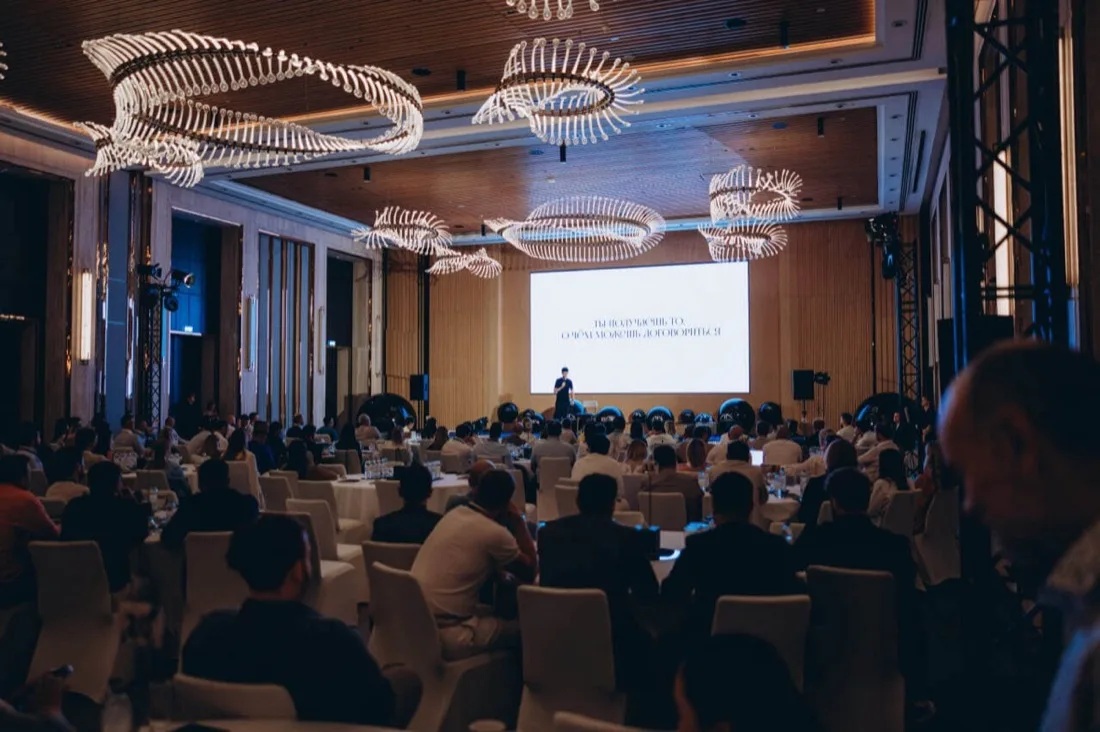
Vision’s clubhouse is in Loft Offices 3, Dubai Internet City. Its public description makes access conditional on residency or invitation. The rooms host forums, dinners, business discussions and smaller interest groups. The physical address gives introductions somewhere to develop beyond the first exchange of messages.
The programming is deliberately mixed. Alongside business formats are AI and IT meetings, marketing discussions, music and arts, tea gatherings and cinema-related sessions. A specialist conversation can start a relationship; an unhurried social evening can keep it alive. That combination is part of what members are buying when they choose a community over a single event.
The company’s published values include continuous improvement, openness and consistency between thought, speech and action. It also advocates respectful, nonjudgmental communication. Those principles place a burden on how sessions are run: frankness must be possible without turning the meeting into a contest over who sounds most successful.
A supplied profile in Dubai People describes appearances at club events by the band Otpetye Moshenniki and comedian Nurlan Saburov. Shared cultural references have an obvious role in a Russian-speaking community abroad. Members are building a working network, but they are also choosing how to spend an evening.

The app extends that relationship between gatherings. Vision advertises member search, chats, event registration and a knowledge base. For the customer, software reduces the friction of finding a person or booking a meeting. For the operator, the harder task remains keeping the directory worth searching and the events worth attending.
Dubai is the meeting point; the network travels
Through Alliance Clubs, Vision advertises connections with partner communities abroad. Its named partners include Wake UP! in the United States, London Business Club, Poland’s BIZON, Armenia’s CAPITAL, Uzbekistan’s YARD, Cyprus’s GROW and Jewish Business Club in Israel. The offer combines a local base with access to people in other markets.
There is a straightforward reason for that combination. An entrepreneur may live in Dubai while customers, suppliers or expansion plans sit elsewhere. A locally useful community can become more useful if members retain a route into other business circles. The practical question is whether a particular introduction fits the member’s actual task.
Vision operates in an established market for entrepreneurial peer networks. EO Dubai, for example, also offers confidential forums and business events; its forum description specifies groups of seven to ten owners sharing experience. Vision’s distinction therefore rests on its Russian-speaking community, Dubai concentration and particular membership mix, rather than ownership of the small-group idea.
Choosing between these environments is a question of fit. Language shapes how comfortably someone can discuss uncertainty. Business scale shapes which experiences transfer. Location shapes whether people will actually attend. An applicant seeking their first business idea faces a different problem from an owner trying to reorganize a company that already sells millions of dollars a year.
The test is what happens after the introduction
Vision’s early recruitment story and its current service offer point to the same constraint: people cannot be assembled once and assumed to remain a community. The founders had to get the first members through the door. Their staff now have to make continued participation worthwhile.
The guest-month offer gives that proposition a useful frame. Bring a specific question, meet the people who might understand it and judge the quality of the exchange. A practical personal measure would be whether a conversation clarified a decision or produced a relevant next meeting. Counting phone numbers would miss most of the point.
For someone building a similar service, the copyable elements are visible: a defined audience, deliberate introductions, recurring small groups and a place to meet. The difficult element is accumulated familiarity. That takes repeated encounters and members who contribute as well as ask. Vision’s business depends on making room for both.