Vish Dumpeti kept a list in his head. It was a list of people, each attached to a situation in which they might be useful. He carried it through Spotify, WeWork, CLEAR and Justworks. Sometimes an introduction happened immediately. Sometimes he waited years. The thought remained much the same: somewhere, a problem was waiting for this particular person.
He says it took him twenty years to recognize that habit as a skill. Forward Share Network, part of the venture studio he founded in New York, is his attempt to give it a business structure. More than 200 expert operators belong to the network, according to ForwardShare. Their usefulness depends on the match: what they have handled before, what a company needs now, and whether the two belong together.
A mental list has certain advantages over a spreadsheet. It remembers the person who held a team together when the plan fell apart. It remembers which executive can work with an impatient founder. It also has an obvious limitation: it lives inside one person. Dumpeti is trying to turn that accumulated judgment into something other people can use.
“this person would be perfect for that situation.”
Vish Rao Dumpeti, on the thought behind his introductions
The work before the introductions
His career runs through businesses that required rather different things from their software: research at ProQuest, publishing at The New York Times, advertising at MediaMath and Spotify, physical spaces at WeWork, identity at CLEAR, and business administration at Justworks. Hughes and Yahoo also appear in his professional history. The sequence gives his current interest in operating problems some context. A product has to survive contact with the business around it.
Looking back at Spotify, Dumpeti credits his work with building Ad Studio and supporting advertising revenue growth above 60 percent year over year. He reports technology initiatives at WeWork that generated more than $250 million in capital expenditure savings during its IPO readiness phase. At CLEAR, he describes launching verticals that supported more than 100 million identity verifications.
Those are his reported outcomes. The more revealing detail for his present business may be the organizational one: at Justworks, he says he scaled more than 250 people across over 25 platform teams. Someone who has worked at that size has had plenty of opportunity to encounter the distance between a tidy organizational chart and the actual routes by which decisions get made.
His education combines a computer science bachelor's degree from the University of Maryland with advanced executive study at MIT Sloan. The technical background matters here. He can ask questions about the engineering itself, rather than treating the engineering department as a mysterious room that consumes money and occasionally produces a release.
Across 25+ platform teams at Justworks, by Dumpeti's own account.
The expensive pipeline that became a view
One of Dumpeti's accounts begins with a founder asking for a custom data pipeline. The estimated engineering effort was six months. The reason sounded reasonable enough: the business wanted to make decisions faster. A large technical project had already acquired the dignity of a necessary investment.
Before building it, the team asked which decision the founder could not make. Dumpeti says the answer came down to one dashboard, showing one metric, refreshed weekly. The required view took three weeks. In his account, the intervention saved more than 3,000 developer hours and avoided $800,000 of engineering work.
The charm of this story is its lack of glamour. Nobody gets a magnificent new pipeline. There is no ceremonial ribbon for a weekly metric. A smaller piece of software does the useful thing, and everyone gets back some time. The engineering ambition has to make room for the business question.
It is also a revealing description of his role. The person asking for a build has already named a solution. Dumpeti wants to examine the decision behind the request. That adds friction at the beginning, when momentum feels precious. His argument is that the inconvenience can save months at the other end.
Changing his mind about the payroll
Dumpeti has described an earlier conception of a venture studio that depended on a substantial in-house team. Each venture received six to eight specialists. It felt like infrastructure. Looking back, he called it “bloat with a brand.” That is an unusually brisk review of one's own organizational design.
He now describes a smaller core working with operators brought in for defined scopes. In one account, four founders work with a rotating pool of vetted specialists. The practical question becomes who a venture needs over the next ninety days, and what agreement will make that work clear.
This is a change in the way he thinks about commitment. A large permanent team can signal seriousness to an outsider. For a young venture, it can also create obligations before anyone knows precisely which expertise will be needed. Dumpeti's revised model makes the scope of the work carry more weight.
The important word is trust. In his description, the studio provides a system that lets people who are not all on the same payroll move together. That puts pressure on selection, responsibilities and contracts. A network earns its usefulness when a specific piece of work lands with someone capable of owning it.
The hire that took too long to admit
His writing about executive hiring is willing to include an uncomfortable first-person example. He describes spending six months with the wrong vice president of sales, at a cost of $400,000 and two enterprise deals. Along the way, he wondered whether his own coaching was inadequate and whether another quarter might settle things.
The questions are familiar because they allow a decision to remain comfortably postponed. Starting again would be expensive. Admitting the mistake would be embarrassing. Meanwhile, the current arrangement continues to charge rent. In Dumpeti's telling, recognizing the mismatch sooner would have been the more economical choice.
Another account concerns a company that spent twenty-two months searching for a full-time chief technology officer. He says a subsequent ninety-day fractional engagement produced a restructured engineering team, a shipped second-version roadmap and a replacement hiring plan within six weeks. The company in that account is unnamed; the lesson he draws concerns the price of waiting.
His case for fractional leadership is therefore about sequencing as well as spending. An experienced operator can help define a permanent role before the permanent hire arrives. The person who sets the architecture or stabilizes a team may also help determine what their successor should actually be asked to do.
A studio with a stopping rule
ForwardShare cofounds and builds AI-native business software with domain experts. The premise is that people who have spent years inside an industry may understand a stubborn problem particularly well. The studio supplies product, design, engineering and operating support to help that understanding become a company.
Its model includes a production pod, a personal advisory board and a platform called AchieveOS for keeping goals and milestones visible. ForwardShare Capital invests alongside the building work. The company describes taking a minority position while the founder runs the venture, with the proposed equity terms discussed early.
A less festive detail deserves attention: the studio explains how a venture stops. At a monthly call, the parties can decide to end the effort. Capital stops, operators move off, and the entity and intellectual property must be dealt with. Customer conversations and what they taught the founder still have value.
That stopping rule fits Dumpeti's interest in making decisions before they become expensive habits. A venture can demand more money simply because it already exists. Writing down a moment at which people must reconsider gives the team a chance to distinguish progress from continued expenditure. It is a practical provision for a business whose work includes uncertainty.
The week with seven things to ship
He applies the same scrutiny to his own calendar. In one account, Monday began with seven things to ship, four conversations, two decisions and a venture whose direction needed choosing. By Wednesday, three items had shipped and two conversations had happened. Neither decision had been made. The venture's direction remained unresolved.
His response was to try writing down three things he would leave out of the following week, then telling his team. There is a modest comedy in informing one's calendar of a decision, as he describes doing. Calendars have a way of appearing innocent while helping every obligation win admission.
The exercise makes priorities visible through omissions. It also gives his colleagues something clearer than a declaration that everything matters. A founder who talks about disciplined deployment of other people's expertise still has to decide how to deploy his own attention. This account gives the operating philosophy an ordinary, slightly untidy working week.
What happens when the people remember
Dumpeti's interest in teams predates his current studio model. In a March 2023 essay, he discussed Google's Project Aristotle and the conditions that help teams work: dependability, clarity, meaning, impact and the ability to speak freely. He encouraged managers to acknowledge their own fallibility and ask questions.
His former Justworks colleagues describe the human side of that work. Edward Urgola credits him with connecting business context to the development of strong managers. Mike Kenny recalls his contribution to team building and talent selection during a period of growth. These recollections fit a career in which choosing people and helping them work together became a recurring responsibility.
He has also listed mentoring work with General Assembly, Flatiron School, Startup Grind and Technovation. For all the current language of AI and venture creation, helping another person develop a judgment of their own remains an identifiable part of his professional life.
A company built from something
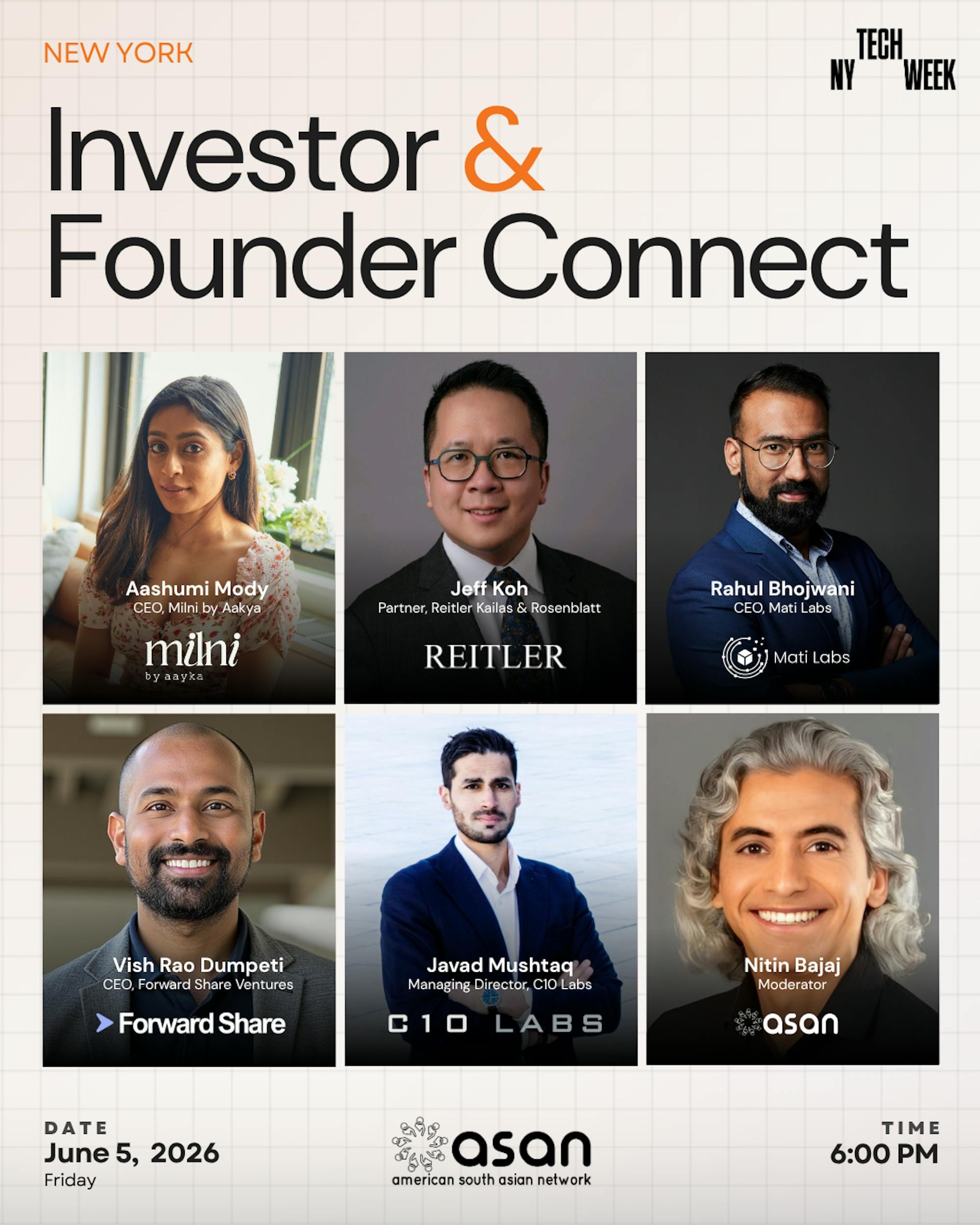
For New York Tech Week in June 2026, the American South Asian Network listed Dumpeti among the speakers for a founder and investor conversation. The subjects included fundraising, scaling and the relationship between founders and investors. It was a public setting for questions he regularly approaches through individual introductions.
In a personal reflection, he wrote that his parents came to America believing they could build something from nothing. He also described the years of learning unfamiliar systems and making a professional life in another language. Forward Share Ventures, he said, was the thing he had now built, even as it remained unfinished.
That gives the business a more personal scale. The accumulated experience includes family groundwork as well as product launches and hiring decisions. His closing wish was for people building something from something. It is a generous adjustment to the familiar founder origin story, which tends to begin after much of the work has already been done.
The mental list is still there beneath the programs, contracts and capital. A person has learned something difficult. Somewhere else, a company needs precisely that experience. Dumpeti's current work is to arrange the introduction and give the people enough structure to do something useful with it.