A public relations agency can make a perfectly good living persuading people to notice things. Virginia Devlin spent eighteen years building one. Along the way, she became interested in a more awkward question: what happens when the people you hope to reach cannot use the message you have made? A campaign can have an excellent headline, a handsome film and a satisfied client, yet still leave part of its audience outside the conversation.
That question gives an unusual shape to Devlin’s career. She founded Current in 2006 with one client, helped turn it into Current Global, and retired from its leadership in March 2024. By October she had joined Prosper Group as a senior counselor. Her working life now includes helping other agency leaders think through the businesses they are building. The promotional instinct and the operational instinct have found another assignment together.
The first client stayed
Devlin’s early education in storytelling came at Northern Illinois University, where she studied journalism and worked on the Northern Star. Photography interested her, too. Her entry into public relations was a secretarial job at a Seattle agency; promotion to account executive followed. It is a useful beginning for someone who would eventually be responsible for other people’s chances to move forward. The first job on a résumé does not always reveal the work someone can do.
Her subsequent agency experience included Publicis work in Seattle and Chicago, followed by nine years at Weber Shandwick, where she rose to executive vice president. Consumer brands were her territory. They offered a particular creative problem: finding something worth talking about in products people already understood. The familiar bottle or household appliance needed a reason to become part of a conversation.
Current began inside Interpublic, the same corporate group as Weber Shandwick. The founding assignment was for The Clorox Company, including Hidden Valley Ranch. Here was a business built around the patient business of keeping a client, even as the work itself called for fresh ideas. Salad dressing might seem an unlikely foundation for an international communications career. Then again, dinner is a fairly reliable audience habit.
By the time she was recognized among PR News’s Top Women in PR for 2014, Current had fifty people across five offices. Devlin was still taking part in brainstorms, planning sessions and client events. Growth had given her more to manage without removing her from the work. That combination matters in a creative business: the person asking for an idea also has to understand the time and judgment it takes to make one.
A Broadway star, a mobile game and the contents of your house
One assignment makes that period especially concrete. Allstate wanted people to document and protect the value of their possessions. Devlin led the competitive pitch for the account and provided strategic and creative oversight for its Protect It or Lose It campaign. Kristin Chenoweth became its spokesperson. A microsite, mobile game, ten-city tour and television appearances carried the idea into different settings. Home inventories had acquired a rather more entertaining publicist.
The campaign recorded more than 300,000 game plays and more than fifty million earned media impressions. Those figures measure different things: playing a game is an action, while a media impression estimates exposure. Together they show the mix of participation and publicity that Current was assembling. A household chore had become something people could encounter on television, try on a phone or meet on a tour.
Devlin’s own memories of consumer work are less tidy than an awards entry. She traveled with the got milk? campaign, applying milk mustaches at county fairs, rodeos and grocery store parking lots. There was also a rose garden she planted at Willard Scott’s farm. Public relations can sound grand in a biography. Some days, apparently, it requires gardening.
Two founders, complementary maps
The next change in scale arrived on April 1, 2019. Current Marketing merged with Creation to form Current Global. Devlin, based in Chicago, and Creation’s George Coleman, based in London, became its founding co-CEOs. The combined operation had more than two hundred staff across thirty offices. Current brought consumer experience; Creation brought capabilities including technology work. Their existing footprints gave the merger a practical logic.
The firms had already collaborated. Devlin described the merger discussion as developing over roughly eighteen months, as the value of their combined resources became clearer. At launch, the leaders said layoffs were not part of the plan because the businesses had little overlap. That detail says something useful about the proposition: the new organization could add capabilities and locations without beginning by subtracting the people doing the work.
For Devlin, the job now included the everyday consequences of that larger map. An idea can travel instantly; a working organization needs people who can deliver it in different markets. Co-leading an agency means tending to those relationships as well as the client’s. The merger turned the founder’s consumer business into a broader communications company, with all the coordination that the word “global” politely conceals.
The audience inside the production brief
In December 2020, Current Global launched Accessible by Design. The agency committed to making the content and campaigns it produced accessible to audiences of all abilities. Guidelines and a toolkit were rolled out to its global team. The promise reached into ordinary production decisions: how a document is structured, how an image is described, how a video communicates its information.
It was an operational undertaking as much as a creative one. A commitment covering every piece of communication has to survive busy account teams and approaching deadlines. A toolkit gives people something to use at those moments. An accessibility audit, which the agency planned as part of the offer, gives a client a way to examine its existing communications and decide where to begin.
“Really, the problem is the content itself.”
Virginia Devlin, speaking with Doug Simon, 2022
In her conversation with Doug Simon in 2022, Devlin brought the issue down to the level of the person making the material. Automated tools could help, but a human still needed to read an image description and consider whether it conveyed what was happening. Social media could be difficult to navigate even when someone had assistive tools. The content creator had responsibilities that software alone could not discharge.
Her advice was manageable: begin with small actions and practice them daily. There is a welcome lack of ceremony in that approach. Someone preparing a presentation or publishing a post can change the next thing they make. The work becomes part of professional competence, as routine as checking a spelling or confirming that a link opens.
THE IDEA, AT THE DESK
Examples of the production practices covered by accessible communications guidance.
The agency worked with the PRCA and PR Council on free communications guidance. By the third edition in 2023, the material addressed representation in imagery and language, social channels, and physical and virtual events. A braille edition was available by request. The project had moved beyond an internal promise into a set of working documents that people elsewhere in the profession could use.
Fast Company recognized Accessible by Design in its 2021 World Changing Ideas program. For Devlin, the longer consequence was a subject she could keep teaching through industry discussions and interviews. The idea also connected her two professional habits. Creative judgment asks whether a message makes sense to someone. Operational judgment asks whether the team has a dependable way to achieve that result again.
A return to the student newspaper
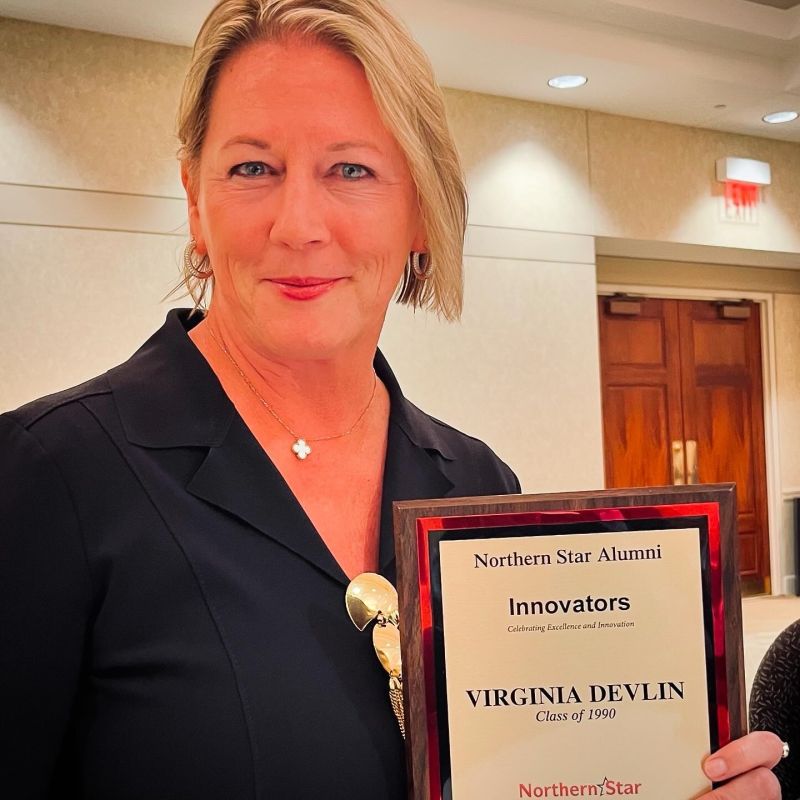
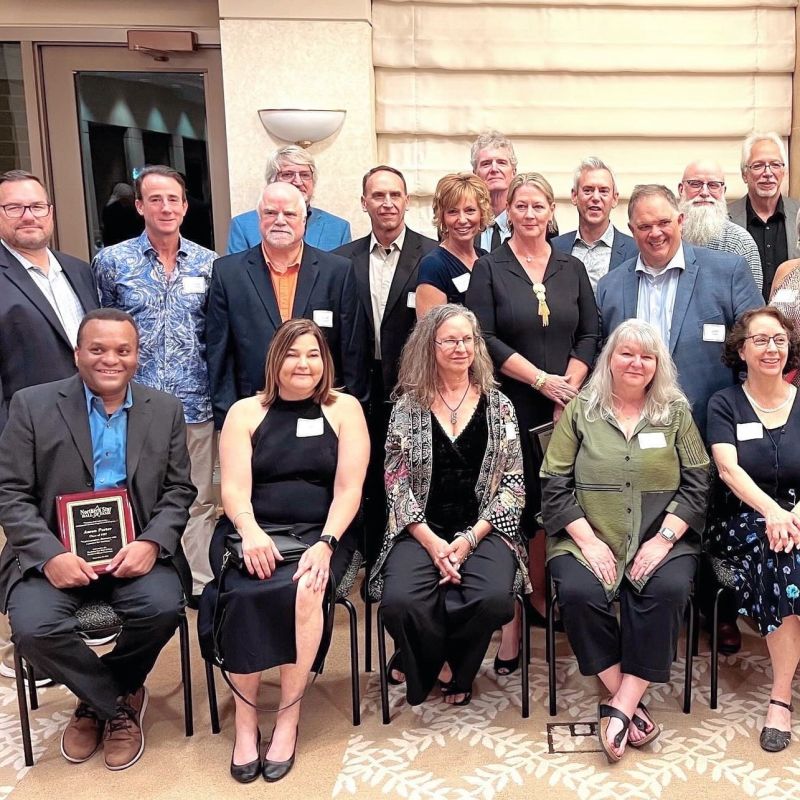
Her departure from Current Global came with a cluster of recognitions. Communication Leaders of Chicago gave her its 2024 Career Service Award. The Publicity Club of Chicago honored her with its Lifetime Achievement Award at the October 16 Golden Trumpet ceremony. In September, she returned to Northern Illinois University and received an award from the Northern Star alumni community.
That last return brings the career back to a working student newsroom. Devlin credited the newspaper with teaching skills that guided her public relations career. In the photograph she shared, she holds a framed Innovators award identifying her as Class of 1990. The distance between a student paper and an agency leadership role is considerable. The interest in making something people will read is recognizably the same.
The next client has a payroll
Prosper Group gives Devlin a different kind of client relationship. Its team includes former agency owners and leaders advising people who face the decisions they once faced themselves. Her colleagues include managing partner Alex Halbur and M&A practice leader David Bosses. Her contribution includes business differentiation, growth, financial management, client service and culture. Prosper’s biography describes the agency she built as a $40 million business.
Her Boarderline advisory profile makes the conversations more specific. Is a leadership structure working? Is a brand’s position distinct enough? Can financial practices produce better profit? How should an owner prepare for a possible sale? These are questions that rarely have a clever slogan for an answer. They call for someone willing to examine the business underneath the presentation.
She has also expressed a wish to help more women who own and lead agencies. Away from advisory work, her interests include traveling, gardening and cooking. After retiring, she described taking classes at the Chicago Mosaic School. There is something pleasing about a communications executive returning to a practice in which the pieces must actually fit.
In announcing her retirement, Devlin thanked the colleagues who had shaped Current Global, including people who had moved on. That is a fitting way to understand an agency founder’s influence. Some of the work remains in campaigns and client relationships. Some travels with the people who learned to do it. Her next brief is to help other leaders build places where that can happen.