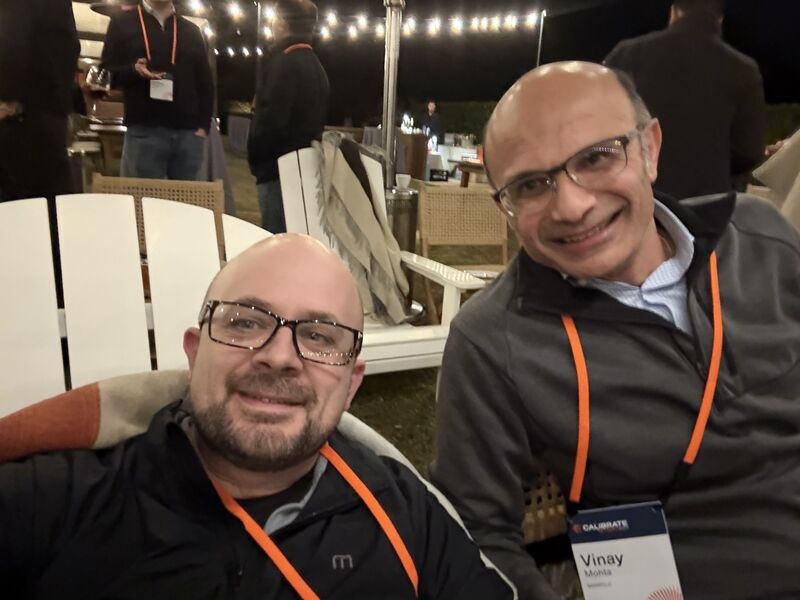
At a founders’ retreat, Brad Porter took a selfie with Vinay Seth Mohta. There were conference lanyards, outdoor chairs and a familiar face. Porter’s accompanying memory reached back to MIT, where he, Vinay and Vivek Mohta had spent late nights working through problem sets. By the time of the photograph, the subjects had companies to build and people to lead. The old assignment had been replaced by rather longer ones.
Mohta thanked the retreat’s hosts and said he valued meeting founders at different stages of company building. It is an unceremonious place to begin a CEO’s story. It also reveals something a list of appointments can miss: a working life has people running through it, sometimes for decades. His career makes more sense when those people are allowed into the picture.
A good place to learn what work feels like
Mohta studied at MIT, earning undergraduate and master’s degrees before entering a career in software. His early work included MathWorks, whose tools serve scientific computation and engineering. He later described catching the startup bug in the late 1990s. The phrase carries the lightness of a remembered decision. The years that followed gave it weight: architecture, product work, customers, founding teams and eventually the chief executive’s chair.
Endeca was his second job out of school. Looking back, his first reaction sounded delightfully uncomplicated: “this is fun, work is fun.” There is an entire genre of founder biography in which every early job becomes an ordeal nobly endured. Mohta’s version permits enjoyment. It makes room for the possibility that interesting problems and a market moving quickly can turn work into something a person actually wants to do.
In retrospect, he understood the experience as a vivid encounter with product-market fit. He said he had rarely felt it again at the same velocity. That distinction matters. The young employee had experienced momentum; the older founder could recognize its conditions. Memory had become a reference point. When a product is being pulled into use, the sensation can stay with its builders long after the company itself has moved on.
When someone else’s career rides on your code
Between 2000 and 2006, Mohta’s Endeca work moved from software architecture and development into new market development. The progression placed him on both sides of a consequential conversation: what the system could do, and what someone might need it to do. Enterprise software brings those questions together under pressure. The people buying it have jobs, budgets and colleagues awaiting results. Their interest in the architecture usually has a practical destination.
“I learned the human side of buying and building products.”
Vinay Seth Mohta, reflecting on Endeca
His recollection of Endeca includes customers running their businesses on the platform. Their careers, to some extent, depended on it. He also remembered getting prototypes into the field quickly and learning what resonated. He called it his first customer development experience and said he had repeated the pattern throughout his career. The customer was present before the finished product, while there was still time to alter it.
There is a useful tension in those memories. People need dependable systems. Builders need opportunities to learn. A prototype lets the conversation begin, but reliance changes the terms of the relationship. The obligation grows with use. An elegant technical answer still has to survive somebody’s working Tuesday.
His name also appears among the inventors of an Endeca patent on retrieving information from object collections with complex interrelationships. The official record makes a plain connection to his engineering past. Searching and navigating relationships were concrete technical problems he helped work on, before leading a company became his main public role.
- MathWorksScientific computing software
- EndecaArchitecture, search and new markets
- KAYAKPredictive marketing analytics
- KyruusCo-founder and CTO
- ManifoldCo-founder and CEO
The question behind the marketing budget
At KAYAK, Mohta worked on a predictive analytics platform to measure the impact of multi-channel marketing. A travel company provides a different setting for the same broad interest in data and action. Here the question was tied to marketing effort: how could the company understand the effects of what it was doing? His role joined technical development to a business question with money and decisions attached.
The work also helps explain why his career resists a tidy division between engineering and business. Software architecture and product management ask for different kinds of attention. A person moving between them has to deal with both the mechanics of a system and the reasons someone wants it. Neither side can simply hand the other a finished answer.
He went on to co-found Kyruus, serving as chief technology officer and chief information security officer. Those titles put product building alongside responsibility for the conditions under which information could be used. In his later description of his career, Mohta placed himself at the intersection of business and technology. The phrase is common enough; his earlier jobs give it a specific history. He had written and designed software, then taken on work that required understanding the organization around it.
A company arrives in Newton
Manifold began in 2016 as an applied AI lab. Its present biographies identify Mohta as co-founder and CEO. A contemporary company announcement supplies a more precise date for the executive appointment: November 2017. The following October, Manifold announced a new office in Newton, Massachusetts, after expanding from its Oakland headquarters. Mohta was leading the company and its Boston-area office.
That early Manifold operated as an AI engineering services firm. In 2018, it reported tripling its team and doubling its office footprint. The announcement emphasized the connections its engineers, advisers and leadership had to MIT and Harvard. It was putting people together to deliver work for clients, with an East Coast base close to an established pool of technical talent. The company’s later platform story had a services chapter before it.
By December 2025, Manifold announced an $18 million Series B led by Reach Capital, joined by SilverArc Capital, Industry Ventures, TQ Ventures and Calibrate Ventures. The company put its total capital raised at $40 million. Those are company financing figures, with the usual work of hiring, building and delivering still ahead of them. A round gives a founder more capacity. It also gives the next set of decisions a larger audience.
Led by Reach Capital. Company financing, announced December 18, 2025.
Keep the thread, keep the people
In an early interview about machine learning products, Mohta wanted executives to ease up on the “pixie dust.” His account of Lean AI connected understanding the business, understanding the data, engineering, modeling and putting work in front of users. It treated learning as something that continued through a project. Data could change what was possible; feedback could change what was worth making.
That approach has an everyday appeal. A company may begin with a vision, but the available information and the people using the product get a vote. His explanation kept those realities close to the engineering. It is an account of building with questions still open, while trying to expose risks early enough to do something about them.
His more recent writing follows the coordination problem. In December 2025, he described the costs of specialization: work waiting for people who understand several domains, and context deteriorating as a question passes between them. At Manifold, his proposed response brings organizational data, tools and institutional knowledge into the working environment. The ambition reaches beyond an individual completing a task faster. It concerns the handoffs around that task.
After a February 2026 industry event, he picked up a fellow panelist’s idea of team flow: people collaborating with AI while preserving a shared understanding of the project. He also discussed narrowly scoped agents, human decisions and the move from experiments into production. His June Agent OS announcement returned to controls and verifiability. The questions have become more organizational as the tools have changed.
The return to Kendall Square
Cambridge gives this story a geography. Mohta has described Manifold splitting time between Kendall Square and its Newton office. MIT and early Endeca are part of his memory of the area. “It has felt like coming home, really,” he wrote. His enthusiasm included a practical intention: gathering vertical platform founders more regularly near Kendall Square.
The proposed gathering is a small action beside the scale of an AI platform. It belongs in the story all the same. A person whose career has passed through several companies can still find value in a room where other builders compare experiences. The retreat photograph shows an older version of the same connection: classmates with new problems, catching up.
Mohta’s public career now comes with funding announcements and product launches. Underneath them, the customer conversations remain legible. So do the colleagues, the prototypes and the places where he learned to work. The human side of the machine has occupied him for years. In Cambridge, he is making time to talk about it again.