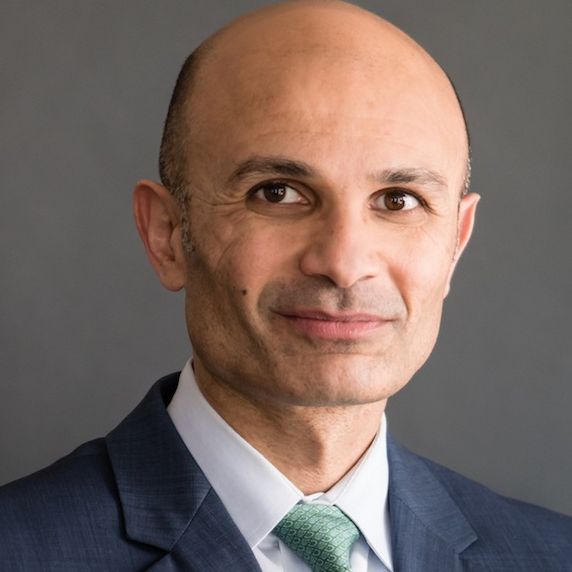
A drug takes a decade. He thinks that is a software bug.
Vinay Seth Mohta has a number he repeats until it sticks: ten times faster, ten times cheaper. Not for a feature. For the entire machinery of clinical research.
Most people who run an AI company in 2026 talk about models. Mohta talks about a button. His test for whether a machine learning system is worth building is almost rude in its simplicity: "If at the end of the day somebody's not pushing a button differently because of your model or pulling the leverage differently because of your model, it really doesn't matter that you built it in the first place." That is the whole philosophy. Build the thing that changes what a human does next, or do not build it.
He runs Manifold, a vertical AI platform for life sciences headquartered in the Boston metro area. The pitch sounds grand until you hear how he frames the problem, which is when it gets specific and a little bleak. Drug development, he points out, has been getting worse for decades. More money, more scientists, more compute - and fewer FDA approvals per dollar spent. Economists gave the pattern a name by spelling Moore's Law backwards: Eroom's Law. Mohta builds his company against it.
Eroom's Law, in one picture
His diagnosis is the part worth holding onto, because it is contrarian. "This isn't a scientific problem," he says. "This is a structural problem." The science, in his telling, is not the bottleneck. The bottleneck is everything around the science - the data scattered across institutions, the value chain that runs from target identification to the clinic, the handoffs between experts who cannot quite execute what they intend. He has a phrase for that last gap: the Life Sciences Chasm, the distance between what a domain expert wants to do and the technical work required to actually do it. Manifold's products are bridges across that chasm.
"Every delay in developing a new medicine is measured in lives."
From MATLAB to the medicine chasm
The career reads like a slow zoom out. Mohta started at MathWorks - the company behind MATLAB - doing scientific computation, about as deep in the engineering weeds as a job gets. By the late 1990s he had caught the startup bug. He landed on the early team at Endeca Technologies, where he worked on the data structures and indexing behind search and faceted navigation, and where he is a co-inventor on several granted patents. Endeca was eventually acquired by Oracle. That is the first pattern in his story: get in early, build the unglamorous infrastructure, watch it matter.
Then he did it again with stakes attached to people. He co-founded Kyruus and served as its CTO, building a data-driven platform that matches patients with the right physicians - now one of the leading care-access systems serving the largest health systems in the United States. Healthcare got into his bloodstream there. The lesson he carried out was not about algorithms. It was about whether anyone changes their behavior because of what you built.
Across all of it he describes a single trajectory: starting "very technical" and migrating, decade by decade, to the seam between business and technology. He is the rare founder who can read a model's confusion matrix and a customer's org chart with equal fluency, and he treats both as engineering problems.
"Dial back a little bit on the enthusiasm and the pixie dust aspect of AI and really start thinking about it more like a tool."
Lean AI, or the art of not believing your own hype
Manifold began in 2016, not as a product company but as an AI lab. Several co-founders trace back to MIT, and the founding idea was almost a temperament: an AI lab that is pragmatic, that takes research and drags it into application instead of leaving it in a paper. Out of that consulting era came a method Mohta named Lean AI - a feedback loop between business understanding, data understanding, and engineering. The trick inside it is to bring domain experts into the data conversation early, because, as he puts it, "team members who have domain knowledge also have pretty good intuition of what the data should show." The model becomes a shared decision, not a black box handed over a wall.
What is interesting is the restraint. In an era where every deck promises magic, Mohta's signature move is to deflate the magic - to insist that AI is a set of tools that enables new capabilities inside ordinary product development. The pixie dust line is not modesty. It is a filter. It is how you avoid building models nobody pushes a button for.
By 2024 the lab had become a platform. Manifold raised a $15M Series A and launched its AI-powered system for clinical research, with the stated goal of standing up and running clinical and epidemiology studies an order of magnitude faster and cheaper. "Our goal, big picture, is to make it 10 times cheaper and 10 times faster to stand up clinical studies, run clinical studies, and run epidemiology studies," he said. The platform stretches across cohort exploration, data analysis, collaboration, and the governance that life sciences demands and most consumer AI ignores.
The Series B, and what comes next
In December 2025 the company raised an $18M Series B led by Reach Capital, with SilverArc Capital and Industry Ventures joining existing backers TQ Ventures and Calibrate Ventures. Total funding reached roughly $40M, and the framing sharpened: Manifold now describes itself as defining vertical AI for life sciences - domain-specific intelligence rather than a general-purpose chatbot pointed at a hard industry. The roadmap runs three ways at once: extend an Agent OS from biomarker discovery through real-world evidence, deepen cross-organizational collaboration with the governance regulators expect, and grow a data ecosystem whose value compounds with the network.
"This isn't a scientific problem. This is a structural problem."
"The path forward is acceleration."
Read his sentences and a posture emerges. He is not selling wonder. He is selling compression - the idea that every month shaved off a study is a month sooner that a medicine reaches someone waiting for it. The math is brutal and the motivation is plain. He has spent a career building infrastructure that only matters if someone, somewhere, acts differently because of it. Now the someone is a patient, and the lever is time.
It is a strange place for a MathWorks engineer to end up - holding a stopwatch against the pharmaceutical industry and calling its slowness a structural bug. But that is the through-line. Endeca, Kyruus, Manifold: get in early, build the plumbing, make sure it changes what a human does next. The only thing that escalated was the stakes.
Why "vertical" is the whole bet
The word Manifold keeps reaching for is vertical. Not a general model fine-tuned on the side, but intelligence built for one industry's mess. Life sciences is, in Mohta's framing, uniquely punishing terrain for AI: the data is complex and multimodal, the value chain runs absurdly long - from target identification to clinical development to market access to precision medicine at the bedside - and the work crosses organizational boundaries that most software pretends do not exist. A model that ignores governance, lineage, and access control is a non-starter in a field where a regulator can ask exactly how a number was produced. So Manifold builds the boring guarantees in alongside the clever parts.
That is why the product is described less as a chatbot and more as an agent platform - an Agent OS, in the company's language, that spans cohort exploration, data analysis, collaboration, and the governance the industry requires. The thesis underneath the Series B is that this gets better the more it is used: a data ecosystem whose value compounds through network effects, where each new institution and dataset makes the next collaboration easier. It is the Endeca lesson again - indexing and structure as the quiet engine - pointed at biology instead of e-commerce search.
None of this works if the people inside pharma do not trust it, which loops back to the button. Mohta's whole career argues that adoption is the only metric that survives contact with reality. A brilliant model nobody acts on is a rounding error. A modest one that changes a decision is the entire point. He has built search infrastructure that got acquired, a care-access platform that serves the country's largest health systems, and now a research platform whose success is measured in how many studies move faster. The tools changed. The question never did: did anyone, anywhere, pull the lever differently because of what you made?
For now the scoreboard is funding rounds and roadmaps, which is the wrong unit and he knows it. The real scoreboard is a calendar - the day a study opens, the day evidence lands, the day a treatment clears the chasm and reaches a person who was running out of time. That is the number Mohta is actually playing for, and it is the one nobody gets to round up.
Five things that fit on an index card
Two MIT degrees in the same field - an S.B. and an M.Eng. in electrical engineering and computer science.
His first job was at MathWorks, the company behind MATLAB. He started in the equations, not the boardroom.
He is a named inventor on several granted patents from his Endeca days - search and faceted navigation.
He coined an in-house method, "Lean AI," before Manifold was even a product company.
His personal handle, @vinaysethmohta, is separate from the company's @manifold_ai - the founder keeps his own line.