A person in Mumbai can spend the morning inside an American company’s software, order lunch through another, and finish the evening watching a third company’s television show. Becoming a customer requires almost no thought. Becoming a shareholder has historically required rather more. Vested Finance grew out of that awkward difference: a global consumer economy paired with investment accounts that stopped at the border.
- US shares, ETFs, global funds and managed portfolios for Indians and NRIs.
- Fractional US investing starts at $1; moving money and trading still carry costs.
- The useful idea: solve the paperwork around the purchase, too.
The border was in the workflow
In a 2020 interview, co-founder Viram Shah described a shared frustration among three Berkeley students. Shah, Darwin Arifin and Eric Huynh came from different countries, but their savings back home faced the same geographical concentration. The companies they knew were international. Their portfolios were local. Vested, founded in 2018 and launched for investors in 2019, approached the mismatch as a practical design problem.
Shah had worked in investment banking at J.P. Morgan before his Berkeley MBA. The opportunity demanded more than a screen with familiar stock symbols. An Indian customer needed an overseas account, a way to fund it and help understanding unfamiliar reporting requirements. Vested’s early proposition bundled paperless onboarding, fractional shares, investment information and Indian tax support. The stock purchase was one step in a longer sequence.

The dull steps do the heavy lifting
A useful way to understand Vested is to follow the money. The customer completes identity checks, opens an account and transfers funds. Then comes the investment decision. Later come dividends, sales, withdrawals and tax records. Every handoff can introduce uncertainty. A product that makes only the buy button pleasant has left much of the job unfinished.
“One of the biggest bottlenecks in the U.S. investing journey currently is the fund transfer process.”
Viram Shah · TechGraph interview · July 2020
The underlying machinery has several owners. VF Securities provides brokerage services; Vested Finance supplies investment advisory services. DriveWealth supplies clearing and custody infrastructure. Bank relationships help customers fund accounts. Those distinctions explain why an app can feel like one service while a transfer problem involves more than one institution.
- 01Verify
- 02Transfer
- 03Invest
- 04Report & return
For a customer, the appeal is coordination: recurring investments, portfolio information and downloadable tax documents in the same workflow. For an NRI, Vested also advertises account continuity on returning to India. The competition includes INDmoney, Appreciate and international brokers such as Interactive Brokers. Vested’s positioning rests on making this particular cross-border journey understandable, rather than on exclusive access to American shares.
Free has a price list
The business has changed since early descriptions of commission-free investing. Its current India pricing lists a Basic plan without a subscription charge and a Premium plan. US stock and ETF brokerage is 0.25% per trade on Basic and 0.15% on Premium, with a $35 maximum on either. A free account, in other words, can still generate a trading bill.
Illustrative brokerage only. Premium subscription, foreign exchange, transfer charges and other applicable costs excluded.
Managed Portfolios add another model: the public product page lists annual advisory fees of 0.6%-1% of assets. Underlying fund expenses can also matter. Vested’s relationship summary discloses additional revenue sources, including bank revenue sharing, payment for order flow, securities lending and cash management. The convenience has an economic structure, and understanding it requires looking beyond the headline commission.
The company itself needed capital to build that structure. It raised a $3.6 million seed round in 2021, followed by a $12 million Series A led by Ayon Capital in April 2022. Its announcement reported more than $250 million in transactions during 2021. Transaction volume describes activity passing through the platform; it is a different measure from company revenue.
Distribution matters as much as software. Vested also reaches customers through established Indian financial firms, including HDFC Securities, Axis Securities and Angel One. For a customer who already has a brokerage relationship, overseas investing can arrive through a familiar doorway. For Vested, those relationships offer another route to customers alongside its own app.
Access became a bigger question
Once someone can buy a US stock, a second problem appears: what should the portfolio contain? Vested’s range now spans individual stocks and ETFs, managed portfolios, global funds and selected private-market opportunities. These serve different purposes. A basket built around a theme can still concentrate risk. A private-market fund brings a different liquidity question from an exchange-traded share.
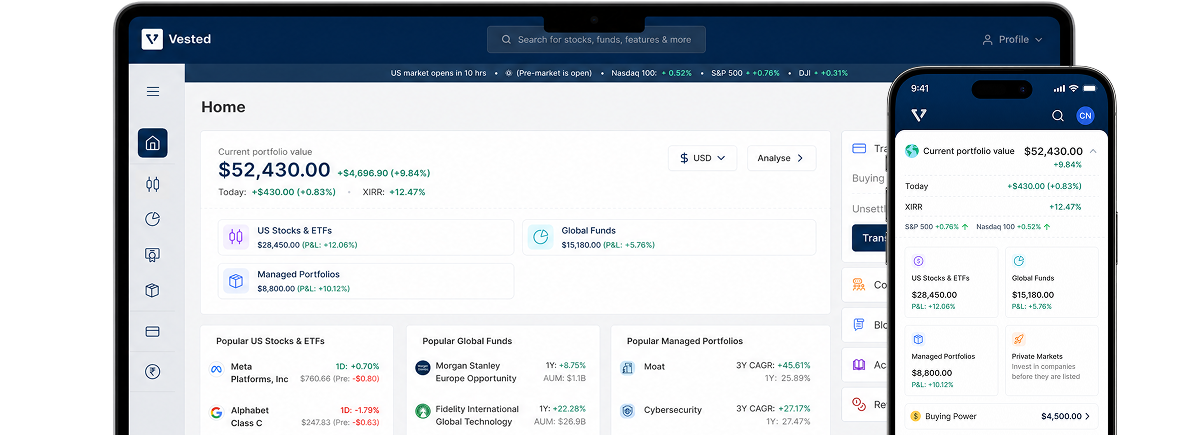
Global Funds makes the shift particularly visible. Vested offers Europe-domiciled UCITS funds from international managers, giving customers another route across markets and strategies. In March 2026, it introduced recurring investments for the product after customers requested a systematic alternative to manual orders. That announcement put participation at close to 5,000 investors since the December 2025 launch. The feedback concerned how people invested, as well as what they could buy.
The scale is meaningful, with an important qualification. Vested’s India website reports more than 400,000 Indian investors and over ₹10,000 crore in assets under administration as of June 2026. Those are company-reported figures. Assets under administration describe the money serviced through the platform; they do not tell us how many customers trade regularly or how profitable the business is.
The organization reflects the cross-border task. Its 2022 funding announcement described a team spread across India, the United States and Canada. Banking, regulation and customer service have to meet across those locations, just as they do inside the product.
Build the return journey, too
The friction has not vanished. In a May 2025 community discussion, a Vested representative acknowledged a bank-account linking difficulty and said the case had been escalated to a partner. That narrow incident illustrates the dependence: interfaces can simplify a chain of institutions without controlling every link.
There is a useful lesson here for anyone building a service. Map the complete customer task, including the boring steps and the exit. Vested’s expansion suggests customers eventually want portfolio construction alongside access. But the proposition has limits: foreign exchange can alter returns, fees weigh on small transfers, and buying several familiar technology stocks can preserve concentration. Easier access works best when the investor understands the exposure being purchased. A border crossed is the beginning of that decision.