A clot is an awkward passenger. The physician has to reach it through a vessel, catch it, and bring it back without leaving pieces farther downstream. Some clots are soft. Others are stubborn, dense with fibrin, or lodged in anatomy that gives a catheter little room to negotiate. The word “removal” conceals a sequence of chances for the clot to slip away.
The short version
- Vesalio makes retrieval devices for clots in the brain, heart and peripheral arteries.
- Its signature design uses open pockets, called Drop Zones, to catch clot inside an expandable mesh.
- A randomized 2026 coronary trial reported less heart-muscle injury on its primary measure in a selected patient group.
- The company says its devices have been used in more than 20,000 patients across more than 60 countries.
Arthur J. Ulm, an endovascular neurosurgeon, began working on the technology in 2013. The company dates its founding to 2017, the year Steve Rybka joined as its first full-time employee. That distinction matters. Inventing a device and building a medical-device company are separate undertakings. Rybka’s account of the early years includes establishing a quality system, gaining European approvals, securing U.S. study permissions, raising capital and assembling a team. A clever piece of metal still needs a factory, evidence and physicians willing to use it.
The pocket, not the hook
Vesalio’s NeVa stroke retriever looks like a tiny expandable scaffold. Its unusual feature is a series of large open pockets in the mesh, offset at 90 degrees. The company calls them Drop Zones. As the device expands inside a blocked vessel, a clot can enter one of these openings and sit within the scaffold during withdrawal. NeVa NET adds a fine braided filter at the far tip, meant to catch fragments that might otherwise travel into smaller brain vessels.
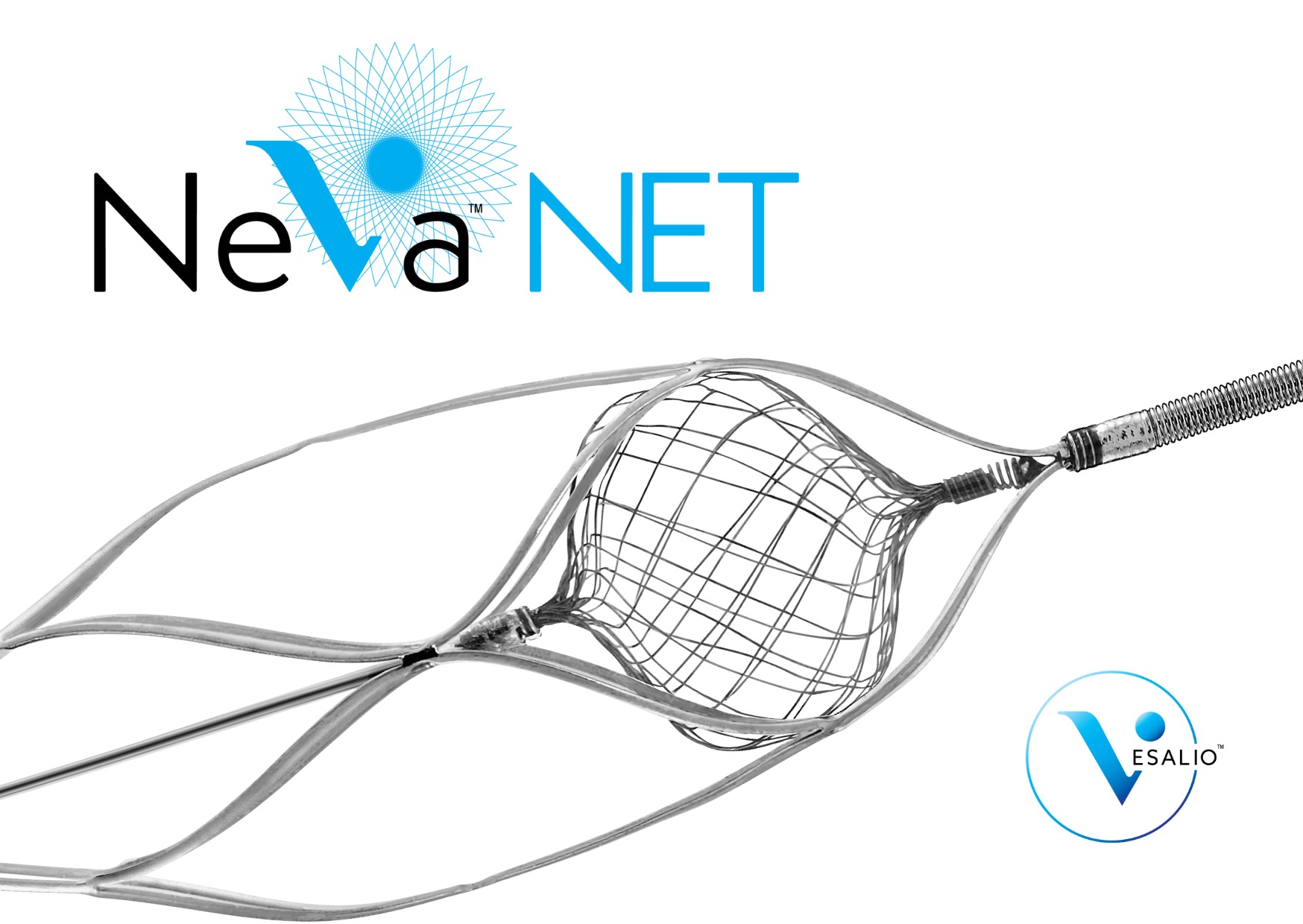
The design targets a practical failure: a stroke team may open a large blocked artery yet still face extra passes or fragments that escape into new territory. One successful pass can shorten a procedure, but the precise clinical gain depends on the patient, the vessel, the clot and the care around the device. The company says many older devices were adapted from other uses and struggled with organized clots. Vesalio’s CLEAR study, a prospective single-arm investigation, enrolled 139 patients at 25 centers. In its 107-patient primary analysis group, 73.8% achieved at least eTICI 2b reperfusion after the first NeVa pass. That is a measure of restored blood flow, not a promise for every patient.
CLEAR was a single-arm study. Its first-pass figure describes the analyzed patients and does not establish that NeVa outperforms every alternative in routine care.
This is where product language can outrun evidence. NeVa and NeVa NET are CE-marked, but Vesalio says they are not currently cleared for U.S. stroke use. NeVa VS, despite its similar name, addresses a different problem: vasospasm, a severe narrowing that can follow a ruptured brain aneurysm. It has U.S. approval under a humanitarian device exemption for a specific group of adults after other medical treatment has been exhausted. The FDA pathway rests on probable benefit; the device labeling says effectiveness for that use has not been demonstrated.
A family resemblance across three vessels
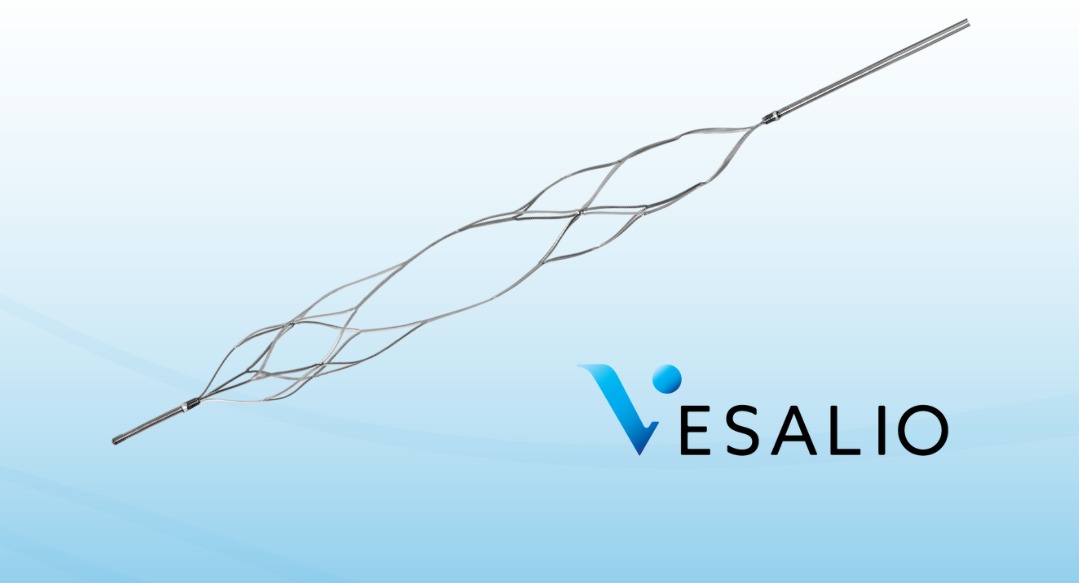
The company’s next bet was that the pocket could travel. In the heart, enVast uses a stent-based retriever to engage coronary clot. In the limbs, pVasc removes thrombi and emboli from peripheral arteries. The anatomy and medical decisions are different, so each product has its own indication and evidence. The family resemblance is mechanical: expand, engage, retain, retrieve. In August 2026, Vesalio received FDA clearance for pVasc NET, which adds a fine-pore distal filter to its peripheral device.
The peripheral line is instructive for the business as well as the engineering. Vesalio says pVasc needs no capital equipment. A hospital can evaluate the device without first buying a dedicated console, although it still needs trained specialists, imaging and the rest of an endovascular service. A U.S. territory-manager posting spells out the less photogenic work behind adoption: opening hospital accounts, guiding value-analysis reviews, training physicians and teams, and supporting cases. The customers are specialist clinicians; the buyers are healthcare institutions. The company earns from regulated devices used in procedures. It has not published device pricing, so there is no honest retail cost to quote.
The trial that made the heart case sharper
Coronary thrombectomy has a difficult history. Removing visible clot sounds attractive, but the useful question is whether doing so improves outcomes beyond conventional coronary intervention. Vesalio’s NATURE trial narrowed the question to patients with ST-elevation heart attack and a large thrombus burden. At 11 centers, 154 patients were randomized to enVast-assisted retrieval followed by conventional PCI or to standard care. The trial’s primary endpoint was infarct size measured through the area under the curve of CK-MB, a blood marker of heart-muscle injury.
In August 2026, Vesalio reported a nearly 26% reduction on that measure in the enVast arm. Cardiac MRI, a secondary measure, showed a favorable 25% relative trend at day three. There were no strokes or deaths in the enVast arm at 30 days, compared with 1.3% and 2.6% in the control arm, respectively. Those safety counts are small, as one would expect in a trial of this size. The result is meaningful because it is randomized and specific. It concerns a defined high-clot group and an injury measure; it does not establish that every heart-attack patient should receive a retriever. The enVast instructions also exclude use in circumstances such as nickel allergy or vessel tortuosity that prevents device placement.
“The reduction in infarct size demonstrated in NATURE ... represents important new evidence for mechanical thrombectomy in patients with LTB.”Marco Valgimigli, NATURE principal investigator
enVast received U.S. 510(k) clearance in December 2025, after gaining a CE mark in Europe. The trial followed a 61-patient first-in-human experience and gave Vesalio a stronger kind of evidence for its cardiac expansion. It also gives readers a useful rule for interpreting medtech news: ask which patient group, which comparator and which endpoint produced the headline. A device can be promising without becoming universal.
What the first employee had to build
Vesalio is based in Plano, Texas, after moving its headquarters to the Dallas area in 2024. Rybka brought commercial experience; Ulm brought the clinician’s problem and the underlying inventions. The team now includes development and regulatory specialists, sales leaders and an international commercial network. In 2019, the company announced $5 million in investment capital to expand NeVa sales, run clinical studies and add products. Public reporting does not attach a reliable price tag to the invention itself, and the company has not disclosed a valuation or revenue figure.
Its reported reach has grown from more than 12,000 patients in over 50 countries in 2024 to more than 20,000 patients in over 60 countries by August 2026. Those are company-reported cumulative use figures, not a measure of clinical success. Still, they show how far the pocket has traveled. The real lesson is portable: begin with a specific failure that clinicians repeatedly see, design around that failure, then test the design in the setting where it will be used. Vesalio’s story gets interesting each time that last step changes - from a brain vessel to a coronary artery to a peripheral one.