The walker was supposed to make life easier. In a testimonial published by Verio Healthcare, Rod and Val Miller describe waiting two months while another equipment supplier failed to get their mother a walker and a bath chair. Then her insurer switched suppliers. Verio responded in a day; the equipment arrived two days later. A representative named Johnnie set it up and showed her how to use it.
“Mom feels so much more confident now,” they wrote. This is one family’s account, selected by the company, rather than a service audit. But it identifies an interesting unit of value. The transaction ends with someone feeling able to move around her home. A delivered box would have been an incomplete ending.
- The work: home medical equipment, respiratory support and recurring supplies.
- The method: coordinate the order, deliver, set up and teach.
- The customer: patients and caregivers, with health plans often directing the referral.
The person who comes with the walker
Verio’s catalog contains objects whose usefulness is easy to underestimate: shower chairs, transfer benches, walkers, wheelchairs, homecare beds and patient lifts. These are practical answers to practical problems. A bathroom needs to be usable. Getting out of bed needs to be manageable. A patient’s home has to accommodate the equipment prescribed by a healthcare provider.
The company supplies those objects and sends representatives to install them and explain their use. It describes short-term and long-term equipment needs, with support accompanying both. The proposition is a package of goods and assistance. Its market position depends on how reliably the package holds together.
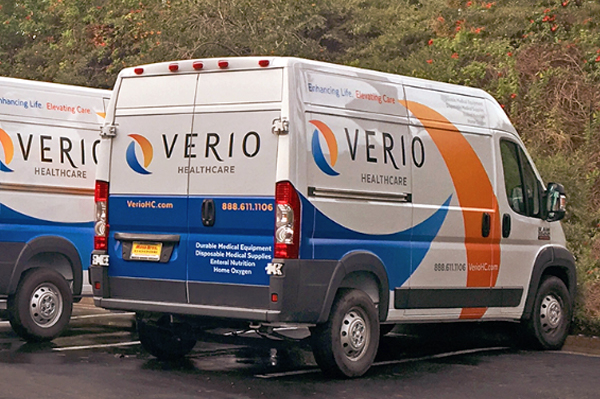
Even the uniform gets a role. Verio says its delivery representatives wear Hawaiian-style shirts to make their arrival feel friendly. Imagine the planning meeting in which someone decided that a tropical print belonged beside medical equipment. It is a small, oddly memorable detail. The company is thinking about the person who opens the door.
The buyer behind the patient
To understand this business, follow the referral. On January 1, 2016, Molina Healthcare of California began using Verio as its default durable medical equipment vendor for San Diego members. A bulletin explained the transition, including the collection of existing equipment and delivery of replacements. Members were being moved through an organized network.
The document also asked the question any family would ask: would the new equipment cost the member anything? Its answer was no. That answer applied to that transition. It says nothing about a universal price today. What it does reveal is a business in which the insurer’s purchasing decision can matter more than a patient’s comparison shopping.
There were boundaries from the beginning. Pediatric enteral supplies were to continue through Rady, and existing vendors could handle items outside Verio’s capitated contract or availability. A referral system needs exceptions as well as a default. For families, the useful first question is whether this supplier handles this equipment under this plan.
- 01Referral
- 02Benefits check
- 03Delivery + setup
- 04Patient instruction
A reading of Verio’s described workflow. The steps are connected; this is not a measured performance chart.
Paperwork before horsepower
Verio offers customized homecare plans and describes expertise in capitation. Its stated processes include checking benefits before delivery, managing supply use and containing costs while following qualification rules. These tasks are less photogenic than a van. They determine whether the van should be dispatched with the requested equipment in the first place.
The relationship has lasted. An October 2, 2025 Molina bulletin calls Verio its capitated provider for respiratory and durable medical equipment services for Medi-Cal members in San Diego County. It directs the network’s referrals to Verio. That is a concrete commercial position: a specified service role inside a health plan’s local network.
Verio also sits within a larger supplier organization. AdaptHealth’s public filings date its acquisition to February 2021, and its subsidiary list for December 2025 still includes Verio Healthcare, Inc. For readers mapping the industry, Verio belongs in home medical equipment provision, with a local operating identity inside a national group.
The instruction is part of the equipment
The respiratory offering makes the service layer particularly visible. Verio lists CPAP and BiPAP equipment, nebulizers, oxygen systems and ventilation management. Its registered respiratory therapists help develop the equipment-related therapy plan, set up devices, train patients and provide continuing support. A machine placed in a bedroom comes with questions that a shipping label cannot answer.
The same attention to fit appears in complex rehabilitation equipment. Verio describes custom manual and power wheelchairs, seating and pediatric mobility products, assessed with clients, families, therapists and other clinicians. Here, suitability involves the person and the setting. The catalog is a starting point for a conversation.
A delivered box would have been an incomplete ending.
Then there are the supplies that need replacing. Verio offers enteral nutrition, ostomy, incontinence, wound and diabetes care products, with home delivery or mail options. Its patient resources include manufacturer videos covering equipment setup, operation and maintenance. The teaching can continue after the representative leaves.
A clock, and an important distinction
Verio publishes a two-hour response target for STAT requests and four hours for urgent requests, and says hospital discharges are treated as STAT. Routine requests are scheduled with patients or caregivers. Those are company-stated service commitments, rather than independently measured results. The distinction matters when a family is organizing a discharge around an expected arrival.
Published company targets for a Patient Care Representative response. Not audited delivery times.
The transferable lesson is to design the handoff as carefully as the product selection. Check eligibility, establish who coordinates the order, explain the equipment and make the next support step clear. That approach depends on suitable equipment, trained people and coverage that fits the request. A friendly shirt cannot resolve an excluded benefit.
Return to the Millers’ story. The first breakdown they describe was waiting for equipment through another supplier. What changed was their insurer’s supplier arrangement; what they remembered afterward was Johnnie’s explanation. Verio’s opportunity is in that interval between an approved order and a patient who feels ready to use what arrived.