The least glamorous workplace problem may also be one of the most expensive: an employee knows the thing they need exists, but not whether it lives in SharePoint, an email, an HR portal, a chat thread or the folder maintained by a colleague who is currently on holiday. Unily built a business around that small daily scavenger hunt. Its software gives large employers one branded front door for news, knowledge, people, applications and conversation. Increasingly, it wants that door to open itself.
This is not a collaboration app in the Slack sense, nor is it merely a prettier skin for Microsoft 365. Unily is an employee-experience layer: a cloud platform that sits above the tools a company already owns, deciding what each worker should see and helping them get to it. Communications teams publish news and campaigns. HR teams organize onboarding and learning journeys. Employees search knowledge, find colleagues, join communities, receive targeted alerts and, on mobile, do it without sitting at a corporate laptop.
The customer list explains the architecture. Shell, British Airways, CVS Health, American Airlines, Wipro, Estée Lauder Companies and Dentsu do not have tidy org charts or one kind of worker. They have shifts, regions, regulatory obligations, local languages and systems accumulated across decades. Unily says it reaches more than six million employees. The product is aimed at organizations from roughly 1,000 to one million people, which is another way of saying that its natural habitat is complexity.
A consultancy discovered its repeatable trick
The company did not begin with an AI agent. Will Saville and Richard Paterson founded BrightStarr in 2005 as a Microsoft-focused digital workplace consultancy. Its teams learned the irritations of SharePoint from the inside: the power was there, but every customer needed design, plumbing and patient translation. By the mid-2010s, BrightStarr had packaged that experience into Unily, then described as an intranet-as-a-service product.
The useful lesson is not “start a consultancy.” It is to notice when the same custom job keeps returning. BrightStarr turned repeated implementation knowledge into software, then let the software cannibalize the parent identity. In 2018, after Unily had passed one million users, the company renamed itself after the product. The new name simplified a muddled sales story: there was one company, one platform and one reason to call.
A Microsoft-centered consultancy begins building digital workplaces.
Recurring SharePoint work becomes a repeatable intranet service.
BrightStarr rebrands as Unily after passing one million users.
Silversmith and Farview back international expansion.
CVC Growth agrees to a majority investment.
Glass and Indi move from announcement to general availability.
Capital followed the focus. In 2019, Silversmith Capital Partners and Farview Equity Partners invested $68 million after Unily reported two consecutive years of 60 percent annual growth. CVC Growth agreed to buy a majority stake in 2021; management and the existing investors stayed involved. The price of that transaction was not disclosed. Neither was a public valuation. Unily remains private, which means its boldest performance numbers mostly arrive through company releases and customer case studies rather than a quarterly filing.
The proof is hiding in 82 seconds
Shell supplies the clearest account of what the old system cost. The energy company wanted one destination for knowledge, applications and communications across more than 80,000 employees in over 70 countries. Time-to-task tests found that common jobs could be completed 82 seconds faster after introducing a searchable Unily launchpad. Shell translated that into more than 3,500 employee hours saved each day and upward of $42 million a year.
British Airways shows what failed first: the channels. Static SharePoint pages and a separate email product could not reliably reach a workforce in terminals, engineering bays and aircraft cabins. The communications team lacked personalization, usable analytics and speed during disruption. BA launched a mobile-friendly Unily workplace in eight weeks, later removed the standalone email tool and says that decision saved £80,000 from day one.
“Rolling out a new platform in just eight weeks is almost unheard of at this scale - but Unily made it possible.”Peter Lyons, Head of Internal Communications, British Airways
The longer result matters more than the launch stunt. BA reports 91 percent monthly use across roughly 40,000 employees, an increase of 30 points in engagement over five years and 85 percent of employees understanding the company vision. When Heathrow suffered a major power outage in 2025, its communications team used page templates, targeting and mobile delivery to publish urgent updates without waiting on IT. It also turned sustainability training into role-based journeys for pilots, cabin crew, engineers and office staff; more than 10,000 colleagues engaged with the program.
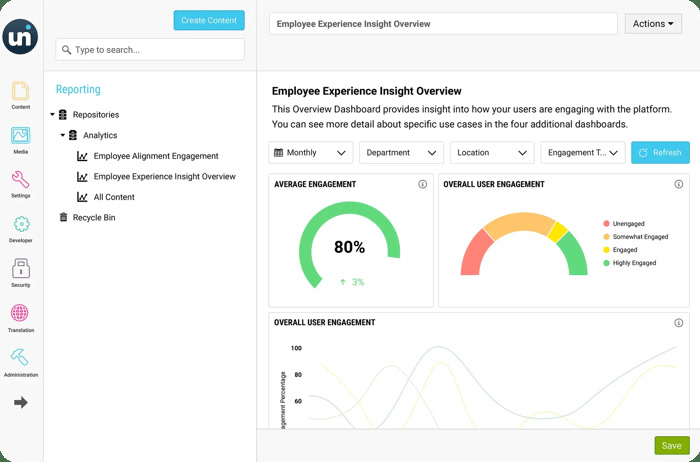
Those stories expose what changed buyers' minds. Neither customer began by craving an “employee experience platform.” Shell timed a recurring task and found a huge aggregate cost. BA audited a tangle of channels and found that the frontline kept losing. Once the inconvenience became a number, the intranet stopped looking like a cosmetic project.
The homepage learns to take action
Unily's next act is called Futures. Announced in October 2025, it has two main characters. Glass is a conversational interface for employees. It searches across Unily and connected systems, synthesizes an answer, then offers the next action: raise a ServiceNow ticket, request leave in Workday, handle an opportunity in Salesforce, inspect an Outlook invite. At launch in March 2026, Unily said Glass supported more than 60 executable actions across Microsoft 365, Google Workspace, Slack and other enterprise applications.
From question to completed task
Indi faces the other side of the screen. A communicator can ask for a safety-week campaign hub or an onboarding destination; specialized agents assemble structure, draft content and apply brand rules, permissions and approval flows. It reached general availability in June 2026 after a pilot with 20 global enterprises, including Johnson & Johnson. The pitch is minutes rather than days for work that used to require a brief, a designer, a builder and several nervous rounds of review.
The key word is governed. Generative text is abundant. A global employer needs to know which model touched which content, who can publish it, which translation is authoritative and whether the result respects local rules. Unily's differentiation is not that it found a chatbot. Every serious rival has AI. It is that the assistant sits on a permissioned content layer with an established publishing system, integrations and analytics.
The early Glass savings figure - more than 15 minutes per employee per day - comes from estimates by participants in Unily's Lighthouse program, not an independent controlled study. Treat it as a hypothesis to test against a buyer's own workflows.
Enterprise depth is an advantage - and a filter
Unily competes in a crowded aisle. Simpplr emphasizes usability; Workvivo leans social; Staffbase is strong in multichannel communications and frontline reach; LumApps spans Google and Microsoft environments; Microsoft Viva and SharePoint are already sitting inside many corporate licenses. Firstup, Interact and Blink frequently appear on the same shortlist. Analyst recognition helps Unily: it says Gartner placed it as a Leader in the intranet packaged-solutions category for three consecutive years through 2025, while Forrester and IDC have also classified it as a Leader in relevant reports.
Its sharper distinction is the combination of deep Microsoft history, a broad content and governance system, mobile reach and a willingness to integrate rather than replace. A company can bring SharePoint, Teams, Outlook, OneDrive, ServiceNow, Workday, Salesforce and Google Workspace into the same experience. That flexibility is valuable when the corporate estate cannot be cleaned up. It also means there is real implementation work.
What does it cost? Unily does not publish a current list price. It quotes according to headcount, capabilities, integrations, deployment and support, with add-ons for products including Glass, Journeys and premium services. There is no self-serve trial. An older UK government marketplace listing put a package at £150,000 per year, but that historic figure is not a current universal price. Buyers should budget for the less visible work too: identity mapping, content migration, governance design, integrations, training and the people who will keep information useful after launch.
Where the model earns its keep
- Global or frontline-heavy workforces
- Many systems and content owners
- Regulatory, security or language complexity
- A team accountable for adoption
Where it gets heavy
- Small, mostly co-located teams
- A simple newsfeed is enough
- No owner for governance or content
- The goal is a cheap, instant rollout
This is where the approach will not travel. A small company with a few dozen desk workers, a clean Google or Microsoft setup and no dedicated communications owner may acquire more platform than problem. The same is true when leadership wants a launch but will not retire duplicate channels, measure tasks or give content owners time. Software can make a single source of truth possible; it cannot make colleagues trust a source that is stale.
The copyable part is not the software
There is a practical Unily playbook hiding beneath the enterprise language. First, measure one irritating journey before buying anything: minutes to find a policy, calls to reset a password, missed frontline updates. Second, choose a narrow launch with an owner and a number. BA used modular templates and a phased rollout; Shell tested time-to-task. Third, make the new front door useful enough to earn the communications audience. People return for a shift detail, HR answer or working link, then see the CEO message.
Finally, automate only after the information underneath is trustworthy. Glass is interesting because it can complete an action, but the action is only as sound as the permissions, integration and policy it invokes. Indi can build a handsome campaign in minutes, but a fast wrong page is merely a more efficient mistake. Governance is not the dull tax on the product. For Unily's customers, it is the product.
That makes Unily's evolution unusually coherent. The consultancy learned how enterprises make a mess. The SaaS platform gave the mess one navigable facade. The AI products now try to spare employees from navigating it at all. The intranet has spent years as somewhere work is announced. Unily's bet is that it can become where the next small piece of work gets finished.