Twenty-two countries is a respectable answer to the question of what you did with your year off. Tyler Moore returned with another answer as well: he wanted to buy and grow a small business. After leading chaos and reliability engineering programs for Amazon Stores, he took a year-long sabbatical, then joined The Brydon Group as a CEO-in-Residence alongside his longtime friend Vivek Chhabria. The next chapter would involve a different sort of system: a company with an owner ready to consider succession or a growth partner.
There is something pleasingly awkward about that sequence. A career in reliability is concerned with keeping things running. A sabbatical requires interrupting the usual schedule. Buying an established business asks what should continue and what should change. Moore’s career brings those questions together without making them look tidy. His announced search began in measurable risk and compliance, under a broader umbrella of business-to-business services supported by technology.
The work before the departure
Moore studied Computer Science and Engineering at The Ohio State University, earning a bachelor’s degree. His work at Amazon took him from software engineering into organizational leadership. At Amazon Stores, he led programs in chaos and reliability engineering, developing capabilities in incident response and preparation for peak demand. Those are jobs whose success often looks suspiciously like nothing happening. The page loads. The purchase completes. Everyone continues with their day.
That apparent ordinariness conceals difficult work. Incident response concerns what happens when a system misbehaves. Peak readiness concerns what happens when demand rises. Both involve more than writing a clever piece of code: someone has to organize the preparation and the response. Moore’s documented remit included both. For a leader moving toward operating businesses, it is a relevant background in the practical business of keeping essential services available.
His account of learning the craft includes a colleague named Josh. Moore recalled joining a team adjacent to Gremlin before the teams merged, and described Josh as an early Amazon mentor. The help was specific: late evenings at Obidos, feedback on code reviews, assistance with heavy on-call workloads, and conversations about design problems. Moore credited those exchanges with much of his engineering foundation. A technical career, in this telling, includes a person who stays to help.
“I owe much of my engineering foundation to Josh.”
Tyler Moore, reflecting on an early Amazon mentor
Code reviews can sound like a minor detail in an executive biography. They deserve their place here. They are where someone else examines a decision closely enough to challenge it, explain a better approach, or ask an inconvenient question. Moore’s recollection gives leadership a modest scale: two colleagues, a demanding workload, and time spent working through the difficult parts. It is more revealing than a list of flattering adjectives.
A rehearsal that has to resemble the crowd
A patent issued on March 24, 2026 provides a concrete example of the engineering problems associated with Moore’s career. He lists it among his patents, and the document names Tyler Lehman Moore as one of six inventors. Assigned to Amazon Technologies, US12587501B1 concerns peak-event testing for content delivery networks: the distributed servers that deliver a website’s content. Its subject is a deceptively simple problem. A simulated crowd can arrive from the wrong places.
The document describes how test traffic generated from a limited number of data centers can concentrate on too few network locations. Real customers are geographically dispersed. A test that funnels requests into nearby delivery points can therefore produce an unrealistic load. The proposed system changes location-related information in DNS queries so that requests reach a wider distribution of delivery points. The rehearsal becomes more representative without requiring changes to the delivery network itself.
The lesson is precise enough to resist becoming a motivational poster. A test is useful when its conditions resemble the thing being tested. More activity alone does not necessarily produce better evidence. That principle belongs to the patent’s technical design; its appeal extends to anyone who has watched a convincing demonstration become less convincing when ordinary people start using it.
A year with the calendar opened up
In May 2025, Moore announced his partnership with Brydon after the year away. He connected the break with considerable reflection about what to build next. The announcement offered to talk with people contemplating sabbaticals about his decision and the opportunities it had opened. Travel was part of the account, but so was the return to work. The year had an ending, and that ending involved a search.
The invitation is a small, useful detail. Career announcements usually present the completed move, neatly wrapped. Moore left room for the uncertain period before it: whether to take time away, what that time might make possible, and how to choose the work that follows. Twenty-two countries makes an attractive statistic. The more interesting question is what to do after putting the passport away.
“what I want to build next”
Tyler Moore, announcing his move to Brydon
A partner who remembers the prom photographs
Chhabria and Moore’s friendship predates their acquisition search. Their shared history includes cross-country races, prom photographs, and helping one another move into college dorms. They acknowledged that becoming business partners required thought: a friendship carries something worth protecting. Their case for working together rested on trust, ability, and the prospect of sharing the difficult stretches as well as the satisfying ones.
The partnership combines Moore’s Amazon experience with Chhabria’s McKinsey background. In their explanation of choosing Brydon, the pair emphasized how sellers should be treated and the value of partners with operating experience. Moore’s less formal details include a preference for black cold brew or an almond-milk cortado from Solid State in New York, and the Spotify playlist “House Focus” for two-to-three-hour work blocks. He also returns to the Acquired podcast. The business search comes with its own soundtrack.
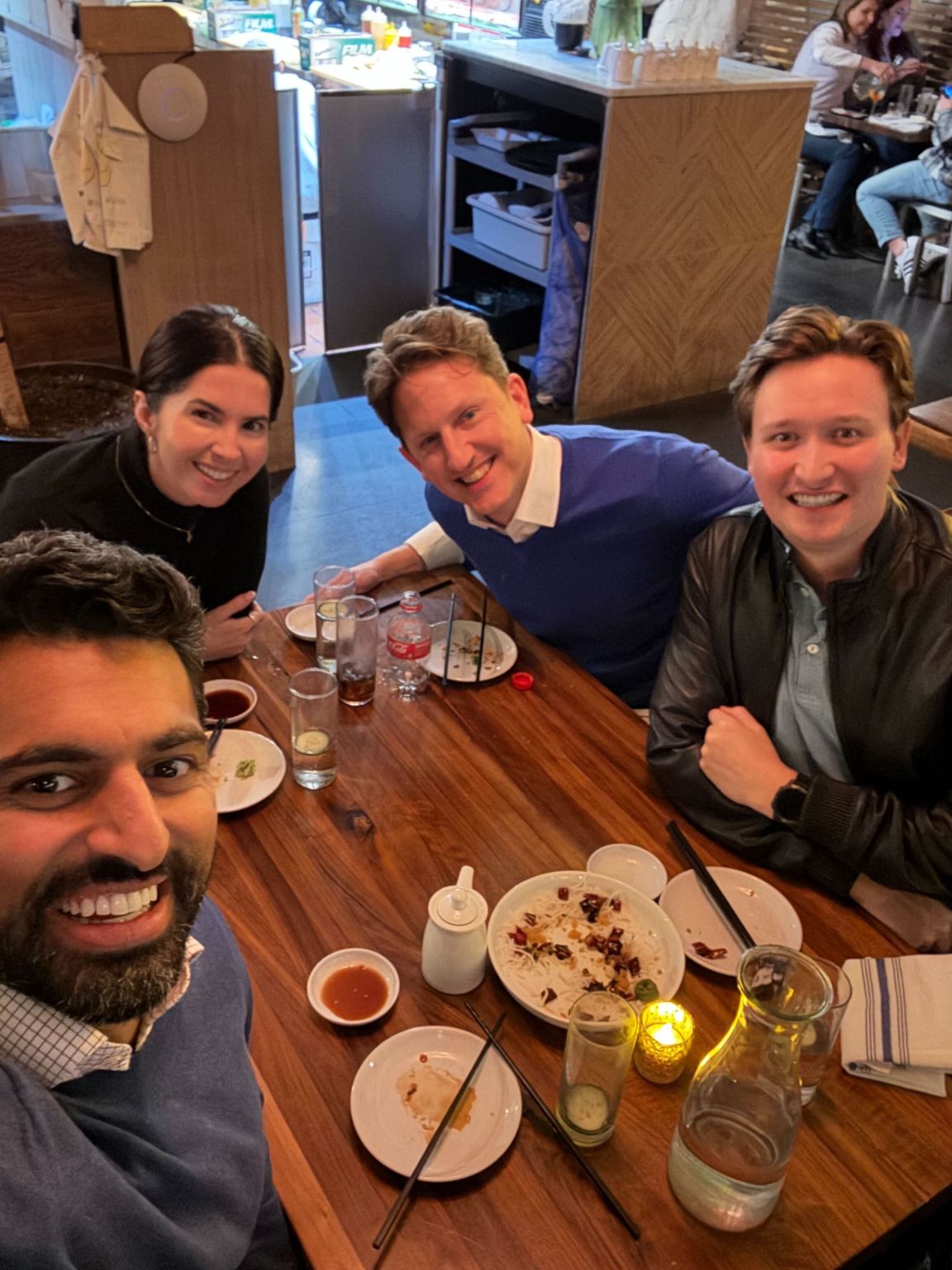
A longstanding friendship gives the story a different starting point from the usual introduction between potential co-founders. Before there was a prospective deal, there were races and moving days. Those experiences do not remove the demands of running a company together. They explain why the two approached the decision with both enthusiasm and some caution. A prom photograph is excellent evidence of familiarity, though a poor substitute for a business plan.
The company already has a first chapter
Entrepreneurship through acquisition begins with an existing business. Moore and Chhabria’s announcement invited conversations with owners considering succession or growth partnerships. That makes the owner’s situation part of the work from the outset. A buyer is considering what the company could become; a seller has spent time making it what it is. Their conversation has to accommodate both versions of the business.
Brydon’s CEO-in-Residence program supplies a structure for that transition into ownership and operations. The firm describes committed capital, compensation during the program, onboarding, operating playbooks, and access to external experts and peers. It targets more than $30 million of equity behind each platform. That is a program target, rather than a personal allocation to Moore. The distinction matters: a prospective operator enters a supported process, while the eventual business still has to be found and assessed.
- FindMeet owners considering succession or growth.
- EvaluateAssess an established business and its operating needs.
- OperateBring leadership to the company’s next chapter.
The program’s training covers sourcing, diligence, and small-business operations. Its model asks people with professional experience to apply that experience to a company they can acquire and run. Moore brings an engineering and organizational background to that prospect. The scale changes from Amazon Stores to smaller businesses, but the operating questions remain concrete: who depends on the service, how the work gets done, and what preparation makes tomorrow easier.
When installing software is only the beginning
By May 2026, Moore and Chhabria were discussing managed service providers with Luis Giraldo on MSP Confidential. The episode examined practical AI applications, advisory relationships, pricing, and transaction readiness. Its published description says the pair were looking to build an MSP platform. These businesses support other companies’ technology needs, placing operational reliability close to the center of the conversation.
The discussion’s published themes include the gap between deploying an AI tool and helping people use it. Training, changes to working practices, and continuing support all belong to that gap. Another theme is the risk of putting hastily built software into important workflows. For an audience of service providers, those are commercial questions as well as technical ones. A tool has to keep working after the presentation ends, and a client needs more than a successful installation.
The episode also considers industry specialization and the challenge of pricing advisory work around measurable results. It is an apt setting for a former reliability leader now exploring business ownership. The recurring problem is how a promise becomes a service someone can depend on. Moore’s next chapter is being pursued with capital backing, an engineering history, and a friend who remembers the earlier chapters. His account of that work even includes a playlist: a small practical detail in a consequential career change.