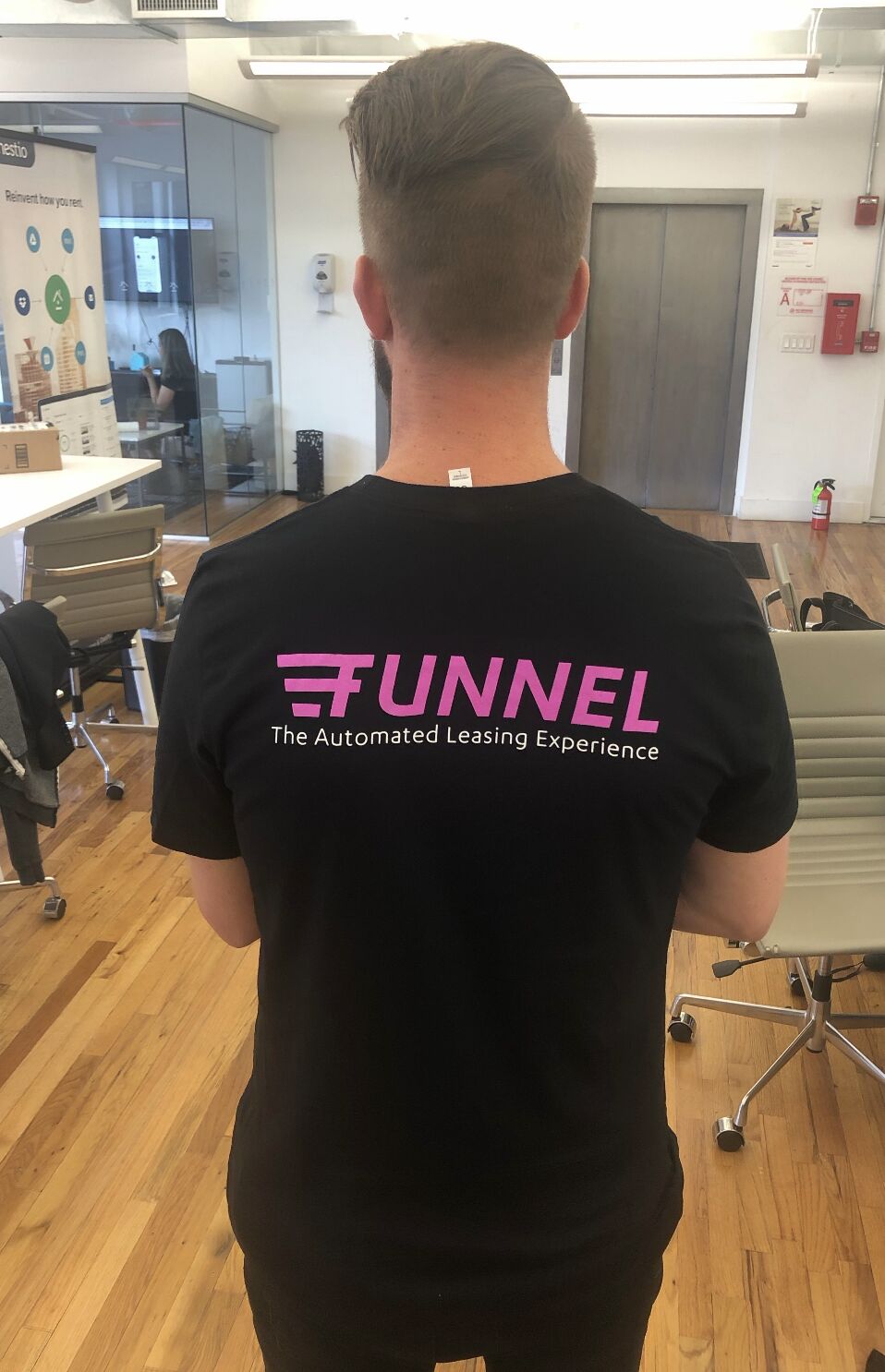
The shirt came before the customers. It was black, plainly cut, and stamped in the sort of pink that refuses to enter a room quietly. On the back sat a promise: “The Automated Leasing Experience.” Tyler Christiansen tried it on in a Manhattan office before the National Apartment Association conference in June 2019. Funnel, the company named across his shoulder blades, then had zero CRM customers, zero apartment units, and zero dollars in recurring revenue. It did, however, have a tagline ambitious enough to require a very straight face.
Seven years later, Christiansen posted the old photograph again. The tag is still sticking out of his collar. A colleague observed that this was the picture’s true finishing touch. The joke improves the artifact. Company origin stories tend to acquire flattering lighting and impossible foresight; here was a CEO preserving the wardrobe malfunction.
The company would eventually become large enough to make the numbers sound faintly unreal. Funnel says its software now powers one in ten professionally managed apartments in the United States. It reported passing $50 million in annual revenue in six years and landing on the 2026 Inc. 5000. Yet the interesting part of Christiansen’s story is not the familiar march from zeros to commas. It is how a practical nuisance became a theory of the apartment business.
A rent check and a billboard
Housing was already in the family. Christiansen did internship work for his father at Wasatch Property Management and spent some time selling single-family homes. At Brigham Young University, where he studied from 2008 to 2012, he captained the men’s soccer team while it competed in the minor leagues of professional soccer. Then, in Utah, he saw a billboard advertising jobs at Property Solutions, the company now known as Entrata.
He had sales experience from working through school. He also knew what it meant to be a renter. Each month, he walked a paper check down to pay the rent. Property Solutions was selling a proposition that sounds quaint only because it worked: let people pay rent online. Christiansen joined in 2012 and found the meeting point between his two interests, housing and technology. “I fell into that and immediately just loved early days of Property Solutions,” he later said.
The sales record was brisk. He was named a rookie of the year, became the top producer of new revenue among a team of 30 sales executives in 2013, and collected President’s Club honors. At The Rainmaker Group, where he learned the language of revenue management, he was named the organization’s top salesperson in 2015. Public biographies describe six years running national sales for a major property-management software company. It was an education in the quiet machinery behind apartment living: payments, pricing, leads, inventory, and all the repetitive work a renter never sees.
“As an entrepreneur, you pull the thread to see where it goes.”Tyler Christiansen
The accidental thesis
In late 2018, Nestio recruited Christiansen as chief revenue officer. The New York company served the city’s brokerage market and wanted to expand nationally. Christiansen spent the next summer in Manhattan learning that business. In June 2019, the team unveiled Funnel, a new brand and product built for the wider multifamily industry.
The first problem looked like an inbox problem. Internet listing services were pouring leads into property systems. Leasing agents faced the same questions again and again: Are pets allowed? When can I tour? What fees apply? More demand had produced more clerical work and, sometimes, less enthusiasm for the prospective renter on the other side. Funnel aimed to organize that traffic, automate follow-up, and give time back to the person at the leasing desk.
Then the architecture revealed a second use. Most apartment software treated the property as the basic unit. Move your search from one community to another and, operationally, you might as well become a new person. Funnel kept a single renter record across a portfolio. That choice made it possible to share leads, information, and labor across multiple buildings. A team no longer had to duplicate every role at every address. People could specialize. Operators could centralize. The product’s data model had begun rearranging the org chart.
A technical choice about identity became permission to redesign the work.
Christiansen is refreshingly candid that this was not the grand insight that started everything. Customers helped the company see it. Many also warned that centralization was a bespoke trick for the largest real-estate investment trusts, not the basis for a scalable company. Funnel chose the opposite wager. Christiansen borrowed Peter Thiel’s language of believing in a secret long enough to build a moat. The secret was that centralized work could matter beyond the giants.
Transformation travels in small steps
Centralization is a cold word for a very human upheaval. A property manager cannot simply buy a login and wake up with a different operating model. Jobs change. Reporting lines move. A specialist might handle applications for several communities while an onsite colleague focuses on tours and resident relationships. Software is the easy part; habit is the stubborn part.
On a 2023 solo podcast, Christiansen described an operations leader who liked the vision of shared services but did not know where to begin. His answer was to stop treating the work as a race or a discrete installation. “It is not a project, it is a transformation,” he said. Apartment companies did not become digital on the morning somebody published a website. They accumulated digital behavior over years. The operating model, in his telling, changes the same way: one useful decision after another.
Christiansen became CEO in 2020. That November, Funnel announced more than $14 million in strategic funding led by RET Ventures. A $32 million Series B-2 followed in 2023. The company grew from about 30 employees when he took the top job to more than 175 by 2026, and Entryway reported that the platform supported more than 1.5 million apartment units across North America.
The growth also acquired a small automatic levy. Christiansen helped establish HOME by Funnel, a nonprofit to which Funnel directs one dollar for every lease completed through its online leasing product. It is philanthropy written like a product rule: use goes up, giving goes up. HOME supports organizations including Entryway, which connects people facing situational homelessness with employment and stable housing. After serving Entryway’s Central Florida advisory group, Christiansen joined its national board in April 2026. His wife, Kari, has volunteered with the organization too.
The AI salesman draws a line
By 2026, Funnel’s original promise of automated leasing no longer looked precocious. It looked crowded. Every software company had discovered AI, usually with a breathless adjective attached. Christiansen’s response was to become more specific and more skeptical. The useful question, he argued, was not how many questions an AI could answer but how much real work it could complete inside a connected system.
In September, Funnel introduced Fenix, a common AI layer across the renter journey, and Funnel Fabric, an open system for connecting outside tools, models, and data. The platform can coordinate communications, analyze portfolio information, and route work between machines and people. Funnel also made an unusually explicit promise for a software vendor: it would not build a property-management ledger and force customers into a closed suite.
At the same time, Christiansen published an essay whose title dismissed completely autonomous property management in two blunt letters. The provocation contains his present strategy. Housing is not a vending machine. A renter may want an answer at ten at night, but a complicated move, complaint, or renewal can require someone with judgment and the willingness to own an outcome. “Technology and humans together outperform either one alone,” he wrote.
“When AI handles workflows and humans focus on high-value interactions, three things happen: teams thrive, renters get a better experience, and the business results follow.”Tyler Christiansen, 2026
There is a useful tension here. Christiansen runs a company that profits when machines do more, yet he argues that the best outcome is not the one with the fewest people. AI supplies speed, memory, consistency, and reach. Humans supply empathy, creativity, local knowledge, and accountability. The hard managerial work lies in deciding where one ends and the other begins. Buying an AI agent is considerably easier than answering that question.
Still pulling the thread
The first Funnel shirt promised automation because automation was the obvious relief for an overwhelmed leasing desk. The company that grew around it now makes a broader promise: connect the renter’s history, let work travel across property lines, give specialized teams better information, and use machines without confusing efficiency for hospitality.
Christiansen’s career has followed the same thread from a paper rent check to online payments, from sales territories to national software, from a New York listings company to a Tampa-area platform. None of those moves required a mystical vision of the future. They required noticing what the existing system made unnecessarily difficult, then refusing to treat that inconvenience as a law of nature.
The tag on the old shirt is funny because it ruins the pose. It is also the right emblem for a company built around unfinished work. The shirt announced the future too early. The product discovered its thesis after launch. The operating model changes by degrees. Even the latest AI arrives with a human hand still firmly on the loop. Neat stories hide those seams. Christiansen’s is better for leaving one visible.