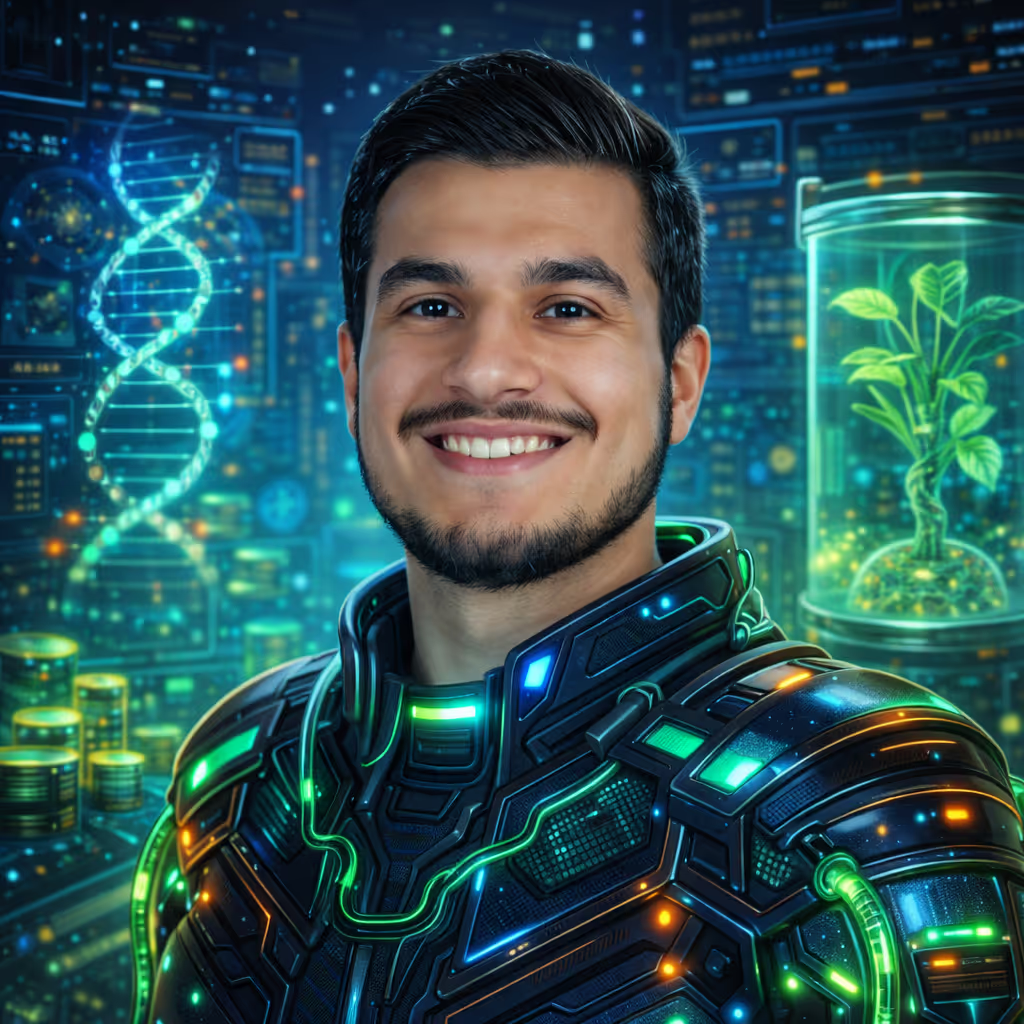
Troy Kanji doesn't fit in a box. He's the analyst at Boost VC who spent his college years pipetting RNA samples in an ALS genetics lab, then pivoted to evaluating cryptocurrency networks, then genomics markets, and now backs everything from human organ testing platforms to portable nuclear reactors. Most venture capitalists pick a lane. Kanji built a highway system.
At Brown University, he wasn't just playing with fruit flies. He was conducting RT-PCR, RNA sequencing, and genetic alignments to understand TDP-43 proteinopathy - the molecular mechanism behind amyotrophic lateral sclerosis. The work required precision. One wrong move, one contaminated sample, and weeks of research evaporated. That same exactitude now guides his investment analysis at Boost VC, where he helps deploy an $87 million fund across 400 deep tech companies.
The transition wasn't linear. After Brown, Kanji tested the waters at Castle Island Ventures, diving into cryptocurrency adoption and DeFi ecosystems - about as far from neuroscience as you can get. Then came F-Prime Capital, where he circled back to biology through the lens of next-generation sequencing markets. Then Trinity Life Sciences, consulting for pharma and biotech companies. Each stop added another lens, another framework, another way of seeing problems.
$87M
Boost VC Fund IV
400+
Portfolio Companies
$300M
Radiant Nuclear Deal
4x
Revalia Bio Growth
The Revalia Gambit
While working at Boost VC, Kanji did something unusual for an analyst - he co-founded a company. Revalia Bio, a Yale spinout, had a provocative thesis: stop testing drugs on mice and start testing them on actual human organs. Not living patients, but deceased donor organs deemed unsuitable for transplant. The kind that would otherwise be discarded.
The problem Revalia tackles is brutal in its simplicity. Ninety percent of drugs fail in clinical trials. They work great in mice, look promising in petri dishes, then catastrophically fail when they hit human biology. What if you could skip the animal models entirely and go straight to human data? What if those organs gathering dust in transplant rejection could become the testing ground for the next generation of therapies?
"I watched the Revalia Bio team transform into world-class operators. Revenue grew 4x last year, and we now have multiple top 10 pharma customers onboard."
Revalia raised $14.5 million in seed funding. Kanji sits on the board, watching scientists execute what sounds like science fiction. Keeping deceased organs alive long enough to run drug trials. Generating data that actually predicts human response. It's exactly the kind of frontier bet that defines his approach to investing - technically ambitious, ethically complex, commercially viable if it works.
Betting on Atoms
When Radiant Nuclear announced its $300 million Series D in late 2025, Troy Kanji was in the middle of it. Boost VC co-led the round alongside Draper Associates, backing a company building one-megawatt nuclear microreactors small enough to ship on a semi-truck. The kind of reactors you could deploy to a remote mining operation, a military base, or a data center in the middle of nowhere.
"Pre-seed and Series D," Kanji posted on LinkedIn, with characteristic brevity. "Insanely pumped." That's the range Boost VC operates in - they'll write $500,000 checks to garage projects and lead $300 million rounds for nuclear startups seven years later. The firm's thesis is simple: back technologies that could make a billion lives better. Nuclear microreactors qualify.
Radiant's bet is helium-cooled reactors using TRISO fuel, ceramic-coated uranium particles designed to withstand extreme temperatures without melting down. The demonstration reactor goes live at Idaho National Laboratory in summer 2026. If it works, it rewrites the economics of remote power generation. If it doesn't, it joins the graveyard of ambitious nuclear projects. Kanji's job is to evaluate which outcome is more likely.
The Multidisciplinary Advantage
Troy Kanji's edge isn't depth in one domain - it's the ability to connect dots across biology, cryptography, genomics, and nuclear physics. When a startup pitches a biological computing platform, he can evaluate both the molecular biology and the market dynamics. When a crypto project claims to solve scientific data sharing, he knows enough about lab workflows to spot the bullshit. Cross-domain fluency is rare. Kanji weaponizes it.
The Career Arc
2019-2023
Conducted research on TDP-43 proteinopathy in ALS-focused Drosophila genetics lab at Brown University, running RT-PCR, RNA-Seq, and sequence alignments
~2021
Investment Analyst Intern at Castle Island Ventures, researching cryptocurrency adoption and DeFi ecosystems
~2022
Investment Analyst Intern at F-Prime Capital, evaluating next generation sequencing market investments and attending entrepreneur pitches
~2023
Associate Consultant at Trinity Life Sciences, contributing to management consulting in the life sciences sector
2024
Joined Boost VC as Analyst, focusing on deep tech investments across biotechnology, nuclear energy, AI platforms, and bio-infrastructure
2024
Co-founded and joined board of Revalia Bio, a Yale spinout revolutionizing drug development with human data trials
2025
Part of Boost VC team that co-led Radiant Nuclear's $300M Series D, one of the largest nuclear energy startup rounds
The Investment Philosophy
Boost VC doesn't do incremental SaaS tools or social media clones. The firm backs what founder Adam Draper calls "frontier bets" - companies building technologies that sound like science fiction. Programmable biology. AI-native drug discovery platforms. Neurotechnology. Regenerative medicine. Bio-infrastructure for scaling health innovation. The portfolio reads like a speculative fiction anthology, except the startups are real and the stakes are commercial.
Kanji's role is to evaluate these moonshots with scientific rigor. Can this team actually deliver on the technical promise? Is the market real or wishful thinking? What's the regulatory path? How long until proof-of-concept? Most importantly - does this technology have a plausible path to making a billion lives better?
Research Background
- TDP-43 proteinopathy studies at Brown
- RT-PCR and RNA sequencing
- Molecular biology, cell biology, biochemistry
- Neurodegenerative disease mechanisms
Investment Focus
- Programmable biology & cellular editing
- AI-native biological discovery
- Neurotechnology & regenerative medicine
- Nuclear energy & bio-infrastructure
Portfolio Highlights
- Revalia Bio (human organ trials)
- Radiant Nuclear (portable reactors)
- 400+ deep tech companies
- Healthcare, aerospace, energy sectors
The Strange Specific
There's a photo of Troy Kanji on the Boost VC website. Standard venture capitalist headshot, except the filename betrays its origin: "ChatGPT Image Jan 15, 2026." Even his professional portrait is generated by AI. It's oddly fitting for someone who straddles the boundary between biology and technology, between atoms and bits.
His LinkedIn bio is two words: "Scientist × Strategist." Not scientist-turned-strategist. The multiplication sign matters. He's both simultaneously, applying laboratory thinking to market analysis, using investment frameworks to evaluate scientific claims. It's a hybrid identity that serves him well in deep tech, where the best deals require understanding both the science and the business.
Based in San Mateo, California, Kanji operates from Boost VC's offices on East 3rd Avenue. He's part of a small team deploying one of the most ambitious venture funds in Silicon Valley. While other VCs chase SaaS metrics and user growth curves, Boost VC backs fusion energy, space travel, genetics moonshots, and ocean technologies. The stuff that takes a decade to validate and could reshape civilization if it works.
The best deep tech investors don't just understand the technology - they've lived it. Kanji pipetted his way through enough failed experiments at Brown to know the difference between ambitious science and delusional science. That pattern recognition is worth more than any MBA.
What's Next
Revalia Bio is scaling. Radiant Nuclear is building its demonstration reactor. Boost VC's Fund IV is deploying across the deep tech landscape. And Troy Kanji is in the middle of all of it, evaluating the next generation of frontier technologies.
The companies he backs today won't exit for a decade. That's the game in deep tech. No quick flips, no SaaS multiples, no growth hacking shortcuts. Just hard science, patient capital, and the belief that breakthrough technologies eventually find their markets. Kanji has the background to evaluate the science and the strategic sense to assess the opportunity. In an industry that rewards specialization, his generalist approach is the edge.
From fruit fly genetics to nuclear microreactors. From cryptocurrency networks to human organ trials. Most people would call that scattered. Troy Kanji calls it Tuesday. And somewhere in that cross-pollination of disciplines is the future of venture capital - multidisciplinary thinkers backing technologies that don't fit in existing categories. Because the biggest opportunities never do.