The founding artifact is almost suspiciously startup-perfect: two friends, beers in Krakow, a pile of planning fatigue and notes scratched onto paper napkins. In 2017, Nick Poggi and Lauren Schneider were midway through a two-week European vacation with friends when they wondered why group travel for young professionals felt so clumsy. They did not come home and buy buses. They built a marketplace.
TrovaTrip's useful insight was that a trip has three distinct jobs. Somebody must gather people who want to travel together. Somebody must know how to move them safely through a country. Somebody must collect money, manage documents, answer anxious questions and keep the whole thing from becoming a group chat with a cancellation policy taped to it. TrovaTrip calls those parties Hosts, Operators and itself. Travelers are the customers moving through the system.
That division sounds obvious only after someone has done it. A yoga teacher can persuade 14 students to go to Bali but probably should not negotiate hotel allotments or audit a local company's crisis plan. A certified Balinese operator can run the itinerary but may not have a creator's audience in Minneapolis. TrovaTrip sits between them with booking pages, surveys, pricing tools, payment processing, traveler support, marketing workflows, document collection and a network of vetted local operators.
The creator is distribution, not decoration
The creator economy is crowded with small products: a sponsor slot, a PDF, a subscription, a T-shirt. TrovaTrip gives a community leader a much larger transaction. A Host chooses an itinerary and dates, shapes the theme, polls the audience, sets a margin, promotes the departure and then joins the group. The Host is neither a celebrity pasted onto a tour nor the operator responsible for the ground logistics. The Host is trusted distribution plus social glue.
Customers can be followers of a photographer, readers of an author, students of a fitness coach, members of a queer outdoor group or regulars at a neighborhood studio. The experience is specific because the group is specific. A stranger may hesitate to book a conventional tour alone; the same person may happily join a week in Costa Rica when the invitation arrives from someone whose work has lived in their phone for three years.
One booking, three kinds of work
The money has a confirmation switch
The cost to a traveler is not one universal subscription or membership. It is the price of a particular trip, built from accommodation, transport within the itinerary, listed meals, activities, guide costs, operator economics, the Host's chosen margin and platform fees. Flights to and from the destination are generally separate. TrovaTrip's own 2025 demand research found a median stated trip budget of $2,000 and an average of $2,955, useful context rather than a company-wide price list.
The revealing mechanism is confirmation. Each departure needs enough bookings by a deadline to become guaranteed. If it misses the threshold, it does not run and the company's stated policy is to refund payments for the unconfirmed trip. Hosts and Operators do not pay upfront to join the marketplace and nobody gets paid until the trip confirms. That puts demand risk in plain view instead of hiding it in a warehouse of unsold seats.
Where $100 of trip revenue goes, on average
Company-reported typical shares; individual departures varyTrovaTrip says roughly 60 percent typically goes to the local Operator, Hosts receive more than 20 percent on average, and the platform earns 15 to 20 percent on average, including a 2.9 percent card transaction fee. The percentages are approximate and can move because Hosts control part of the final price. Raise the margin and potential earnings rise; raise it too far and the community may admire the trip from the comments section.
“The audience survey is a tool for planning the best possible group trip, not a gatekeeper.”TrovaTrip, introducing Trova Unlocked
What failed first was the waiting room
For years, the audience survey was both product and bouncer. TrovaTrip had learned that Hosts collecting at least 100 responses were more likely to sell a trip. The survey asked potential travelers about destinations, dates, activities and budgets. It produced demand intelligence, warmed up the audience and kept weak launches from consuming operator time. For a social creator with reach, it was sensible.
Then the predictor hardened into a rule. A Pilates studio might have 80 fiercely loyal regulars and no appetite for pushing a public survey. An artist might organize through Patreon, a coach through an email list, a small business through people who walk in the door. These communities could be economically real without looking large on social media. The survey had started measuring one kind of readiness and excluding another.
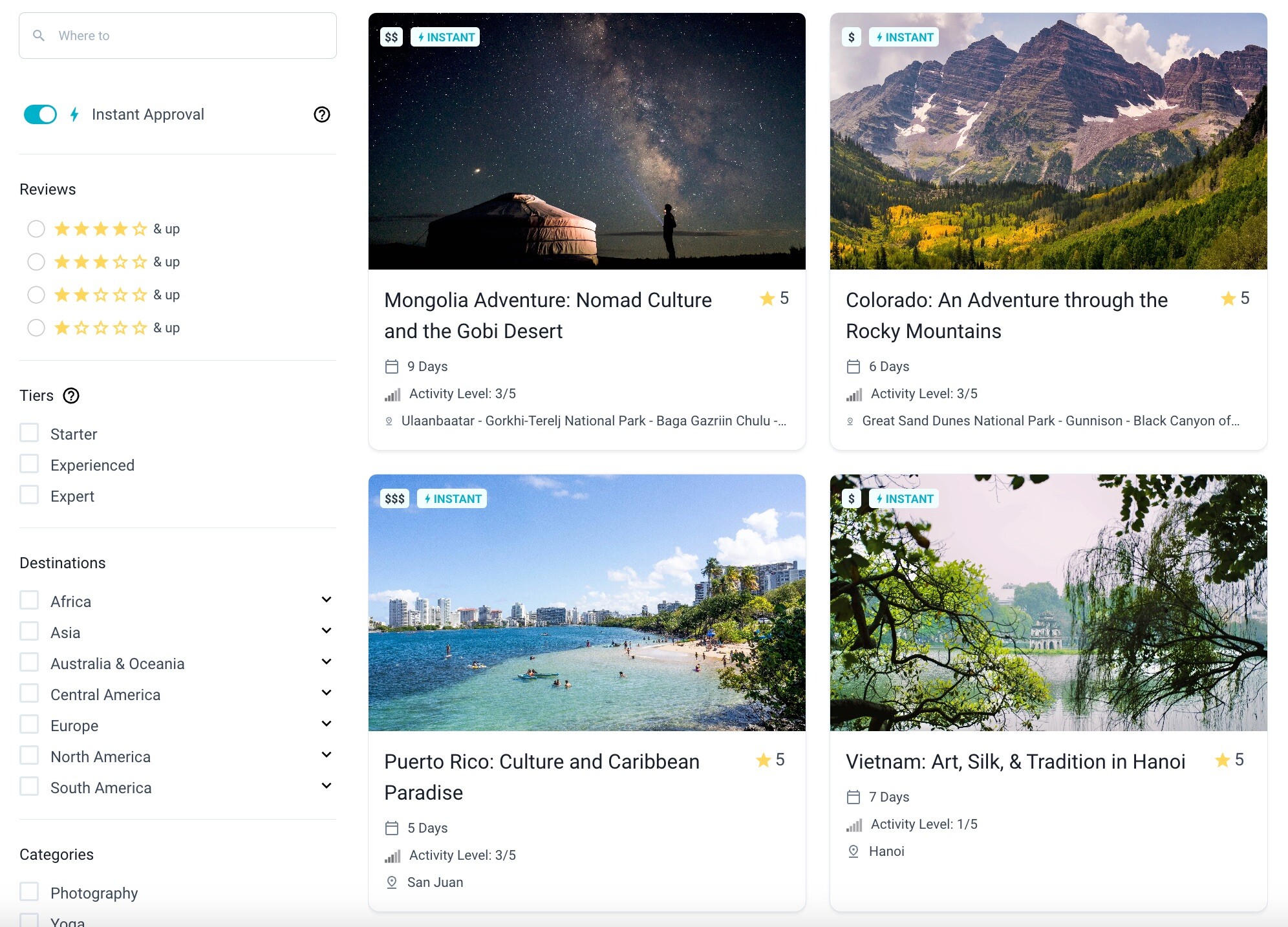
Trova Unlocked, released in September 2024, changed the sequence. An algorithm now routes a Host either directly into planning or toward a survey when more proof is useful. The free survey remains, but it is no longer mandatory for everyone. TrovaTrip also stocked an off-the-shelf library with more than 100 professionally designed trips whose dates, details and pricing are visible and ready to reserve. A process that could take days or weeks can, for eligible Hosts, take hours.
This is the copyable lesson. Do not throw away a tool because its universal application is bad. Separate its information value from its permission value. TrovaTrip kept the survey for price and destination research, then stopped insisting that every worthy community perform the same proof-of-demand ceremony. The change also makes supply more legible: pre-approved dates and less customization reduce uncertainty for the Host and the Operator.
The moat is the unphotogenic middle
Competitors can attack from several directions. TourRadar aggregates tours. Intrepid Travel and G Adventures operate established group products. Contiki owns a recognizable youth-travel niche. Retreat planners, destination-management companies and creator-trip startups can assemble similar departures. A determined creator can reproduce the software surface with forms, Stripe, email and a heroic spreadsheet.
The difficult part is orchestration. TrovaTrip says it reviews operator insurance, crisis systems, sustainability practices, employment practices and local impact. Operators supply English-speaking local Guides and manage hotels, transport and activities. TrovaTrip handles the traveler relationship before departure and real-time support around the trip. The Host must keep selling without being mistaken for the party driving the van. Each boundary has to be clear when everything is normal and even clearer when it is not.
That operational layer helped the company grow when the category looked radioactive. Global travel stalled during the pandemic, yet TrovaTrip reported tenfold booking growth in 2021. It raised a $5 million seed round that August, then a $15 million Series A led by Madrona in September 2022. By 2023 it ranked No. 236 on the Inc. 5000. Funding bought room to expand the platform, marketing and itinerary supply; it did not repeal the need for each individual Host to convert affection into deposits.
What to steal, and when it breaks
A founder outside travel can copy the architecture. Find experts with difficult supply. Pair them with community leaders who have trusted distribution. Standardize the repeatable service into inventory. Let the community leader retain creative control where identity matters, and keep regulated or safety-critical work with qualified operators. Use a confirmation threshold so the transaction funds itself. Finally, collect demand data before committing scarce supply, but let evidence choose the path instead of worshipping one metric.
Works when
The Host has real trust, the product is emotionally meaningful, supply can be standardized, and all parties earn from the same confirmed transaction.
Breaks when
Followers do not become buyers, the Host avoids promotion, customers demand bespoke planning, or local execution cannot deliver a consistent and safe experience.
TrovaTrip is a poor fit for the traveler who wants every hour customized, the creator who dislikes selling, or the audience that will not commit before a deadline. It is also vulnerable to the oldest creator-economy problem: reach is not trust, and trust is not purchase intent. A million passive followers can be less useful than 150 people who attend the same class every Tuesday.
That is why the company's most interesting update is not another country pin. It is the admission that a good marketplace must recognize different shapes of demand. TrovaTrip began by helping creators turn audiences into trips. Its next act is learning that a community does not have to look like an audience first.