Nic Wood had a rather personal connection to the hospital he helped reopen in May 2024. He had been born there. Back then, it was St. Joseph Hospital. Later it became Trinity Hospital of Augusta. By the time Wood was its administrator, the sign said Piedmont Augusta Summerville. The names changed more often than the address. That little distinction explains quite a lot about what happened on Wrightsboro Road.
The story in three moves
- 2017: Quorum sold Trinity and its affiliated outpatient facilities for $15.9 million.
- 2020: The Summerville campus became an isolation hospital for COVID-19 patients.
- 2024: Emergency and inpatient care returned alongside clinical education.
Trinity was an acute care hospital, licensed for 231 beds, serving Augusta and neighboring communities. Its work was tangible: inpatient treatment, surgery, diagnostic testing, outpatient visits and emergency care. Patients needed somewhere to be examined, treated or admitted. Physicians needed the people, equipment and rooms that make those decisions possible. Its business depended on providing clinical services and receiving payment for that care.
A buyer with the opposite problem
The institution began in 1952 as St. Joseph Hospital, opened by the Sisters of Saint Joseph. In November 2006, Triad announced a joint venture that put approximately 65 percent of ownership with its affiliate and 35 percent with members of the medical staff. Corporate management and physician ownership shared the same building.
By 2017, Trinity belonged to Quorum Health, a Community Health Systems spinoff. The financial trouble preceded the disappearance of the name. Quorum reported $7.4 million in pretax losses related to Trinity for the first six months of 2017, following a $33.9 million impairment of its property, equipment and capitalized software in 2016. The business was consuming value before the campus stopped being useful.
Hospital + outpatient facilities
First six months of 2017
Purchase price measures the transaction. Loss measures a period of operations. Neither is a patient bill.
Across town, University Health Care System faced a different constraint: its main campus was running short of room for economical expansion. Trinity offered existing buildings and land. The Richmond County Hospital Authority acquired the facility, and University renamed it University Hospital Summerville. A struggling competitor became space for a neighboring system.
The immediate work sounded reassuringly unglamorous: a roof, a nurse call system and a transition to Epic electronic records. Buying hospital capacity meant repairing and connecting it. University welcomed approximately 370 former Trinity employees across the campus and its wider system. A new name on the sign was the easy part.
The spare campus became the pressure valve
In December 2020, the emergency department closed and Summerville was converted to isolation beds for COVID-19 patients. Concentrating those patients there freed room at the main hospital. A campus acquired to solve a space problem had become useful for a much more urgent version of that problem.
When COVID inpatient demand declined, patients and staff moved back to the main campus. Summerville continued with outpatient services. Piedmont took over the University system in March 2022. The former Trinity was now part of a larger nonprofit network, with its role still being rewritten.
One campus / changing assignments
- 2017System satellite
- 2020COVID isolation
- 2023Clinical classrooms
- 2024Emergency care returns
This is the interesting wrinkle in Trinity’s history. The property outlasted one owner’s financial case for operating it. Its next use depended on the needs around it: first capacity, then isolation, then training. Preserving a building did not require preserving every previous assignment.
A classroom with hospital plumbing
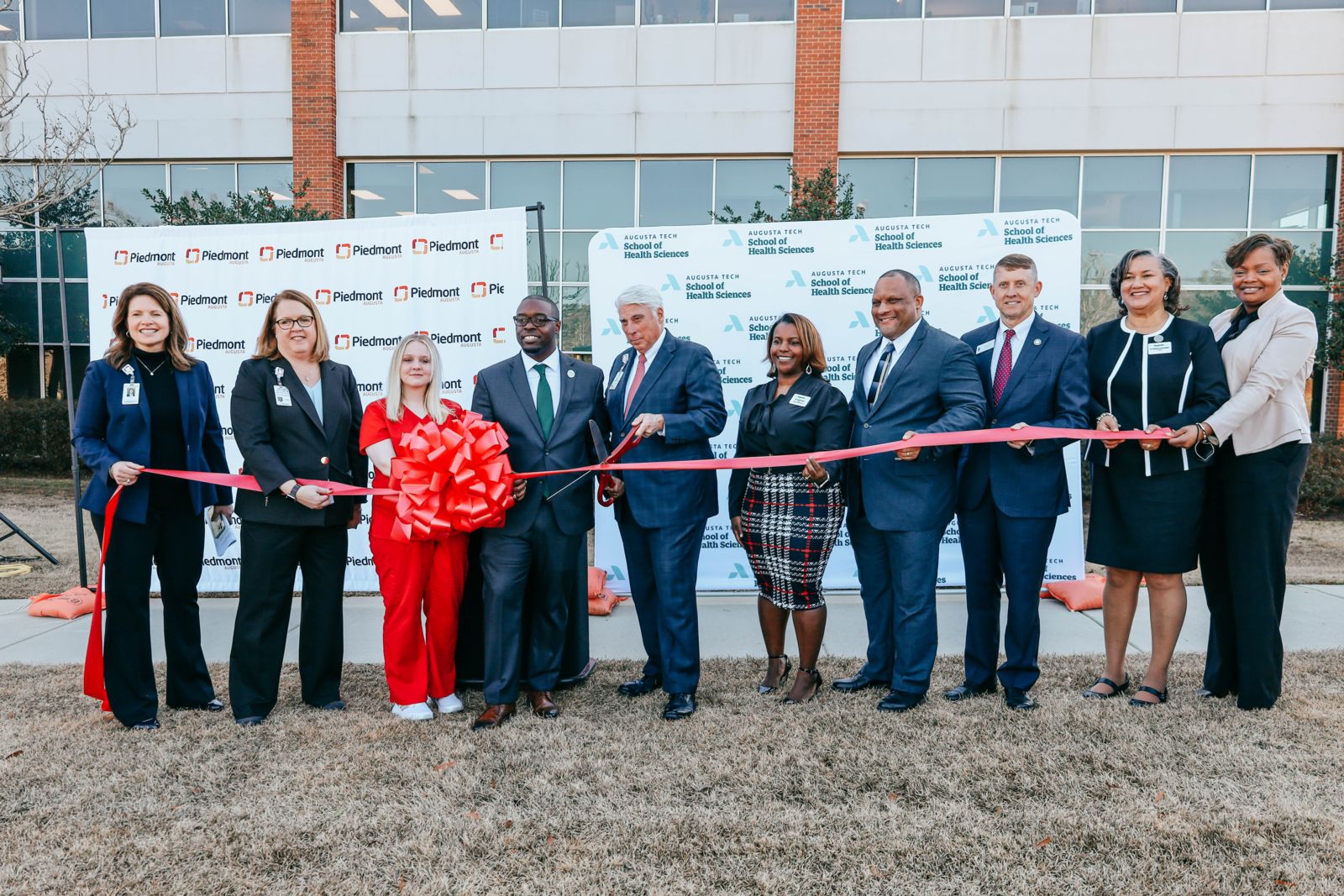
Augusta Technical College’s School of Health Sciences opened its Summerville location in January 2023. Its programs included nursing, respiratory care, surgical technology and radiologic technology. Students could learn in an actual hospital setting, with equipment and medical professionals already nearby.
“Our Summerville Campus was underutilized, and Augusta Tech needed room to grow their Health Sciences programs.”Hugh Hamilton, Piedmont Augusta board chairman, January 2023
That pairing gave unused space a purpose and an education provider room to expand. In 2025, Piedmont’s foundation reported that its nursing scholarship effort had awarded more than $880,000 to over 90 students since 2022. Recipients committed through work agreements to serve within the Augusta network, including Summerville. Tuition support also became a way to recruit future colleagues.
Fifteen emergency beds. A different proposition.
On May 16, 2024, Summerville reopened emergency and inpatient services: a 24-hour, 15-bed emergency department, a 12-bed inpatient unit and enhanced imaging. Those figures describe the reopened services; the old 231-bed licensed capacity describes the historical hospital. Treating them as interchangeable would badly misread the comeback.
Community feedback mattered. Leaders said residents missed the campus’s efficiency. Its practical distinction among Augusta’s alternatives, including Doctors Hospital and Wellstar MCG Health, was neighborhood access within a larger system. The reopening also included a dedicated ambulance for patients needing higher-level care. A small campus works differently when it has somewhere to send a patient.
The campus’s range is useful precisely because ordinary healthcare involves repeated visits as well as dramatic emergencies. A laboratory test, a wound appointment and a primary care consultation each need reliable local access. The operating idea is to keep those services nearby while using the wider network for needs beyond this campus’s scope.
Today, patients can use the successor campus for emergency medicine, general medicine inpatient care, imaging, laboratory and sleep services. Outpatient offerings include wound and hyperbaric treatment, diabetes services, heart care, primary care, occupational medicine and a Coumadin clinic. These are current Piedmont services, rather than a claim that the Trinity brand still operates.
Keep the space. Reconsider the assignment.
What can another operator copy? Start with a concrete mismatch: one organization has usable space; another lacks it. Fix the infrastructure, connect the systems and choose services the neighborhood will use. Summerville’s education partnership supplies an especially clear example. In May 2026, the campus’s Clinical Laboratory Science Program earned full accreditation.
The conditions matter. Existing rooms cannot substitute for staff, equipment, paying demand or access to more complex treatment. Nor does an acquisition price establish what care will cost an individual patient. Trinity’s story rewards a narrower conclusion: a hospital can lose its name while its address keeps earning another job.