Travis Sorensen arrived at coding school with an MBA already behind him. In the usual order of professional upgrades, this might look like taking the stairs after buying a lift. He had studied business. Now he wanted to understand the thing a technology business actually made. At Codesmith, he met lead instructor Rob Wilkinson. Their first application followed within a month. The student had found more than a new skill: he had found the person with whom he would build Oddball.
There is a pleasing lack of inevitability to that beginning. A future co-founder was teaching the class; another was trying to fill a gap in his knowledge. The partnership grew out of those different positions. Sorensen’s career makes an argument for entering a room without being its expert, then paying attention to who is already there.
The student with the business degree
Sorensen places the start of his partnership with Wilkinson in 2015. He described their friendship as fast-forming and their approaches as complementary. His reason for attending the bootcamp was unusually plain: he wanted practical software-development knowledge to go with his MBA. The classroom was a way to acquire some fluency in the work he hoped to sell and organize.
His business-school connection was to the University of Virginia’s Darden School of Business, where he belongs to the Class of 2014. That education later became part of another strand of his work: teaching and supporting access to business knowledge. For the moment, though, the immediate task was learning to make software. An academic credential could travel with him. It could hardly type the code.
Oddball’s name gave the two founders room for a joke about their working habits. They wanted to understand the business case behind an application and to communicate while building it. Sorensen put the latter point neatly: “We’re the DevOps team that values communication.” A company name can require an expensive explanation. This one came with a fairly economical one.
A tutorial with an imaginary heckler
A small piece of Sorensen’s early writing makes the beginner in this story easier to picture. In June 2015, he published an explanation of jQuery as a conversation with a friend who was, he admitted, largely imaginary. His counterpart insisted the software was magic. Sorensen answered with functions, objects and a visit to the browser console.
The joke has a purpose. The imaginary friend keeps resisting the explanation, which forces the writer to show the mechanism. Rather than announcing that something is obvious, he walks through it. The reader gets to borrow the friend’s skepticism without having to raise a hand.
This is a modest artifact, far removed from a contract announcement or an executive biography. That is its appeal. It preserves someone working through a concept in public, finding a way to explain it without pretending the confusion never existed. Before there was a company to describe, there was a function to understand.
The people outside the room
Oddball began at a kitchen table before acquiring an office. In Sorensen’s account of those early days, the office group developed the easy familiarity of shared lunches and walking meetings. Remote colleagues had less access to that daily company life. One employee, Ryan, left; Sorensen traveled to Denver to meet him. Ryan later returned.
The episode prompted a change in how the central team worked. More people worked remotely, and office attendance shrank to one day a week. Those accustomed to being together had to experience the arrangement their colleagues already knew. Inclusion began to require a change of habit from the people who felt most at home.
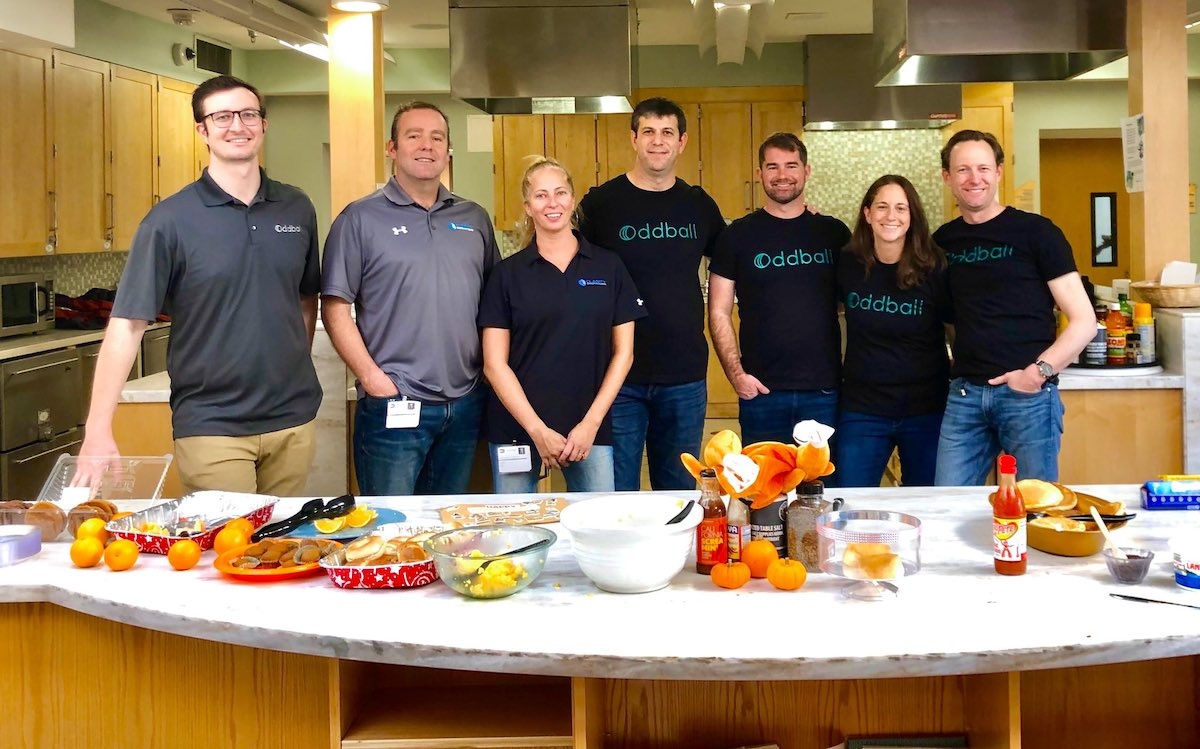
Remembering the strain of starting without investment, Sorensen offered a less polished description of entrepreneurship: “It’s a bit like building a car as you’re driving.” Anyone contemplating that vehicle might reasonably ask about the brakes.
An invitation into government
Oddball’s move into federal work came after an 18F staff member encouraged Sorensen to bring the company’s agile software approach into government. It entered that market in 2017. The invitation matters in his story: a company formed through one professional connection found its next direction through another.
By 2019, Oddball had worked on the Department of Veterans Affairs’ Lighthouse program, a developer portal providing access to VA datasets through application programming interfaces. It also secured its first prime contract, supporting the Veteran-facing Services Platform. The work included software development, delivery management and the operations needed to keep a platform running.
That same year, FCW named Sorensen a Rising Star. Oddball’s team had grown to nearly 50 people. These are useful markers because they fix the company at a particular point in time: no longer just a young partnership, but still early in its federal career. They also show how much of its work depended on teams and partnerships. A founder’s biography can easily turn a collective software project into a solo expedition. This one requires more seats.
In accepting the recognition, Sorensen thanked mentors, partners and colleagues, including Ad Hoc and the Digital Services Coalition. Oddball was a charter member of the coalition. For a company whose name celebrated being different, its path also involved learning from people working on related problems. The name allowed individuality; the work still called for company.
Permission to be practical
By 2022, Sorensen was making a case for “pragmatic digital service.” His account of modernization began with the business challenge, the team’s current situation and the constraints around the project. Policy, funding and an organization’s tolerance for risk all belonged in the discussion. A fashionable tool could wait its turn.
He described inviting government clients and affected stakeholders into the regular working conversations of a software team. That meant opportunities to identify a problem while work was under way, rather than waiting for a finished deliverable to reveal a disagreement. The aspiration was continuous improvement at a pace the organization could use.
There is an appealing restraint in that position. Technology businesses often have a new noun ready before the client has finished describing an old difficulty. Sorensen’s argument asks the supplier to listen longer. It makes room for institutional knowledge as well as fresh technical skills, and for the possibility that the sensible next step will be smaller than the sales presentation.
Five places in the classroom
In November 2021, Oddball announced a veterans’ scholarship fund with Codesmith. Its initial commitment supported five full scholarships for qualified applicants accepted into the school’s full-time or part-time software-engineering programs. The company was returning to the setting where its own founders had met, this time helping other people attend.
For Sorensen, an Army veteran, the connection was personal as well as professional. He had joined the military while still in high school and graduated from the University of Maryland in 2009, the year he left the Army. His own path had included several educational settings. The scholarship initiative offered another route into software careers for veterans.
Five funded places is a number with people-sized proportions. It describes an initial commitment without asking anyone to imagine an entire industry transformed overnight. The opportunity still required admission and study. What the fund supplied was help with access to the training. A classroom that had produced one partnership could become the starting point for other careers.
Another kind of second start
Sorensen’s connection to education also reaches beyond coding. He is a Darden PREP alumni instructor, linked to business education for incarcerated learners. In May 2025, Resilience Education reported that Oddball had contributed $30,000 over three years to support its work. The continuing relationship adds substance to the company’s interest in opening career pathways.
The support helped the Resilient Professional Community, an online network led by formerly incarcerated people, and its educational programming. A new eight-week entrepreneurship course used business case studies and the Socratic method. Here, again, the practical ingredients were knowledge, discussion and access to people who could help.
“We understand the value in building strong connections and great mentorships when launching a startup.”
Travis Sorensen, May 2025
Sorensen’s emphasis on connections makes sense beside his own founding story. A class had put him in contact with a future partner. Supporting another learning community offered a way to make that kind of encounter more available. The contribution was Oddball’s; the continuity with his experience is visible in what he chose to emphasize.
A company outgrows its first arrangement
January 2025 brought a different sort of partnership. Falfurrias Management Partners announced a growth investment in Oddball. The announcement retained Sorensen and Wilkinson in leadership and named Sorensen among the company’s board members. It also described a fully remote workforce, connecting a later business arrangement to an organizational choice made much earlier.
An investment announcement changes the cast around a business. In this case, operators and investors joined a company built by a business-school graduate and a coding instructor. The original partnership remained part of the account, while the responsibilities around it expanded. Growth brings more people into the room, even when the room is mostly online.
On November 4, 2025, Oddball announced Rob Silverman as chief executive. Sorensen welcomed him after ten years leading the team. The handover gives this story an essential later chapter. The co-founder who had once entered a classroom to understand software was now supporting someone else’s arrival at the head of the company he had helped create.
It would be tidy to turn every step into a rule for founders. Sorensen’s actual story allows more uncertainty: a course taken to address a knowledge gap, a useful friendship, an invitation into a new market, an employee’s departure that demanded attention. The recurring act is quite ordinary. Learn enough to recognize the next problem. Find people who can help. Leave a place for the next beginner.