A gigabyte of numbers ought to be a reasonably sociable thing. Move it from one scientific tool to another and it should remain a gigabyte of numbers. In the Python world Travis Oliphant inhabited in the early 2000s, this was asking rather a lot. Two competing array libraries, Numeric and numarray, could leave researchers copying large quantities of data simply to get their tools to cooperate. The computer was busy. The scientist was waiting.
Oliphant found the situation irritating enough to take responsibility for it. In 2005, while teaching electrical and computer engineering at Brigham Young University, he began the work that became NumPy. He wanted a common foundation beneath the growing collection of scientific Python libraries. A shared way of handling arrays would let other people get on with their own problems.
That impulse connects much of his career. He has written code, written a book, helped start a nonprofit and co-founded companies, including Anaconda. Each undertaking has confronted a slightly different obstacle between people and useful tools. Eventually, the obstacles included payroll.
Two arrays, one headache
Oliphant had been using Python for scientific programming since 1997. He arrived as a working researcher with calculations to do, rather than a language designer looking for followers. Numeric, created earlier by Jim Hugunin and other contributors, already offered an array object. There was a community to join and a useful body of work to extend.
In 1999, he released Multipack. That work helped lead to SciPy, which brought scientific routines into a common collection. Eric Jones and Pearu Peterson were co-creators. The names matter: a collection of tools becomes useful through the labor of people who know different pieces of the problem. SciPy’s own account still identifies all three as co-creators.
NumPy later addressed the split at the array layer. To a reader who has never wrestled with scientific software, an array might look like bookkeeping. But agreement at that level gives many separate tools something they can understand in common. Without it, every boundary between libraries can become a negotiation.
A common array foundation
for scientific Python tools
Oliphant has recalled a particular confirmation: John Hunter’s Matplotlib chose NumPy as a dependency. Another project was willing to build on the foundation. There are louder forms of professional approval, but few more concrete than someone deciding to rely on your work.
He also keeps returning to the contributors whose names can disappear when history acquires a single protagonist. In 2025 he singled out Paul Dubois, an early Numeric maintainer and community organizer. Dubois helped give him credibility, helped the transition to NumPy, and joined him in a 2005 meeting with Python creator Guido van Rossum. Oliphant’s version of the story has room for the people who made agreement possible.
A manual with a meter running
A shared foundation creates a less romantic problem. Someone must explain it. Oliphant wrote Guide to NumPy, a technical manual whose contents move through indexing, memory layout, data types and array methods. Anyone seeking a brisk beach read was going to need a particularly unusual beach.
The book also carried an experiment in funding. He sold it with temporary restrictions on redistribution. The December 2006 edition explained that purchases could bring forward the date when the material became freely distributable; the restrictions would expire by October 31, 2010 at the latest. Payment and eventual sharing were both written into the arrangement.
There is a useful glimpse of the person in that mechanism. Oliphant was willing to make something open, and equally willing to ask how the work would be supported. The answer involved a book with a timetable attached. Economics had entered the documentation.
“I am honored to be one piece of the open source legacy”
Travis Oliphant, on Python’s documentary history
NumPy’s later reach gives that early predicament a different scale. The project’s history points to its use in gravitational-wave analysis and its citation by the M87 black-hole imaging project. An agreement about arrays travels surprisingly far. The people making those discoveries need dependable numerical tools; they do not need to revisit the original argument every morning.
The company they did not quite plan
Between 2007 and 2011, Oliphant served as president of Enthought, taking scientific Python into commercial work. His career moved from the university into contracts, customers and the practical demands of delivering software. Then, in 2012, he and Peter Wang founded Continuum Analytics, the company that became Anaconda.
The original ambitions were broad: connect Python to larger data problems, help people build visual applications and make the stack work across more hardware. In his later account, Oliphant admitted that the products which succeeded only vaguely resembled what the founders first imagined. Building a Python distribution had been well down the list.
Wang’s own explanation of Anaconda’s beginnings puts installation near the center. The numerical tools were powerful, but getting them installed properly could be difficult. A collection of open libraries was available; a working environment still demanded effort. The founders saw an opportunity to shorten that journey.
Anaconda and conda helped make the collection manageable. Conda handles packages and environments, including the dependencies that allow a project to run. This is the sort of accomplishment that becomes less visible when it works. A newcomer gets to start an analysis instead of acquiring an accidental specialization in installation failures.
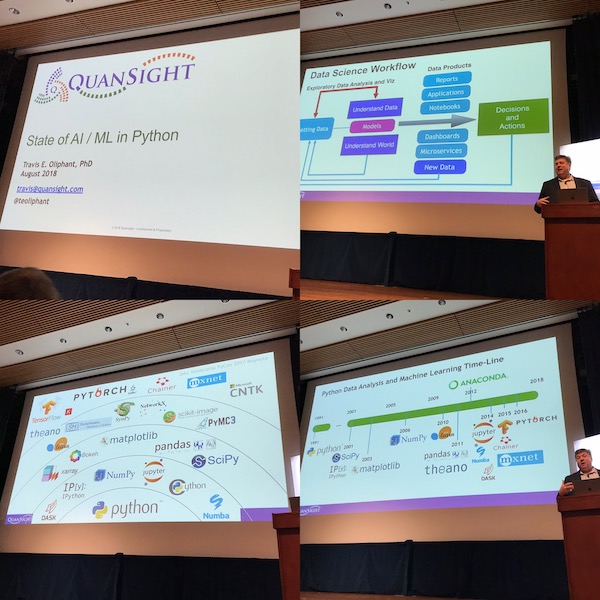
Oliphant also started Numba, which approaches another familiar irritation: speed. The compiler translates a subset of Python and NumPy code into machine code at runtime. It lets numerical programmers keep working in Python while accelerating suitable functions. The appeal is practical. A researcher can spend more time on the calculation and less time moving the calculation into another language.
The same year that Continuum began, Oliphant joined the founding board of NumFOCUS. Its other founding members included Fernando Pérez, Perry Greenfield, John Hunter, Jarrod Millman and Anthony Scopatz. Leah Silen became founding executive director. Scientific software had grown enough to need an institutional address.
Continuum helped supply early office space, staff support and funding. PyData events helped raise money and bring people together. The company and the nonprofit served different purposes within the same community. One could sell products; the other could provide a home for support that belonged to projects and their contributors.
Build the foundationNumPy gives numerical tools common ground.
Make it usableAnaconda and conda simplify access to a working environment.
Support the peopleNumFOCUS provides nonprofit infrastructure for projects.
Keeping the commons in working order
Oliphant’s next chapter became Quansight. In March 2018, he introduced the company while reflecting on leaving Anaconda. The name shortened “Quantitative Insight.” Its work connected organizations needing technical help with people and communities building open tools.
Quansight made that connection part of its identity. Its team includes active open-source contributors, and the company describes more than half its full-time technical staff as contributors to such projects. For a business, that expertise is something clients can buy. For a software community, employment can create time to do work that enthusiasm alone cannot reliably schedule.
SciPy’s own institutional-partner list illustrates the relationship. It names Quansight and individual contributors employed there. Its donations are managed through NumFOCUS, which also supplies administrative and legal services. A library’s continued existence involves arrangements as ordinary as an employer, an account and someone available to answer the next difficult question.
The result is a career with a curious rhythm. Oliphant helps create something that people can use freely, then works on organizations around it. The code spreads. The obligation to maintain it remains with actual people. Every successful abstraction eventually encounters somebody’s calendar.
Back to Utah, forward into AI
By 2026, his attention had turned toward what OpenTeams calls owned intelligence. In March, he stepped into the CEO role, succeeding Joe Merrill. The announced next phase centered on Nebari product development and private intelligence hubs, following the acquisition of Quansight’s consulting division.
The argument extends his longstanding interest in shared tools into a world of AI services. He wants organizations to retain control over their data and the capabilities they build around it. The distinction has business consequences: a customer choosing infrastructure is also choosing dependencies, operating arrangements and how much control to hand to a supplier.
His personal geography was changing too. In June 2026, Oliphant announced that he and his wife were returning to Utah after nineteen years in Texas. Their six children had graduated from Texas public schools. His reflection made room for colleagues and customers, the difficulty of payroll, business mistakes, family memories and the mountains drawing them home.
It is a rather fuller accounting than a list of software projects. The companies brought opportunities and demands; the family and community gave those years their meaning. The developer associated with shared abstractions was describing the particular people to whom he felt committed.
Python’s history has recently become a subject for film, with Oliphant appearing in CultRepo’s documentary work. The story is easier to tell now that the tools have recognizable names. At the beginning there were incompatible arrays, complicated installations and people volunteering to help. He keeps coming back to the arrangements that let those people continue.
Follow the threads
Writing and projects
Watch and listen
Elsewhere