On a five-story self-storage project, a few columns appeared where they should not have been. The submittal review had passed. The subcontractor’s installation check had passed. A routine quality-control walk finally exposed them, before drywall could turn a visible mistake into an expensive excavation through finished work. Rycon Construction estimates that the catch prevented $75,000 in rework and related costs. The camera did not notice the error by itself. What mattered was that the team had a navigable record of the floor, current enough to make an awkward question answerable.
That is the business Track3D is in. The Milpitas company takes imagery from 360-degree cameras, drones, laser scanners and phones, attaches it to drawings and locations, and uses computer vision to measure what has been installed. Its customers are general contractors, trade partners and owners who need to know whether the work in the field matches the account of it in a meeting.
- Track3D makes site imagery searchable by place and date, then measures progress by trade, floor and zone.
- Rycon says its 17-month project reached 98.7% visual coverage and caught an estimated $75,000 error.
- A Hensel Phelps airport pilot reported 2,964 hours and $342,000 in project cost savings.
- The software is sold to construction teams; a public 2026 offer put progress tracking from $0.15 per square foot.
The first thing that failed was the photo folder
Rycon’s earlier routine was recognizable to anyone who has managed a project: superintendents took weekly photos and uploaded them to a library. The result recorded what someone thought to photograph, then asked a future colleague to find it. A search for one condition could take 15 to 30 minutes, and sometimes ended with no picture at all. On a 175,000-square-foot building with liquidated damages in play, that is a costly way to remember.
Track3D changed the unit of documentation. The project engineer still walked the site. A roughly ten-minute pass across one 32,000-square-foot floor produced about 1,800 processed visuals, organized by location and date. Across 17 months, the project accumulated 298 captures. Rycon says its team could locate a site condition in about two minutes. The gain was less theatrical than a robot finding a fault: a human could inspect a much denser, more orderly record while the work was still open.
“It was the first time I could look at a floor and know exactly what had been done, not based on what someone told me, but based on what the data actually showed.”Dylan John / Project Manager, Rycon Construction
A camera is only the first draft
The company was founded in 2022 by Chaitanya N K, Kiran Gutta and Vineeth Paruchuri. The founders had worked on technology implementation for general contractors. That background helps explain the product’s mild disrespect for the pristine model. Track3D says ProgressTrack can begin measuring installed work from capture without waiting for a complete building information model. For a project team whose drawings and field conditions keep changing, that removes a genuine point of delay.
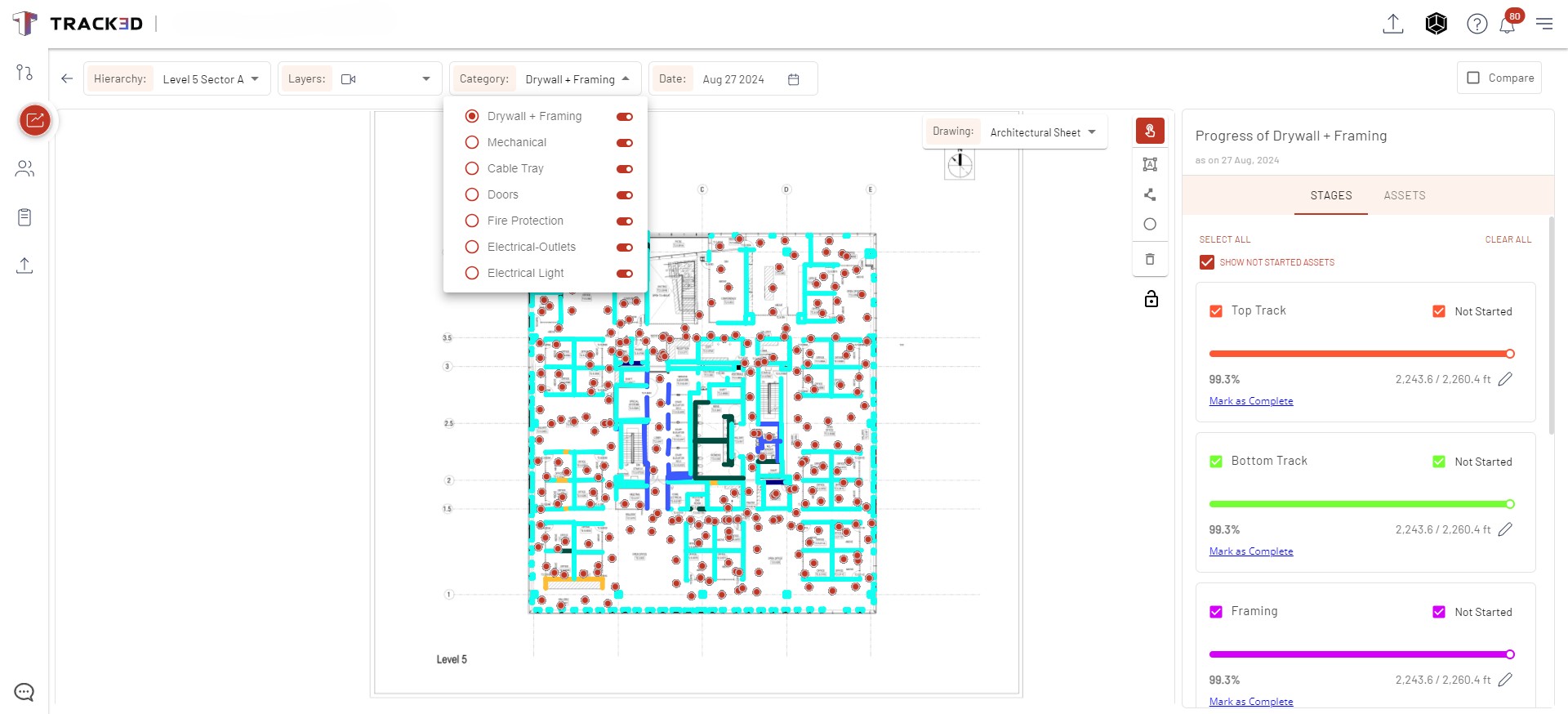
Its first layer, VisualTrack, collects site captures into a dated visual record. ProgressTrack adds quantities, maps and trend lines for installed work. Schedule tools compare observed progress against the plan and flag work that is stalled, behind or likely to miss an end date. The company’s integrations bring Procore records, Autodesk drawings and Fieldwire punch-list items into the same view. The point is not to replace every tool on a construction job. It is to give the tools a shared account of what the cameras saw.
That sequence is Track3D’s answer to competitors such as OpenSpace, Buildots and Doxel, which also turn jobsite imagery into useful records or progress data. The distinction it presses is flexibility: multiple capture sources, a start without BIM, and progress attached to the tools teams already use. These are company claims about how its workflow operates, not proof that every camera or every job will yield the same result.
The airport became the larger test
At San Francisco International Airport, Hensel Phelps used Track3D on the Courtyard 3 Connector project. The team already had visual data. It still needed people to hunt through images, compare them with plans and walk trades separately to verify progress. The case study describes a mechanical scope walk taking 30 to 60 minutes, repeated for other trades. Once the same 360 walks fed a mapped progress record, project engineers could check percent complete for pay applications and quality-control staff could inspect the history of work hidden behind finished surfaces.
The pilot’s reported results include three major reworks avoided and more than a 50% reduction in documentation time. Those numbers come from a customer case study, so the sensible reading is that they describe this project, under its conditions. The meaningful next step was Hensel Phelps’ 2026 enterprise agreement to deploy Track3D across more than 200 active projects. The buyer was testing whether an improvement seen on one complex build could travel.
“We had plenty of data. The challenge was transforming it into insights that supported faster, smarter decisions.”Garin Anderson / Hensel Phelps
The price of knowing sooner
Track3D sells business software to contractors, trades and owners through project and enterprise arrangements. In a September 2026 public offer, the company advertised progress tracking starting at $0.15 per square foot, with visual capture included. That is a useful anchor, though a real contract will depend on project scope and terms. The company raised $4.3 million in seed funding in 2024, then $10 million in a September 2025 Series A led by Ironspring Ventures with Zacua Ventures as co-lead. It reported more than 400 projects at the time. The founders said the reason to raise more money was a change in customer demand: pilots were becoming requests for regional rollouts and deeper workflow integration. In August 2026, specialty contractor Performance Contracting Group also selected the platform as an enterprise standard. That move from one clever project to many routine ones is the test that matters for a construction software company.
A subscription cannot supply a disciplined site walk. Track3D’s results depend on regular capture, readable imagery, current plans and a team willing to act on a flagged condition. Its own product now allows staff to mark progress without a capture, an acknowledgment that some milestones require human verification. A camera can tell a manager where to look; it cannot sign off an inspection, settle a disputed interpretation or persuade a trade to fix a column.
That limit is also the lesson worth copying. First, make the ordinary walk cover the whole work area. Next, label each observation with a place and time. Then compare those observations with the schedule and drawings while the cost of correction is still small. The memorable innovation is not a photograph of construction. It is making yesterday’s site easy to find before tomorrow’s work hides it.