In 1994, Tony Douglass created and installed an electronic courtroom for an inquiry into police corruption. The Wood Royal Commission in New South Wales was investigating the institution charged with enforcing the law. Recording its proceedings was a fairly pointed assignment: an inquiry examining official conduct needed an account of its own.
The commission began public hearings that November. It would hear hundreds of witnesses. Douglass’s contribution concerned the machinery through which a roomful of spoken words could become something durable. There are easier places to discover that a microphone has missed a sentence.
That installation provides a useful starting point for his career. Much later, the language around his work would include cloud platforms, artificial intelligence, and speaker attribution. The underlying task would remain familiar. Capture the words, preserve their integrity, and make them available to someone who needs to examine what happened.
A corruption inquiry needs a record
Douglass began in forensic audio and video analysis, working on evidence enhancement and authenticity verification for major investigations. Those two activities belong together. A recording must be intelligible enough to examine, and reliable enough to deserve examination. Improving the sound and checking the original are different responsibilities, both with consequences.
His later work would carry those concerns into the courtroom itself. The 1994 installation put him at the point where evidence, procedure, and engineering meet. A court can have solemn architecture and meticulous rules while still depending on the placement of an unassuming piece of audio equipment. The microphone enjoys none of the judge’s ceremony and accepts rather a lot of responsibility.
For The Record dates its business to 1993. Its subsequent product history follows the changing possibilities of recorded proceedings: digital audio, video, online playback, and eventually cloud-based tools. Douglass is identified as a founder. His particular place in that history begins with making an electronic courtroom work in a consequential public inquiry.
The room gets a vote
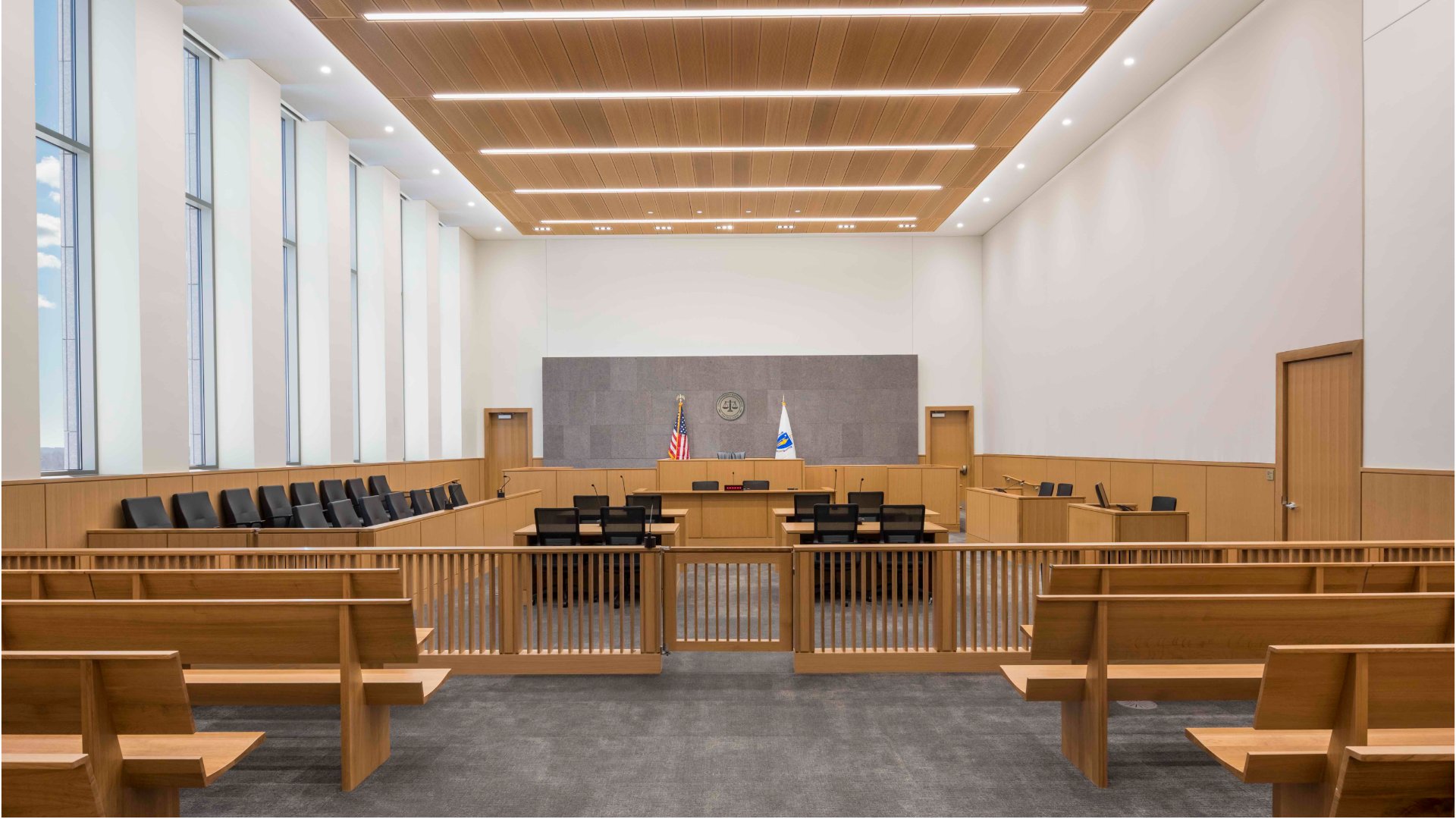
The sales language of software can make a courtroom sound like an orderly stream of data. A physical room is less cooperative. People speak at different volumes. Papers rustle. Several voices can arrive together. Remote participants introduce another set of audio and video inputs. None of these complications becomes smaller because the subject being discussed is serious.
Douglass’s explanations of digital recording tend to return to such practical details. Discussing hybrid courts in 2021, he described the need to record people joining from outside the courtroom as well as those seated inside it. FTR Gold 7 offered separate audio channels and multiple video channels. Separating inputs allows later listeners to work with individual voices.
The useful point is the relationship between capture and review. A transcriber confronting overlapping speech needs material that can be separated and replayed. An impressive interface arrives too late to rescue sound that was never properly captured. The room, its equipment, and its operators all have a say in the eventual result.
The hybrid courtroom also changes what counts as being present. A person appearing by video contributes to the proceeding from another location, using equipment the court may not have installed. The recording still has to bring those contributions into the same account. Douglass’s 2021 comments treated that expanded room as an engineering problem requiring purpose-built recording tools. For someone whose work began with examining existing evidence, it was a further step toward managing the conditions in which usable evidence is created.
In a 2022 discussion of court recording, Douglass described people testing systems before the judge arrives and monitoring recordings during proceedings. They add annotations to help later searches and transcription. The term for checking the recording is confidence monitoring. Confidence, in this setting, comes with a morning equipment check.
“Our solutions are designed with courts in mind and are people-centered.”
Tony Douglass, December 2022
His account leaves a continuing role for court reporters and monitors. Someone still has to pay attention to what the system is capturing. That emphasis is revealing because the public discussion of automation so often skips the person operating it. Douglass describes a working arrangement with people before, during, and after the hearing.
- 01 / CaptureMicrophones and separate audio channels
- 02 / PreserveProtected recordings and controlled access
- 03 / ReviewPlayback, annotations, and searchable text
A file that can answer back
Authenticity is the other thread from his forensic beginnings. In August 2020, FTR announced a patent for verifying recordings using blockchain technology. Douglass, then president, spoke about the growing ability to manipulate audio and video. As editing becomes more capable, the original recording needs a way to establish that it remains intact.
The proposed verification used a digital ledger to check authenticity over time without exposing the recording’s contents. That is a specific use for a technology with a habit of acquiring extravagant promises. Here, the question is quite narrow: has this recording been altered? A court does not need a fashionable answer. It needs a dependable one.
There is an important distinction between checking a file and judging the testimony it contains. Verification can help establish that recorded material has stayed intact. It cannot decide whether the person speaking was truthful. That remains work for the legal process. The technical contribution is to preserve the material on which scrutiny depends, so that a later disagreement has something concrete to return to. The recording is valuable partly because another person can revisit it, listen again, and ask a better question.
Preservation alone leaves another problem unsolved. A recording can be intact and still cumbersome to navigate. Searchable speech-to-text changes how a person approaches it: a passage can be found through words, then examined in the recorded material. Douglass’s work on speaker attribution addresses a related difficulty, attaching the right voice to the right person.
The continuity across these tasks is more interesting than any individual product name. His early work concerned making evidence clearer and checking its authenticity. His later work concerns collecting a record, protecting it, and helping people use it. Each stage makes demands on the others. Search is more useful when the underlying material is dependable.
A president takes the next chair
In May 2022, For The Record announced Douglass’s appointment as chief executive, succeeding Michael G. Rose, who continued as chairman. Douglass had most recently been president. His promotion put a founder with decades of technical work into the company’s top executive role.
The appointment came during a broadening of FTR’s offering. Recording Vault addressed cloud storage and retrieval. Transcript Express handled transcript ordering and production administration. RealTime brought automated speech-to-text into proceedings. The company was working across the journey from a captured hearing to the record someone later requests.
These are connected jobs, though each has its own frustrations. A recording must be stored. Access must be managed. A transcript request has to reach the right people. There is administrative work between the spoken sentence and its eventual reader, and software earns its place by dealing with that work.

His public comments also show the partnerships surrounding the technical work. At the 2024 Center for Legal & Court Technology Court Affiliates Conference in New Orleans, he presented alongside Tyler Technologies’ Ryan Barr on the possible impact of technology on courts over the next two or three decades. Afterwards, he wrote appreciatively about learning new uses for FTR’s speech-to-text.
After the 2026 acquisition closed, he publicly thanked Bison Capital’s Kurt Pilecki and John Voge, then named his leadership colleagues: Jill O’Rourke, John Doyle, Ben Paterson, Jessica Oey, Anthony Agnello, and Craig McKenzie. It was a specific roll call. The business involved finance, software, engineering, customer relationships, sales, and infrastructure, alongside his own expertise.
The recording meets the case file
Tyler had invested in For The Record in 2015. In February 2026, the companies announced an agreement for Tyler to acquire the business. The transaction closed on April 14. Tyler’s closing announcement put the cash purchase price at approximately $212.5 million and said FTR’s management and teams would remain in place.
The relationship had therefore developed over years before the acquisition. Bison Capital, which invested in 2020, described the business at exit as having moved toward cloud software from an earlier mix with a substantial services component. Douglass’s tenure crossed that change in what the company built and how it delivered it.
His stated aim for joining Tyler was to combine FTR’s courtroom recording with complementary courts and justice technology. The companies described bringing recordings, speech-to-text, and case management closer together. A hearing produces information that belongs with a case; connecting the two could reduce the work required to move between them.
That is an ambition with a practical test. A clerk or attorney needs the relevant material at the relevant moment, with appropriate access and enough context to use it. An acquisition provides the organizational opportunity. The integration has to make the connection useful in daily work.
By October 2026, Douglass and Barr were listed together again, this time for a webinar about the integrity of the official court record. Its agenda covered recording, cloud technology, speech-to-text, and trust. The event identified Douglass as FTR’s vice president and general manager within Tyler’s justice portfolio, while FTR’s own leadership page continued to use CEO.
Thirty-two years after the Wood Royal Commission installation, the public conversation around his work had returned to the integrity of the record. The machinery had changed. The obligation remained precise: preserve what was said in a form another person can examine. A courtroom gives words consequences. Douglass’s career has been spent working on what happens to those words afterwards.