It was about eleven at night when the CFO called. Tomás Puig was in the United States; the finance executive was in Europe. Puig remembers the complaint clearly: marketing controlled the company’s largest discretionary spend, yet could not explain precisely what that money did. His reply, as he later recalled it, was exasperated. Was he supposed to visit customers at home and ask?
The joke contained a business problem. Puig had worked his way into marketing leadership, including assignments for private-equity-backed companies preparing for a sale or a public offering. Those owners wanted decisions tied to financial results. A campaign could produce attention, a chart could display activity, and the question from finance could remain stubbornly unanswered.
He describes that period as being “forged in the fires of PE.” It is an unusually industrial phrase for someone whose working life also includes music videos and culinary training. But it helps explain the founder who followed. Alembic, the company he started in November 2018, would take on the problem he had experienced from the uncomfortable end of the telephone.
There is a pleasing complication here. Puig wants better mathematics because he likes storytelling. The numbers are supposed to give creative people more room to work. First, however, someone has to explain the bill.
“forged in the fires of PE”
Tomás Puig, on his private equity assignments
A NASA intern takes the scenic route
Puig began working in web development and security at NASA Ames Research Center at fifteen. That is the sort of opening that usually foreshadows a very orderly technology biography. His took a detour through the recording studio. Early work in music production included recording artists Jack Johnson, Clay McClinton and Laura Cash.
Advertising brought projects for FuseTV, IFC and Namco. Studio One Films, part of the A.G. Nadiadwala Group, recruited him to a technical and creative leadership role in Bollywood. He spent two years working in that world, directing music videos and helping introduce American brands in India. Technical work and entertainment were already sharing the same job description.
Back in the United States, he worked with digital agencies including LEVEL, COG1, Rosetta and Propane. By 2013 he was WP Engine’s director of marketing, living and working in San Francisco. A WordCamp appearance that year placed him among people building businesses on WordPress, a setting where the distance between an idea and its implementation could be refreshingly short.
The biography accompanying that appearance also mentioned Lego, video games, Arduino experiments that did not always survive his attention, and a dog named Éowyn. This was a marketing director willing to leave the circuit boards and fantasy references in the professional introduction. A little personality had apparently passed the approval process.
- AGE 15Web development & security at NASA Ames
- BEFORE 2013Music, advertising & two years in Bollywood
- 2013–2018WP Engine, Emarsys, Cambium & Ceres Imaging
- NOV 2018Alembic begins
The creative director meets the balance sheet
By a 2015 WordCamp appearance, Puig was described as WP Engine’s head of Labs. His next move took him to Emarsys as chief marketing officer. The appointment made sense on its own terms: a cloud marketing software business was hiring someone who understood both the technology and the business of getting people to care about it.
His subsequent career included demand-generation work at Cambium Networks and the head of marketing role at Ceres Imaging. These were different businesses, with different products and buying decisions. Across them, he kept encountering the distance between activity a marketer could count and results a finance team wanted explained.
Consider the perfectly respectable campaign report. It can tell you how many people saw an advertisement, visited a page or downloaded a document. Those observations matter. They can also leave a budget owner wondering which action changed a buying decision, how several actions worked together, and what would have happened if the company had spent differently.
Puig’s experience gave him a customer’s reason to care about those distinctions. He had been the person expected to turn a budget into growth. The appeal of starting Alembic was that the argument could become the product brief. Years spent moving between technical and creative work had delivered a problem that required both.
Why a tide pool beats a tidy funnel
When Puig talks about marketing at scale, he reaches for a tide pool. Numerous customer journeys occur at once; changing one part affects the others. In a conversation with Alembic’s then-CTO Abby Kearns, he used the example of radio reaching a driver who suddenly decides that coffee would be an excellent idea.
His longer example wanders through a television commercial, a white paper, social media, search and Reddit before a purchase. It sounds more like human browsing than the reassuringly straight line of a presentation slide. His interest is in how much each part contributed, rather than making every channel compete for sole possession of the sale.
That view also shapes his treatment of experiments. A Super Bowl commercial poses an awkward testing problem: show it in advance and you may spoil the event you hoped to measure. Puig has argued for keeping existing marketing-mix and multi-touch attribution systems while adding a way to examine those difficult, singular moments.
The distinction matters to his account of Alembic. The company sells a system intended to identify cause-and-effect relationships across business data. A purchase appearing after an advertisement is an observation; deciding how much the advertisement changed the outcome asks a further question. Puig has made that further question his business.
What changed the outcome?
A conversation.
and return.
A financial result.
An airline, an ice cream bar and a microphone
In January 2025, Puig shared a CES stage with Delta Air Lines CMO Alicia Tillman and WndrCo co-founder Jeffrey Katzenberg. The discussion centered on a pilot measuring Delta’s Paris 2024 Olympics sponsorship. Tillman described using Alembic to connect brand exposure with ticket sales, bringing a broad sponsorship question into a conversation about revenue.
The pairing is revealing. A brand’s appearance during an international sporting event is a creative and commercial choice made long before a ticket is bought. Puig’s proposition is that this kind of investment deserves a financial explanation too. For someone who had received the late-night budget call, an airline CMO discussing the work publicly was a meaningful change of seating arrangement.
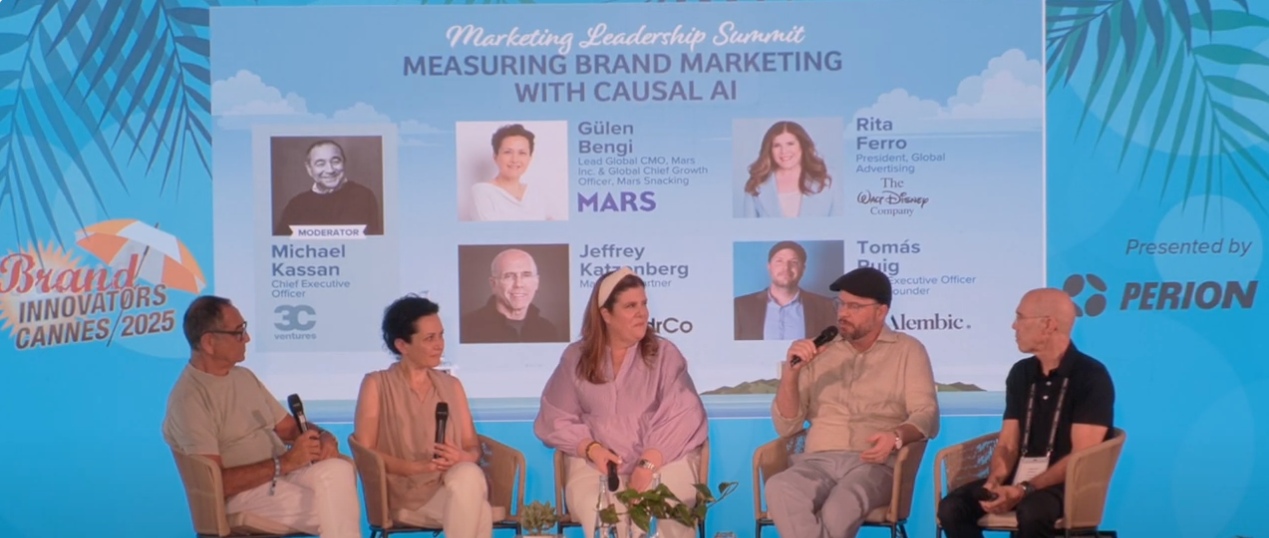
At Cannes that year, Puig joined Katzenberg, Disney advertising president Rita Ferro and Mars marketing and growth executive Gülen Bengi on a panel moderated by Michael Kassan. Bengi offered a less formal starting point for measurement: Justin Timberlake posting about a Snickers ice cream bar.
Michael Phelps and the NFL joined the conversation. Bengi described Alembic tracing how the attention spread and connected with retail sales. The example suited Puig’s argument: culture does not arrive neatly labeled for an attribution report. A spontaneous endorsement, an amplifier and a customer’s eventual purchase can belong to the same commercial story.
For Puig, these panels also brought his earlier worlds into the same room. Advertising, entertainment and technical analysis were discussing a shared question. The person who once directed music videos was now explaining how to measure what happens after people pay attention.
Private information, public expectations
In November 2025, Alembic announced $145 million in Series B and growth funding led by Prysm Capital and Accenture. WndrCo returned, alongside other investors. The announcement named Delta, Mars and NVIDIA among its enterprise customers. The money belonged to a company making an increasingly expensive technical bet.
Puig’s argument at that stage emphasized proprietary information. If competing businesses use similar general-purpose AI models, their own data becomes an important source of difference. The funding announcement tied that thesis to a new NVIDIA supercomputing cluster at Equinix’s SV11 data center. Explaining a marketing budget had become a substantial computing project.
Accenture’s involvement added a route into more enterprises. It announced both an investment and a strategic partnership, and said its own marketing and communications team was piloting Alembic. For Puig, this widened the audience for a question first encountered inside individual marketing departments.
The public agenda grew more technical, too. At NVIDIA’s March 2026 GTC, Puig and Alembic chief science officer George Mathew presented work on separating brand, fame and virality using spatio-temporal causal graphs. The session described GPU processing of more than 100,000 marketing time series. It was a considerable journey from an Arduino that needed rescuing.
On March 19, Alembic introduced version 3.0, with continuously updated causal models and scenario simulations intended to project the financial effects of decisions before money is committed. A June announcement described securing NVIDIA Vera Rubin systems and expanding deployment relationships with Equinix and World Wide Technology. Puig’s stated ambition now reaches across the enterprise, beyond marketing alone.
Series B and growth funding
Led by Prysm Capital and Accenture
Leave room for the storyteller
Outside the infrastructure announcements, the interests remain agreeably difficult to file. Puig has sung opera, trained in cooking in San Francisco and Paris, collected manga and anime, and taken motorcycles to the track, with a preference for KTM. His public biography also includes an underground dinner-party series. The résumé could use a seating plan.
It would be convenient to turn every hobby into a lesson about leadership. There is no need. Cooking can remain cooking, and a motorcycle can remain a motorcycle. What the details do establish is that his appetite for making things has extended well beyond a software company.
He once played in a punk band and imagined a future resembling Green Day’s. Much later, describing why he had gone into film and advertising, he said, “I just loved telling stories.” That preference survives inside a business now discussing private AI infrastructure and enterprise capital allocation. The machinery has grown; the stated purpose remains recognizably creative.
Puig’s career keeps returning to the same negotiation: give people something worth noticing, then account for what happened. The NASA intern learned to work with systems. The filmmaker learned to work with attention. The marketing executive learned that finance would call eventually. At Alembic, he is trying to have an answer ready when it does.