Tomás Camussi has a peculiar product to sell: the pleasure of doing something rather uneventful with your money, again and again. The co-founder and CEO of BeeWe wants saving to become an ordinary appointment that survives the week. In a business usually photographed beside a climbing chart, he makes a case for the calendar. There is something pleasingly awkward about a financial founder whose proposition improves when the customer has less to do.
His starting question was straightforward. Why did people who said they wanted to invest still fail to begin? Camussi brought a background in administration and a long-standing interest in finance to that question. His co-founder, Álvaro Martín Ortiz, brought experience in psychology and people. Their company, founded in Córdoba in 2023, grew around the gap between a sensible intention and the action that follows it.
That gap gives Camussi’s story its shape. He is building software for people who have purposes for their money without necessarily wanting to make financial markets their hobby. A plan has to make sense on the day someone chooses it. It also has to remain workable on an unremarkable Tuesday, when there are other things to think about.
A conversation before there was a company
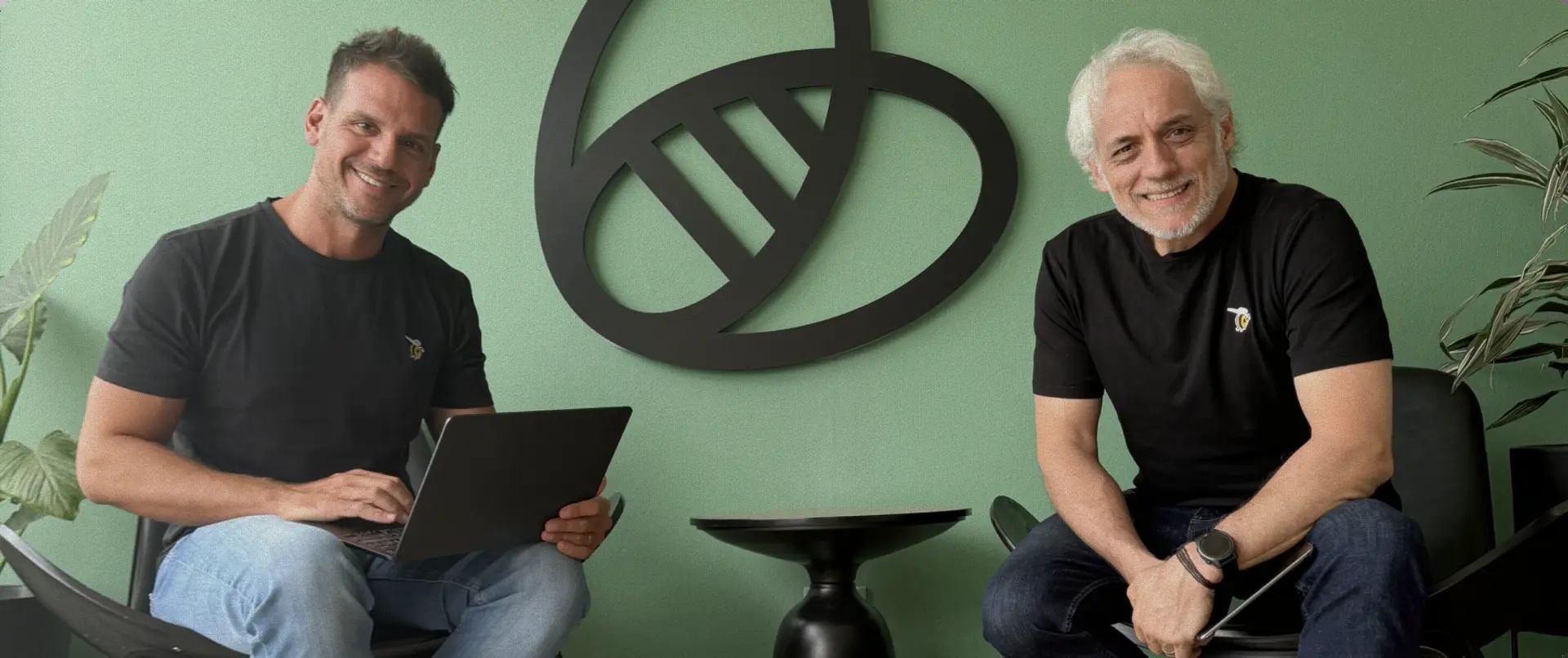
Ortiz remembers an invitation from Camussi and a conversation in a bar. The venture had not yet acquired a settled shape. In Ortiz’s telling, Camussi knew the financial world; Ortiz knew people and organizational culture. The prospect of entering finance gave Ortiz pause. He discussed the decision with entrepreneur Marcelo Cid and with his partner, Yanina Fraenkel, before returning to the conversation with Camussi.
They continued talking and reading, each taking on material that would help them understand the other’s field. The purpose became clearer through that exchange: helping people build a more workable relationship with saving and investing. It is a useful founding scene because the uncertainty belongs to the participants. Neither arrives with every answer. The partnership takes form through the work of finding a question both want to spend time answering.
Camussi’s contribution, in this account, begins with an invitation. He brings someone with a different professional vocabulary into a financial venture and keeps the conversation going. A founder can describe a multidisciplinary team in a presentation. Here the difference between disciplines was present before there was much of a presentation to make.
The customer who already wants to start
By July 2025, Camussi was explaining BeeWe around the puzzle of willing non-investors. Education mattered, but the founders were also interested in the beliefs and habits that made an investment decision difficult to carry out. Their thinking drew inspiration from Daniel Kahneman. The task was to understand what happened between someone’s wish to save and the moment they actually moved money.
The distinction has practical consequences. If a customer is simply missing a piece of information, an explanation may help. If the same customer understands the explanation but keeps postponing the transfer, a longer explanation may become another item on the list of things to read later. BeeWe’s response includes scheduled contributions, goals and a process designed to reduce the need to make the same decision repeatedly.
Camussi’s public language is consistent with that design. In January 2026 he argued that access to financial tools needs to be accompanied by education and attention to behavior. He questioned a model of inclusion that begins with banking and borrowing while giving less attention to learning to save. The order matters to him: the availability of a tool says little about whether someone can sustain the decisions it makes possible.
“Las finanzas no fallan solo por falta de información.”
Tomás Camussi · January 2026
“Financial decisions do not fail only for lack of information.” · Translation
That argument also changes the job of the founder. Camussi has to think about how a person returns to a plan after the initial enthusiasm has passed. Signing up is a moment; saving is a sequence. Designing for the sequence means accepting that customers have uneven attention and other priorities. An app that requires its users to become permanently fascinated by investing has chosen a demanding audience.
Give the money a reason to stay
In an April 2025 post, Camussi laid out his approach to goal-based investing through three stages: a reserve for unexpected needs, medium-term goals that include enjoyment, and retirement. The middle stage is revealing. He included travel, work needs and training among the reasons someone might put money aside. His explanation gave present-day ambitions a place beside distant obligations.
The sequence is part of his communication style. Rather than beginning with an asset list, he asks what the money is intended to accomplish. Time then becomes a way to organize the discussion. A goal that is approaching and a retirement decades away require different conversations. Camussi uses familiar purposes to make that difference legible to someone arriving without a financial vocabulary.
There is a modest pleasure in seeing enjoyment allowed into a financial plan. The future can be a stern correspondent, forever asking the present to send more money. A recognizable goal gives the exchange a little personality. In Camussi’s framing, the habit has something to work toward along the way, rather than a reward visible only at the far end of a career.
He returned to the question of sequence in October 2026, explaining why a reserve for unexpected expenses belongs before longer-term commitments. His concern was that an immediate need could force someone to dismantle a plan built for a different horizon. The subject is ordinary, even domestic. That is precisely where his public work tends to land: in the relationship between a plan and the life it must fit.
A friendly bee has a serious assignment
Camussi has also worked on the invitation people receive before they ever encounter the software. In April 2025, BeeWe’s collaboration with Lanzallamas brought its approach into the language and presentation of the brand. The project involved Camussi, Ortiz and Mariana Santillán on the company side, alongside the agency’s strategy and creative team.
His explanation at the time emphasized making saving and investing accessible without requiring expert skills. That is a claim about the audience he wants to reach as much as a description of technology. A product can offer an efficient process and still make a newcomer feel that they have wandered into a room intended for somebody else.
The bee gives this particular room a less formal doorkeeper. The visual tone suits the work of making a financial conversation approachable. Behind it sits the more demanding assignment of turning a friendly introduction into a process people understand. A mascot can introduce the subject. It cannot do the customer’s understanding for them.
In a testimonial about work with Nueva Mirada, Camussi emphasized the translation of BeeWe’s purpose into an actionable business plan and clearer marketing and communication. The emphasis is practical. An idea that makes sense to its founders still needs to be explained outside their own conversations. For Camussi, that work has involved collaborators as well as code.
The number, and the names beneath it
On November 11, 2025, Camussi announced that BeeWe had exceeded US$20 million in investments, four times its objective for that year. He presented the figure alongside the launch of a new app. The announcement was his own account of the company’s progress, and he described it as an early step.
In investments reported by the CEO, alongside a new app launch.
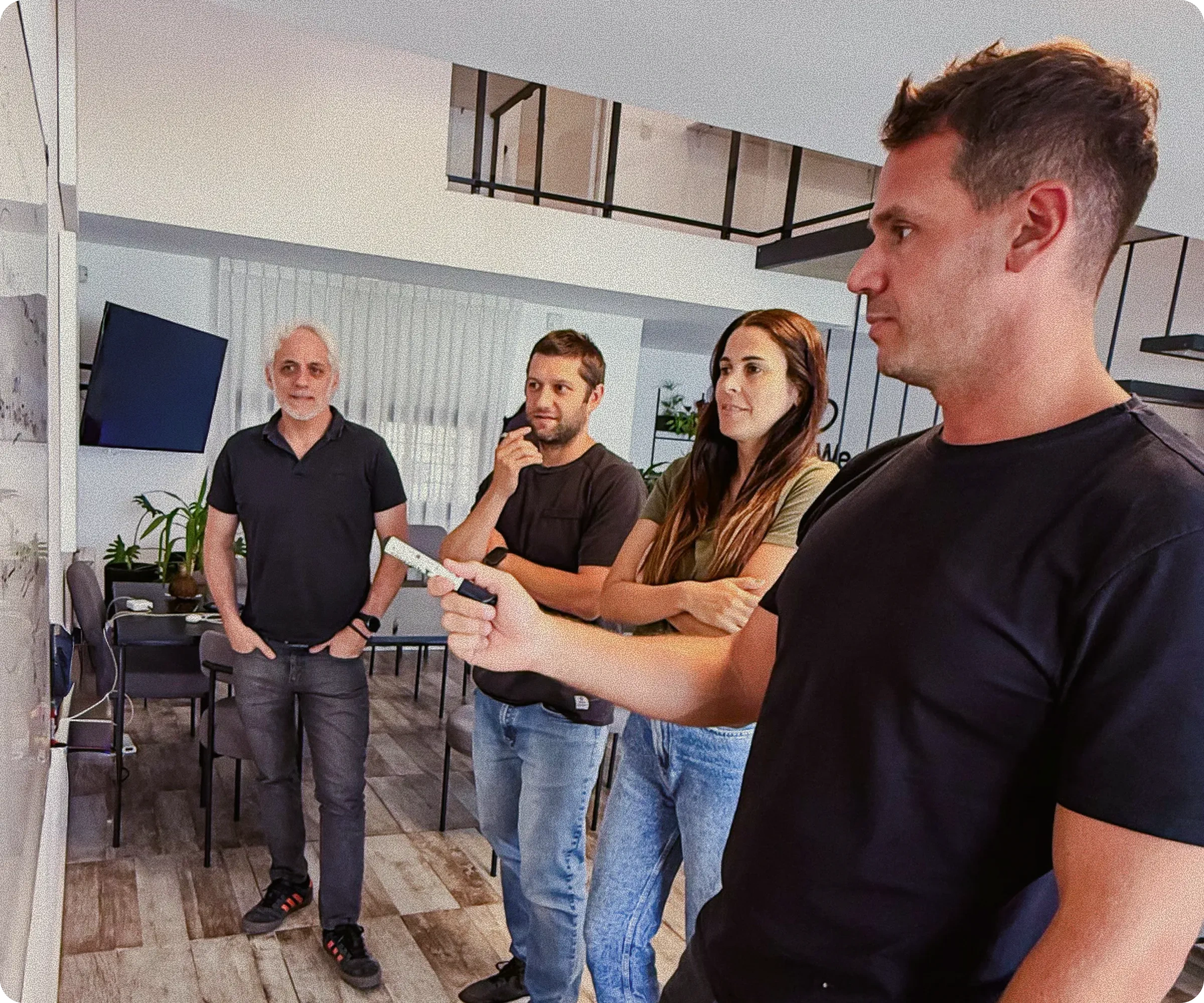
He connected the result to months of work and the confidence of people using BeeWe for personal and business savings. Then came the names: Ortiz, Alejandro Silvestre, Román Canello, Maria Carolina Ferreria Centeno, Gonzalo Vidal, Lucía Muiño, and the Kilómetro team, with a particular mention of Santi Gatti. It reads as a record of shared work. The app had passed through ideas, adjustments and many hours before becoming an announcement.
There are two rhythms in that moment. The company has a target and a launch to celebrate. The customer is being offered something deliberately repetitive. Camussi has to keep both in view: building the organization quickly enough to deliver a useful product, while making the product calm and comprehensible enough to become part of an ordinary routine.
Córdoba, with a wider map in mind
BeeWe’s public export profile places the business in Córdoba and describes a model that reaches people through employers as well as individual users. Its company presentation identifies Argentina, Chile and Mexico as initial markets of interest. Those are plans for a wider reach, rather than a reason to assume the same operating presence in each country.
For Camussi, the expansion ambition sits beside an unusually specific picture of the intended customer. He has spoken about serving the ordinary user who comes from outside the investment world. In July 2025 he and Ortiz also appeared on episode 51 of Bien Cordobés to discuss the company’s beginnings and approach. The local conversation and the regional ambition belong to the same venture.
The thread running through his work remains the small action repeated. A co-founder invites a future partner to talk. The two return with more to read and more to discuss. A team works through the adjustments before an app launch. A customer chooses a purpose, sets a contribution and lets the routine proceed. Camussi’s bet is that progress can be built into those returns. The calendar, at last, gets some credit.