At a bell foundry in Leicestershire, Tom Scott helped break a 142-year-old bell. For someone whose work has long involved explaining how things fit together, it is a splendidly awkward place to begin a comeback. There is heat, heavy metal and a process with enough age behind it to make a presenter keep his hands where he is told. The bell became the first stop in Tom Scott: England, his 2026 series about the curious machinery and customs of the place he calls home.
The series has a map and, unusually for a video project with a weekly release, a known edge. Scott traveled through all 39 historic English counties over about eight weeks, driving more than 5,000 miles. He filmed something interesting in each. That description is deliberately loose. In Rutland, it meant flight without fuel; in Durham, a mist system under the Tyne; in Cambridgeshire, a crack at the top 100 in tiddlywinks. His subjects still refuse to share a neat shelf.
The boundary matters because his previous shelf had no apparent end. From New Year's Day 2014 to New Year's Day 2024, Scott kept a weekly appointment with the internet. He took questions most people would never think to ask, found the people and places with answers, and came back with a concise explanation. After ten years, he closed that run. England marks a return to regular videos, but this time the rhythm belongs to a finite journey.
2014–2024
in the England series
on the road trip
A joke the government read
Long before the red shirt became a familiar internet sight, Scott was a student at the University of York studying English language and linguistics. In 2004, he built a parody of the British government's Preparing for Emergencies site. The official advice had a grave voice; Scott's version had room for a zombie apocalypse. The Cabinet Office asked for the page to be taken down. Scott declined, politely. British institutions have often supplied his material, though rarely on purpose.
That episode introduced a style more durable than any particular prank: understand a system well enough to make a joke at its expense, then see what the system does. By 2008, friends had nominated him for the University of York student union presidency as “Mad Cap'n Tom Scott,” his Talk Like a Pirate Day persona. The joke candidate won almost 3,000 votes and became an actual president. The distinction between bit and biography had become rather thin.
He later ran for Parliament in 2010 after losing a bet. The pirate candidacy collected 84 votes in Cities of London and Westminster. It was a small electoral result and a tidy comic one: a university joke had achieved the awkward maturity of appearing on a ballot paper. Scott's media life was already underway. The Technical Difficulties, his university radio group with Gary Brannan, Chris Joel and Natalie Gray, won a student radio creativity award in 2008. The four kept making shows together as the platforms changed.
He also turned up on the quiz show Only Connect in 2010 as captain of a team called the Hitchhikers. Much later, he represented York on Christmas University Challenge. The appearances fit the same public character as the student pranks, though with fewer pirate hats: someone pleased by a question that takes a minute to untangle. A quiz gives that pleasure a timer. Scott's later shows would find ways to let the untangling run longer.
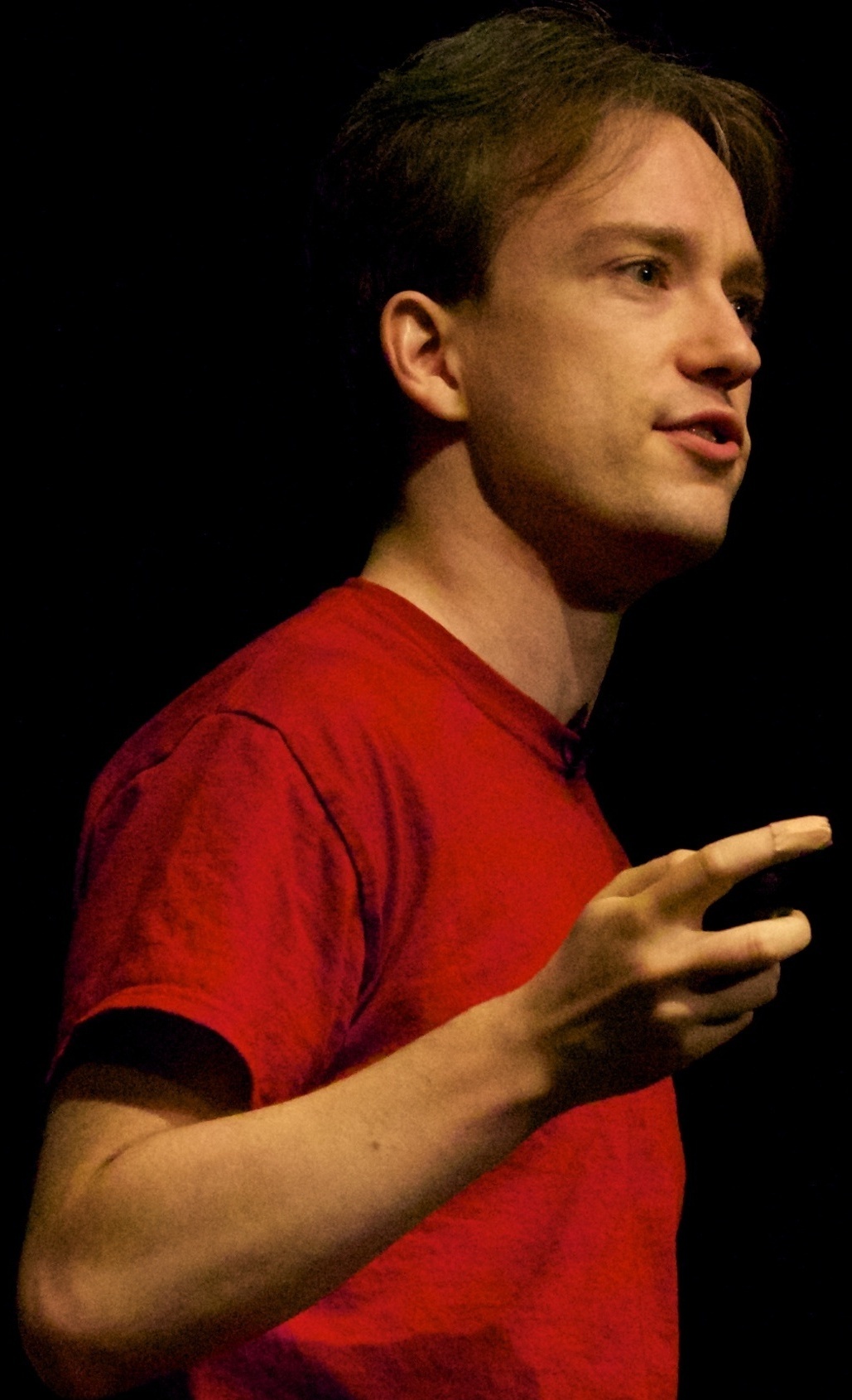
An internet made of small experiments
Scott worked in web development and television before the weekly videos took over. On Sky 1's Gadget Geeks in 2012, he helped create software solutions alongside Colin Furze and Charles Yarnold. Other projects came with a wink and a warning. One exposed what Facebook's Graph Search could reveal about users. Another, Parliament WikiEdits, announced edits to Wikipedia from parliamentary IP addresses. These were jokes with functioning code and functioning points.
In 2014, he and Matt Gray built Emojli, a social network on which names and messages were made of emoji. It lasted roughly a year. A later keyboard project used fourteen ordinary keyboards to make room for every standard emoji. The scale of the contraption is the joke, but it also says something about Scott's taste. An abstract problem becomes more interesting when someone can stand beside a physical answer and press a key.
The same appetite shaped the main channel. A compact video might begin with an odd-looking bridge or a counterintuitive fact about colour, then move quickly toward the person who could explain it. Scott filmed in places where mechanisms can be seen at work: warehouses, transport systems, research sites, remote settlements. Language and geography also recur. A degree in linguistics does not explain every subject he chose, but it does make his attention to words less surprising.
His delivery gave those subjects a common tone. He speaks as if the viewer has joined him on an errand and will appreciate the answer before the parking meter expires. The jokes are usually brief. The diagram, experiment or expert gets the good seat. That approach brought a 2022 Streamy Award for Learning and Education, but its clearest achievement may be that viewers began to recognize a Tom Scott story without knowing what it would be about.
“They'll probably come back to haunt me in a few years' time.”Tom Scott, introducing his projects on his website
A puzzle is better with company
The solo presenter is only one version of Scott. The Technical Difficulties have moved from radio into web series including Citation Needed, Two of These People Are Lying and Reverse Trivia. Their long collaboration has the ease of people who have spent years giving one another an opening, then regretting it at once. A show can change its rules; the four voices still know how to find the joke.
Then there is Lateral, the weekly comedy panel game podcast Scott hosts. Its questions reward the person willing to abandon a sensible first answer. Three guests think aloud while the conversation travels sideways, sometimes for a satisfyingly long time. The podcast grew from a video game-show idea co-developed with David Bodycombe, who produces the audio show. A Lateral puzzle book followed in 2024, making the listener's temptation to shout at the speakers into something one can play at home.
These partnerships complicate the easy picture of Scott as a man who simply knows an immense number of facts. In the group shows, he is often a host, a foil or a willing participant in somebody else's surprise. In his 2026 series, too, the most memorable moments tend to belong to the people who keep a place or process running. His curiosity supplies the route; their knowledge supplies the destination.
The value of a finish line
Scott announced the end of his weekly main-channel run in January 2024, ten years to the day after it began. He had already warned viewers that the format would stop. The decision left room for Lateral, the work with friends, and projects that did not have to fit a Monday-sized box. His channel did not vanish; the standing appointment did.
A year later, he appeared in Jet Lag: The Game, joining the competition across Europe's Schengen Area. In March 2026 came the new work with his name over the door. For Tom Scott: England, he drove the route and filmed on location with his own cameras. Producers Guy and Cambria of Penny4 helped plan the journey, and a post-production team shaped the footage and later studio material into episodes. The solitary figure beside a curious object is only one part of how the finished story gets made.
The format combines location footage without a script with reflections recorded afterward. Episodes run longer than the short explanations many viewers knew: often 15 to 30 minutes. Scott selected the historic counties partly because there are 39, a count with a satisfying last number. On his map page, he cheerfully acknowledges that even this was plenty. The Isle of Wight receives an apology. Scotland, Wales and Northern Ireland remain outside this particular route; the project already has all the geography it needs.
The map exists online rather than as a recurring graphic at the start of each video. Scott considered placing it in every episode, then decided the counties would make the introductions too crowded and slow. Viewers can arrive partway through the series and still follow the story in front of them. On the website, meanwhile, each newly released county gets its own link. It is a small editorial choice, but a telling one: the route gives the series its shape without asking every local subject to carry a geography lesson as well.
There is a subtle joke in the idea of completing England by collecting counties. No journey can do that. A county contains far more stories than one video, and a line on a map hardly tells a camera where to point. The constraint works because it asks Scott to stop everywhere, including places he might otherwise have driven through. In one county a bell cracks; in another a machine makes mist under a river; elsewhere a hobby turns briefly into a competitive ambition. His old question returns in each new setting: what happens here that I have been passing without seeing?
That is the thread connecting the zombie site, the pirate campaign, the emoji network, the quiz table and the road. He has often taken a rule that seems settled and given it a playful, practical test. The difference now is the project has room to linger. Its 39th stop is part of the design, not a failure of imagination. Until then, there are still roads to take and things to find beside them.