A creator uploads a video. The title is set, the thumbnail is chosen, and the work moves from a private editing screen into an enormous public system. Soon there are graphs to read, comments to answer, and a familiar question: what did YouTube make of it? Rene Ritchie spends his working days near that question. He is YouTube's Creator Liaison and Head of Editorial, a job built around making a large platform intelligible to the people who depend on it, then bringing those people's experience back into the company.
He arrived there by a route that gives the job its character. Ritchie spent years explaining technology as a journalist, left to make videos on his own, and then joined the platform whose tools he had been using. He has worked with the newsroom deadline and the creator's lonely upload button. Both are useful when a product change reads as a neat sentence in an announcement and lands as a complicated Tuesday in somebody's business.
The title sounds diplomatic. Much of the work is practical. Ritchie has described his time as roughly divided between helping YouTube understand creators and helping creators succeed on YouTube. The second half often takes the form of plain answers to questions wrapped in folklore. Why did a video slow down? Does a thumbnail matter more than a tag? Is a channel allowed to change its mind about what it makes? The first half requires the less visible skill of listening.
Before the algorithm, the editor
Ritchie's public career begins in a different internet. He says he has been blogging, podcasting and posting videos since 2008. That year he began writing for the iPhone-focused site that would become iMore. The iPhone was young; the language for talking about it was still being made. An editor covering that world had to explain both the device and the habits forming around it, often at the pace of a news cycle that barely paused for sleep.
He had worked in product marketing for SAND, an analytics company, before making technology media his full-time career. At iMore and the wider Mobile Nations network, he moved through editorial leadership roles, including editor-in-chief and editorial director. The publications changed names as the mobile world changed around them. Ritchie remained a recognizable voice through those changes, writing about Apple, questioning the claims around new products, and meeting the demands of an audience that knew the specs and wanted to know what they meant.
At his 2020 departure, Ritchie counted more than four million words and 8,700 posts on iMore, along with more than 1,000 podcasts across Mobile Nations. Those numbers are large enough to sound abstract. They also suggest a daily practice: thousands of small decisions about what a reader needed to know and what could wait. Audio gave that voice another home. Ritchie became a regular co-host on TWiT's MacBreak Weekly in 2013 and appeared on other technology podcasts. His conversations made room for details that a review might cut: the awkward edge case, the odd product choice, the argument about whether a feature would matter after the launch week. Talk long enough about a device and you eventually talk about the people holding it.
There is a small clue to his range on his bookshelf. Alongside iPhone and iPod touch guides, Ritchie's published credits include books on Wing Chun. It is an unlikely pairing only if you assume a person's interests should be as neatly boxed as a website category. Both kinds of book ask an author to break a complicated system into moves a reader can actually follow.
The risk of doing it yourself
In 2020, after 11 years at iMore, Ritchie went independent. He wrote at the time about friends and peers inviting him onto their podcasts to introduce his new work. A familiar editor had become a one-person operation, responsible for the topic, script, camera, edit, title, thumbnail and whatever came after publishing. His channel centered on Apple and technology, but the story of the channel was also about the machinery of making one.
That move is easy to make sound tidy in hindsight. It was a career risk he later described plainly on LinkedIn. The timing put him inside the same daily cycle that many creators know: an idea that seems sound before recording, a title that seems obvious until it needs to fit on a screen, and an audience whose choices can surprise its maker. He had written about platforms for years. Now his own work had to live on one.
He retained the habit of argument. On his site, a 2022 post about a new MacBook Air objected to technology coverage that turns every benchmark into an emergency. In other posts he weighed the trade-offs of product design, privacy and security. A little exasperation could become part of the performance, but it had a target: the distance between a dramatic claim and what the evidence actually showed.
The independent period also changed the meaning of his next job. When YouTube hired Ritchie as Creator Liaison in July 2022, it hired someone who had recently been on the other side of its dashboards. He succeeded Matt Koval in a role designed to give creators a human connection to a company that can otherwise feel like an endless collection of menus, policies and recommendation systems.
A translator with skin in the game
Ritchie explained the assignment in two directions: advocate for creators inside YouTube, and help people outside the company understand how YouTube works. He would not handle individual support cases. His remit was broader, concerned with patterns in what creators need, the language the company uses, and the places where those two things fail to meet.
“I spend about half my time helping YouTube better empathize with creators and the other half helping creators better succeed on YouTube.”Rene Ritchie, writing for the YouTube Blog
That description is tidier than the job itself. A creator worried about views may ask for a rule; a useful answer may be a question about what viewers came for. Ritchie's recurring explanation of recommendations asks people to think about the audience first. The platform tries to find videos for viewers; the creator's task is to make a video those viewers want to watch. It offers less comfort than a secret switch to flip, but it offers more to work with.
Consider the thumbnail. Ritchie has explained that YouTube's thumbnail tests look at watch time, rather than simply rewarding the image that wins a click. A click alone can be bought with a promise the video fails to keep. Watch time asks whether the experience on the other side was worth the viewer's attention. In a 2025 conversation about YouTube Studio, he connected that difference to returning viewers and a lasting audience. The metric is a number; the underlying question is whether a person got what they came for.
He has used short videos, the YouTube Blog and appearances on Creator Insider to answer the questions creators trade among themselves. A 2024 set of Shorts with YouTube's Todd Beaupré addressed tags, categories, file names, thumbnail testing and the evergreen anxiety of pleasing the algorithm. Ritchie also wrote weekly roundups that mixed product explanations with observations from events and creator conversations. Their tone could turn playful; his sign-off, “get with the contenting,” sounded like a wink at the work everyone would return to after reading.
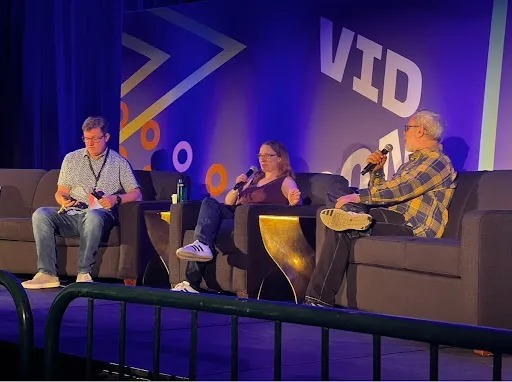
The room matters. In a dispatch from VidCon 2024, Ritchie described talks with Beaupré and Gwen Miller about YouTube recommendations. He also wrote about a policy summit where creators could question teams responsible for advertising guidelines, copyright and discovery. His account returned to faces: a policy has a person behind it, as does a channel affected by it. The observation might sound obvious until one sees how often platforms and users argue as if the other side were a machine.
Keeping a hand on the controls
One of the more revealing things Ritchie wrote that year concerned his own workflow. While employed at YouTube, he was still editing and posting several Shorts on weekdays. He said the work helped him remain an “OG creator” inside the company, testing the old and new workflows and keeping what he called “skin in the game.” It is a useful safeguard for a liaison. A person who has just spent time uploading a video is less likely to mistake a product diagram for the whole experience.
His conversations also range beyond the familiar algorithm questions. He has interviewed creator journalist Johnny Harris about old and new media, discussed podcasting with Jon Youshaei and YouTube product leaders, and joined a 2025 conversation about how YouTube Studio can serve creators at different stages. In 2026 he interviewed Don Lemon at YouTube's Independent Media Summit, a gathering concerned with the practical work of independent journalism. At SXSW the same year, he joined Youshaei for a discussion of creator workflows and AI tools.
Those appearances follow the arc of his own career. A blog editor can ask what a newsroom owes its readers. A solo creator can ask how to make a sustainable operation out of a voice and a camera. A platform employee can ask how the tools, policies and explanations are landing with both of them. Ritchie has held all three positions, and the questions do not cancel one another out.
Ritchie's advice returns to a deceptively ordinary sequence: understand the audience, make a clear promise in the title and thumbnail, deliver on it in the video, then use the response to make the next one better.
There is a modesty in that sequence. It does not promise a formula for every channel or a straight line from effort to views. It leaves room for changed interests, crowded topics, timing and luck. Ritchie wrote in 2024 that audiences evolve and creators have to find ways to stay relevant to them. It is a tougher answer than “use these five tags,” especially from someone whose job could tempt people to expect an insider's magic phrase.
For Ritchie, the personal story is inseparable from that answer. He spent years interpreting new devices for readers, then learned what it meant to build an audience around his own work. He now works inside the company that hosts millions of such efforts. The distance between a creator and a platform cannot be closed by a single video or a job title. It can, however, be shortened by someone who knows what the questions sound like before they reach the meeting room - and who can carry an answer back out in language a person can use.