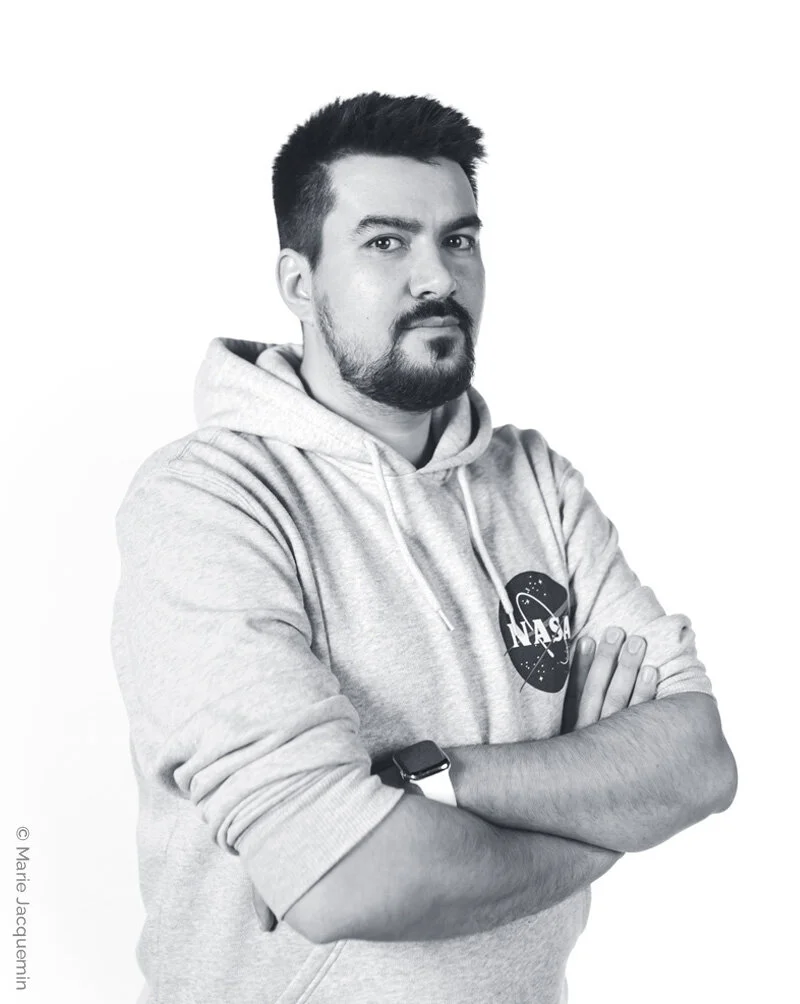
Philipp Dettmer dropped out of school at 15, studied design, and then turned a university thesis project into the internet's most-watched science channel.
Kurzgesagt is not a person. Kurzgesagt is a studio, a school, a philosophical project wrapped inside a YouTube channel. But it started with one person: Philipp Dettmer, born January 21, 1986, in Munich - a city that would also become the permanent home of everything he built.
At fifteen, Dettmer left high school. Not because he was failing - but because the system had nothing left to offer him. What saved him was a single teacher who reignited something: the particular joy of understanding why things are the way they are. He eventually got his degree. Then he went to Munich University of Applied Sciences and studied Communications Design with a focus on infographics and information visualization - the exact skill set that would later make his work unmistakeable.
He graduated in 2013. On July 12 of that same year, he uploaded the first Kurzgesagt video. It was about evolution. The animation was flat, the birds were there from the beginning, and within a very short time people were sharing it far beyond what any thesis project should be able to reach.
"Everything can be made into a story."
- Philipp DettmerThe word "Kurzgesagt" translates from German as "in a nutshell" or "shortly said." The name is both a promise and a method. Black holes, immune systems, the Fermi paradox, nuclear power, loneliness, and the heat death of the universe - compressed into ten minutes without losing the complexity. That's not a design choice. It's the whole game.
What Dettmer built around that idea became something the internet had not quite seen: an animation studio with editorial standards, a design agency running alongside it, and a science communication project that takes funding from sources like the Bill and Melinda Gates Foundation ($570,000 in 2015) and the Open Philanthropy Project (€2.97 million in 2022) while still keeping 65% of its income from its own audience through merchandise, Patreon, and ad revenue. That ratio is not an accident. It's a philosophy about who the work is for.
When the COVID-19 pandemic hit in early 2020, Kurzgesagt produced an explainer video so clear and so shareable that it racked up 89 million views - academic researchers later cited it as a model of how to communicate biological complexity to a general audience. Academic journals don't usually cite YouTube videos. This one got cited.
- The Coronavirus ExplainedBy 2019, the channel became the first German YouTube channel to surpass 10 million subscribers. Today the number sits at 25.2 million with 3.6 billion total views. The studio has grown to 70 people. Channels exist in German, Spanish, French, Hindi, Arabic, Brazilian Portuguese, Japanese, and Korean - eight languages, each with its own dedicated channel.
The studio took a visible public stance on accuracy in 2019, removing two videos - one on the European refugee crisis, one on addiction - that it concluded no longer met its standards for rigor. The act of publicly removing its own work and explaining why is rarer than it sounds in a media landscape where corrections are typically buried and old content is never touched.
As of April 2026
Most-viewed single video
Globally, as of Nov 2025
Most creators chase brand deals. Kurzgesagt built its income around its own audience - merchandise, Patreon support, and ad revenue account for nearly two-thirds of everything it earns. The remaining third comes from carefully chosen grants and sponsorships.
This structure gives the studio an unusual degree of editorial independence. When Open Philanthropy handed over €2.97 million in 2022, Kurzgesagt remained the one making decisions about what to cover and how. The Gates Foundation relationship works the same way. Funders fund. The studio decides what's true.
Source: Kurzgesagt income disclosure, 2020-2022 data
$1.2M - $2.2M
Estimated annual channel revenue. Monthly ad revenue alone: ~$81,700. The studio's total operations - merchandise, agency work, licensing - significantly exceed YouTube earnings alone.
Most science communication tries to be neutral. Kurzgesagt makes a different bet: that a science-based, humanist, and optimistic worldview is both defensible and necessary. That's not naivete - it's a position about what kind of thinking actually changes outcomes. You don't inspire people to act by telling them everything is fine. You also don't inspire them by telling them everything is broken. You find the third path, which is harder and rarer.
Dettmer's background in information design is visible in every frame. The studio's visual style - flat design, bold color fields, a consistent cast of illustrated birds doing increasingly surreal things - is instantly recognizable. It's been imitated endlessly. The imitations are always slightly off, because the visual style isn't decoration. It's argument. The way information is arranged on screen is itself a claim about how ideas relate to each other.
The studio now implements expert fact-checking across all content. When a video on exercise science in July 2024 generated controversy, Kurzgesagt consulted additional experts and released an updated version in September 2024. Not a correction note at the bottom of a video - a new version. This is expensive and unusual and exactly the kind of thing that makes the audience trust the product enough to pay for it directly.
"We think a utopian future is possible. The feeling we want to instill in people is optimism."
- Kurzgesagt Mission StatementVideos range from 8 to 20 minutes and cover territory that spans the very large (the scale of the universe, deep time, the Fermi paradox) and the very small (how cells die, what loneliness does to a body, the mechanics of nuclear reactors). The through-line is always the same: here is how this works, here is why it matters, and here is something that should make you want to find out more.
In November 2021, Philipp Dettmer published Immune: A Journey Into the Mysterious System That Keeps You Alive - a full-length illustrated exploration of immunology aimed at curious readers with no medical background. It's the Kurzgesagt method applied to 300 pages: complex biology translated through analogy, narrative, and a refusal to talk down to the reader.
Bestselling author John Green called it "a truly brilliant introduction to the human body's vast system for fighting infections and other threats" and praised Dettmer's ability to clarify complex ideas through "wonderful analogies." The timing - arriving during a global pandemic that had put immune function at the center of every dinner table conversation - was either fortunate or very deliberate.
The book was translated into multiple languages and extended Kurzgesagt's reach beyond YouTube for the first time. It was the first major indication that Dettmer was thinking about the studio as something beyond a video channel.
↗ Penguin Random HouseIn June 2024, Kurzgesagt announced a partnership with Toukana Interactive - the German studio behind Dorfromantik - to build Star Birds, a cozy space-mining game. It launched in Early Access on September 10, 2025, after deliberately shifting its release date to avoid competing with Silksong, the most-wishlisted game on Steam. (The gaming internet appreciated the move.)
Over 200,000 players signed up for the free demo before launch. Steam reviews settled at 95% positive. PC Gamer called it deceptively complex. GameLuster called it a perfect entry point for newcomers to automation management games.
Star Birds is Kurzgesagt's first venture outside video and print - and a signal that the studio's curiosity-first philosophy can generate new product categories, not just better videos.
Kurzgesagt's stated goal is to "spark curiosity in people about science, humanity, and our future on the planet - and the universe we all inhabit." Dettmer believes a utopian future is achievable. He thinks optimism is not naive. He thinks the way to get people to care about evidence is to make evidence beautiful.
With 70 staff, 8 language channels, a book, a video game in early access, and 25 million people who turn to them when they want to understand how something hard actually works - Kurzgesagt is making a credible run at that goal.