The useful thing about a school district office is that it refuses to behave like a product brochure. People leave. Budgets pinch. A new tool arrives beside five old ones. The person who understands the reporting workflow takes a holiday, and suddenly a perfectly respectable system acquires the temperament of a locked filing cabinet. Tom King learned the school-software business in rooms like these. Long before he became chief marketing officer of Skyward, he worked directly with more than 100 district customers across a decade in regional sales. His education was part software, part anthropology.
King started at Skyward around 2005 and has described holding a variety of sales and marketing roles since. It is a long apprenticeship at one company, but not a narrow one. A seller of K-12 administrative systems sits where technology collides with payroll deadlines, attendance counts, state reports, family questions and the daily ingenuity of school staff. The software may live in the cloud. Its consequences are stubbornly terrestrial.
The three words that survived the product cycle
In 2015, when King was a regional sales manager, he was asked what district leaders wanted from a student information system. He answered with three words: reliability, security and scalability. The compactness is revealing. Enterprise technology invites ornamental language, but district leaders need accurate data available in real time. They need access on mobile devices without surrendering protection. They need the same system to make sense for a district of 1,000 students or 75,000.
These concerns sound almost plain, which is another way of saying they are difficult to fake. Reliability is noticed most vividly in its absence. Security works by preventing the event everyone would notice. Scalability is a promise that must hold after the contract is signed. Together they make a fine description of the unshowy obligations beneath school technology.
King also argued that technology staff should be present when districts make software decisions involving student information. Otherwise, a purchase can sit awkwardly beside the administrative system and push the technology department into reaction mode. The observation comes from someone who had watched decisions travel downstream. Integration was not a technical footnote. It was the difference between a system and a pile.
Reliability
Accurate district data, accessible when administrators need it rather than when a system happens to cooperate.
Security
Convenient access for staff, students and families, paired with protection worthy of the records involved.
Scalability
Enough flexibility to serve a district of 1,000 students or one with 75,000 without losing the plot.
A depth chart for the district office
A year later, King found his best metaphor on a football field. The 2015 NFL season had been bruising: star players were injured, backups became starters and the phrase “next man up” escaped the locker room. King borrowed it for an essay about staff turnover in school districts. Many offices, he wrote, depend on a few all-stars who know their processes, their software and all the undocumented bridges between them. Then one of those people leaves.
His response was an “employee disaster recovery plan.” Technology teams routinely prepare for the failure of infrastructure; King wondered why they did not prepare as carefully for the departure of the person who knew how to use it. Initial vendor training tended to concentrate expertise in a few power users. Those experts trained colleagues, attended conferences and solved problems until turnover thinned the original group. Confidence fell. Useful features sat untouched.
King's prescription joined self-service learning, mastery courses and cross-training so knowledge could survive a change in the lineup.
The alternative he sketched was less heroic and more durable: direct training for key staff, self-service material for everyone else, advanced courses for power users, transparent updates and certifications that made a backup ready before the starter disappeared. This was not really a football argument. It was an argument against institutional fragility, delivered in a form that anyone watching Sunday afternoon could understand.
There is a marketer's instinct in that metaphor, but also an operator's respect for the handoff. King wrote that buying enterprise software was about more than software. The surrounding partnership - training, updates and continuing development - determined whether people could use what they had bought. The line separates a feature list from a lived product. It is also the clearest thread through his public work.
The field rep becomes the person framing the field
By January 2023, King was signing a public district contract amendment as Skyward's vice president of sales and marketing. By March 2025, he was speaking as chief marketing officer. The titles mark a widening circle of responsibility: from individual district relationships to the company's account of where school administration technology is going.
Begins at Skyward and moves through sales and marketing roles.
Regional sales manager with more than 100 district customers served.
Publicly identified as vice president of sales and marketing.
Appears as chief marketing officer at the DistrictPulse launch.
Leads an internal class on sales, marketing and entering new states.
At Skyward's 2025 user conference, that future arrived as DistrictPulse, an analytics and visualization tool developed with Amazon Web Services and connected to the company's Qmlativ platform. The product was designed to give district leaders strategic insight while preserving the access controls already established in Qmlativ. King's comment at the launch stressed performance and decision-making, but its logic echoed his 2015 checklist: useful data, safely delivered, at a scale a district can act on.
A year later, more than 400 K-12 leaders gathered for Skyward's 2026 conference and attended over 80 sessions. The program covered artificial intelligence, product optimization, migration and district operations. King described districts as ready for a more modern, connected future. “Connected” is doing important work there. A school system contains finance, HR, attendance, scheduling, instruction, families and state obligations. Modernity without connection merely gives each silo a nicer screen.
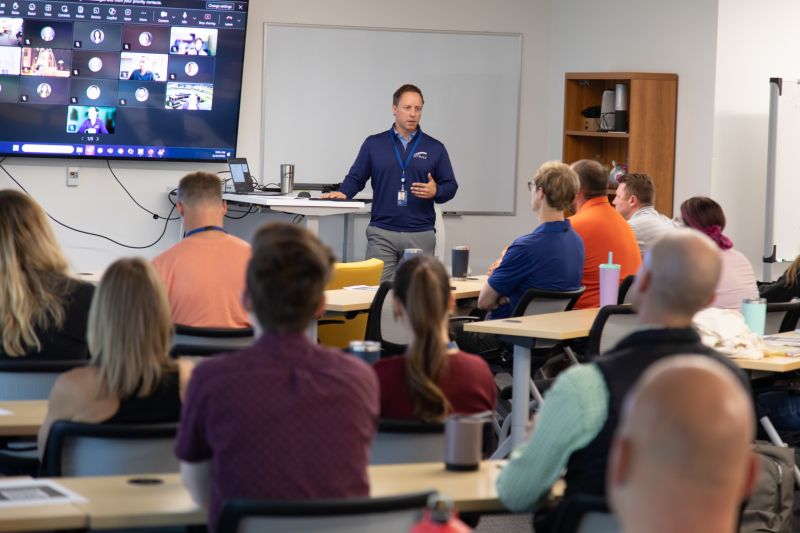
His most recent visible classroom was closer to home. In late August 2026, King led a packed learning session for Skyward employees. He offered a high-level view of sales and marketing strategy, discussed the tools the company uses, and explained how Skyward establishes business in new states. He also connected short-term marketing timelines to long-term goals. The regional salesperson who once learned from district offices was now teaching colleagues how a market is entered. The movement is neat, though the substance remains practical: tools, territory, time.
Bright shorts and a local inheritance
King's connection to Skyward is more personal than a long tenure alone suggests. He is the son of Cliff King, a longtime Skyward executive remembered in Central Wisconsin for his devotion to the company, its employees, its customers and the local university. At the first Cliff King Memorial Golf Outing in 2021, more than 100 friends, former colleagues and relatives arrived in conspicuously bright clothing.
The reason was wonderfully specific. Cliff liked to wear very bright shorts on the golf course. Tom explained that everyone was carrying on the habit because it was something his father would have loved to see. The outing raised money for scholarships for business and economics students at the University of Wisconsin-Stevens Point. A memorial can become solemn by default; this one chose color, golf and future students.
That scene adds useful dimensions to an otherwise orderly executive biography. Skyward was founded in Stevens Point in 1980. Tom King's career there has unfolded within a family history and a regional one, amid the schools and institutions that form Central Wisconsin's civic life. He later studied at UW-Stevens Point from 2023 to 2025, even as his corporate responsibilities were expanding. Seniority did not end his time as a student.
The product around the product
King's public record is compact and consistent, centering on a set of concerns spread across an interview, an essay, product announcements and a company classroom. Listen to district staff. Protect their data. Prepare for turnover. Offer help in more than one format. Make a system flexible enough for different scales. Connect analytics to decisions. Remember that the buyer is choosing a partner as well as a platform.
None of this promises to make school administration glamorous. That may be its virtue. Attendance still has to be recorded. People still have to be paid. Reports still have to reach the state. Families still want an answer. In that environment, “future ready” is not a theatrical burst of innovation. It is the ability to face the next school day with accurate information, trained people and fewer brittle points of failure.
The route from regional sales to the C-suite gave King a view of both ends of the promise. He saw what companies say a system will do, then watched district teams make it true. Two decades later, his work is to frame Skyward's direction for a larger audience. The best clue to how he approaches that job is still buried in the old football analogy: do not build around a single star. Build depth. Share knowledge. Prepare the next person. A durable institution, like a good team, should know what to do when the lineup changes.