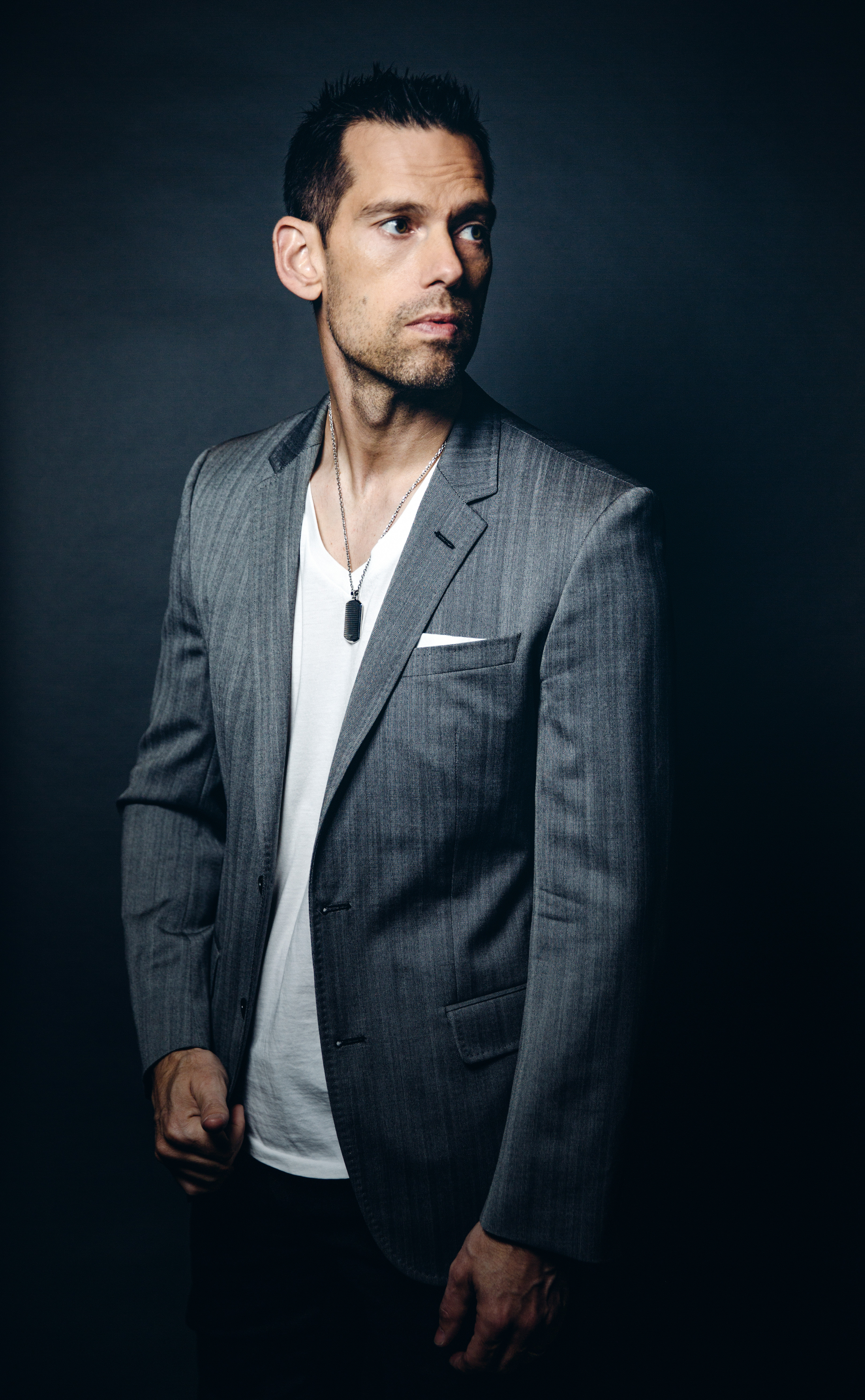
He wore a hairnet. The year was 2010, and Tom Bilyeu was standing on the production floor of Quest Nutrition, a protein bar company he had co-founded out of his living room with his wife Lisa, mixing batches alongside the people he had just hired. Not as a stunt. Not for an Instagram story. He was there because he believed that if you wanted people to work hard for you, they needed to see you doing the hard work yourself. The hairnet was non-negotiable. So was showing up.
That detail - middle of the floor, hairnet on, building something from nothing in the most literal sense - explains more about Tom Bilyeu than any resume line could. He is not someone who managed a billion-dollar company from a glass-walled office. He built it at the molecular level, and when the company sold for $1 billion in 2019, he had already walked away from the CEO role three years earlier to start something harder: changing how people think.
Before the Billion
Bilyeu was born in Tacoma, Washington in 1976 and arrived at adulthood through a series of jobs most profiles prefer to footnote. He worked in a door factory at age 12. He scrubbed industrial vats at a paint factory. He worked at a gun range where he nearly lost his leg. His mother, at various points, worried he would not finish college. He got a full scholarship to the University of Southern California's School of Cinematic Arts anyway - not business, not entrepreneurship, film - and spent years learning how to tell stories before he learned how to sell anything.
At USC he met Lisa, then 21 and a student in one of his classes. They dated for two years. Her father said no when Tom asked permission to marry her. They married anyway, on July 7, 2002, in England. Twenty-four years later, Tom describes the marriage as "by far the best investment I've ever made in my success and mental health." Her involvement in every major chapter of his career is not background detail - Lisa co-founded Quest Nutrition, co-founded Impact Theory, and built her own platform as a figure in the relationship and mindset space.
"The level of effort you tolerate from yourself will define your life."- Tom Bilyeu
After USC, Bilyeu spent years in the copywriting and marketing world - rising to CMO of Awareness Technologies after joining in 2003 - before the idea that would change everything took shape. In 2010, he and Lisa, along with partners Ron Penna, Shannan Pena, and Mike Osborne, launched Quest Nutrition from their living room. The premise was simple and stubborn: food that was actually good for you should not taste like cardboard. The execution was anything but simple. Bilyeu worked the production line. Lisa handled logistics. They packed protein bars by hand. And then, somehow, the numbers broke every model for how fast a food company could grow.
The Protein Bar That Rewrote the Rules
Quest Nutrition grew 57,000% in its first three years. In 2014, Inc. Magazine ranked it the second fastest-growing private company in all of North America. The company had gone from a living room operation to a facility, a team, and a national distribution footprint in the time it takes most startups to finish a Series A round. In 2019, Simply Good Foods Co. acquired Quest Nutrition for $1 billion.
Bilyeu had already made his exit from the day-to-day. In 2016, he stepped down as CEO, told almost no one what he was doing next, and started building a studio. The plan was not to rest on the Quest story. The plan was to make content - every single day - about the things he actually cared about: human potential, mindset, the mechanics of building a life that means something.
"Endurance beats talent every time. Don't ever let anyone outwork you."- Tom Bilyeu
Impact Theory: Five Days a Week, No Exceptions
Impact Theory launched in 2016 as a media company with a specific obsession: producing content at a volume and quality that most media companies treat as mutually exclusive. Bilyeu interviews scientists, entrepreneurs, geopolitical analysts, AI researchers, athletes, and philosophers. Not occasionally. The show publishes five episodes a week. Monday and Friday are Tom's deep dives - solo analysis of ideas, events, and systems. Tuesday brings a guest interview. Wednesday runs an in-depth conversation. Thursday features The Tom Bilyeu Show. The machine runs on a schedule that has not paused since launch.
The result: over 1 billion views of original content, 2.19 million YouTube subscribers, and a podcast presence across Apple, iHeart, Podbean, and Podimo. Impact Theory holds an 8.5/10 rating on IMDb, where it is listed as a TV series. Tom runs it the way a newspaper editor might run a wire service: the story never stops, the edition always goes out.
The content mix has evolved as the world has. By 2025, Bilyeu's focus had turned sharply toward AI - its impact on employment, economic structure, and the psychology of adaptation in a world where the rules of work are being rewritten in real time. In early 2026, he launched Zero to Founder, a four-week entrepreneur bootcamp explicitly built around integrating AI tools into the founding process. The program is live, virtual, and priced at $497 for six months of access. It is not a passive course. It has coaching. It has deadlines. It assumes you are going to do the work.
The Graphic Novels, the DJ Collaborations, and the X Prize Board
Somewhere in the schedule of five episodes a week and running a media company, Bilyeu co-created two science fiction comic book series. Neon Future - co-written with Jim Krueger and inspired by DJ Steve Aoki - runs 224 pages in Volume 1 and is set in a future where technology has been made illegal, splitting humanity into the Augmented and the Authentic. A second series, Hexagon, was co-created with DJ Don Diablo. The USC film degree has not gone entirely to waste.
He sits on the board of Peter Diamandis's X Prize Foundation, which designs and manages large-scale competitions to drive breakthrough solutions in science and technology. His speaking engagements run at approximately $75,000 per talk, with about seven appearances a year. He is not a keynote-circuit regular by design - he treats it as selective deployment, not a revenue stream.
"Don't ask what's the least you can do. Ask what's the most you can bear."- Tom Bilyeu
On Mindset, and Why He Won't Stop Saying It
Bilyeu talks about mindset the way a structural engineer talks about load-bearing walls. Not as inspiration. As mechanics. His framework is consistent across years of content: humans are adaptation machines. The mind is malleable. Identity is not fixed at birth - it is rebuilt through behavior and through what you choose to tolerate from yourself. He often describes himself as someone who "couldn't get out of bed" before deciding to do something about it, and he treats that earlier version of himself not with embarrassment but as data.
He is also explicit about the limits of the "just work harder" message. Bilyeu spent most of his twenties chasing money and admits the struggle was guaranteed while the money was not. The reframe he arrived at - that human connection, shared mission, and identity are the actual infrastructure of a good life - runs through both Quest (built on a values-based culture from day one) and Impact Theory (built explicitly to inspire people rather than to sell to them).
His MBTI type is listed as ISTP - logical, precise, practical, comfortable with ambiguity - and it shows in how he runs conversations. He pushes on definitions. He asks guests what they mean by the words they use. He is less interested in agreeable answers than in accurate ones.
The Marriage as Operating System
Lisa Bilyeu is not a supporting character in Tom's story. She is co-author of it. For eight years after their 2002 marriage, she supported Tom's various ventures from home while he worked through the marketing world. When Quest Nutrition launched, she was at the table from day one - handling logistics, packing protein bars, scaling operations. When Impact Theory launched, she co-founded it. She built a separate platform around relationship psychology and mindset, and Tom speaks about her in terms most people reserve for co-founders or therapists: as the variable that made everything else possible.
The 57,000% growth figure at Quest is sometimes quoted as proof of product-market fit. It is also proof of two people who decided they were going to figure it out, regardless of how many vats needed scrubbing or how many hairnets needed wearing.