A blackberry is a committee of small objections. It stains the fingers, keeps its own eccentric calendar, hides behind thorns and leaves a parliament of hard little seeds between the teeth. Tom Adams looked at this unruly fruit and saw less a snack than a public demonstration. If gene editing was going to mean anything beyond the laboratory, it had to remove an annoyance without removing the blackberry.
In a greenhouse in Durham, North Carolina, the demonstration now grows on compact canes. Pairwise, the company Adams co-founded and runs, has developed a berry whose seeds are soft and small enough to go unnoticed. The same variety has been edited to lose its thorns and grow in a tighter architecture. One change speaks to the eater, one to the picker, and one to the grower trying to coax more fruit from an acre. Biotechnology is rarely so polite as to introduce itself in three languages.
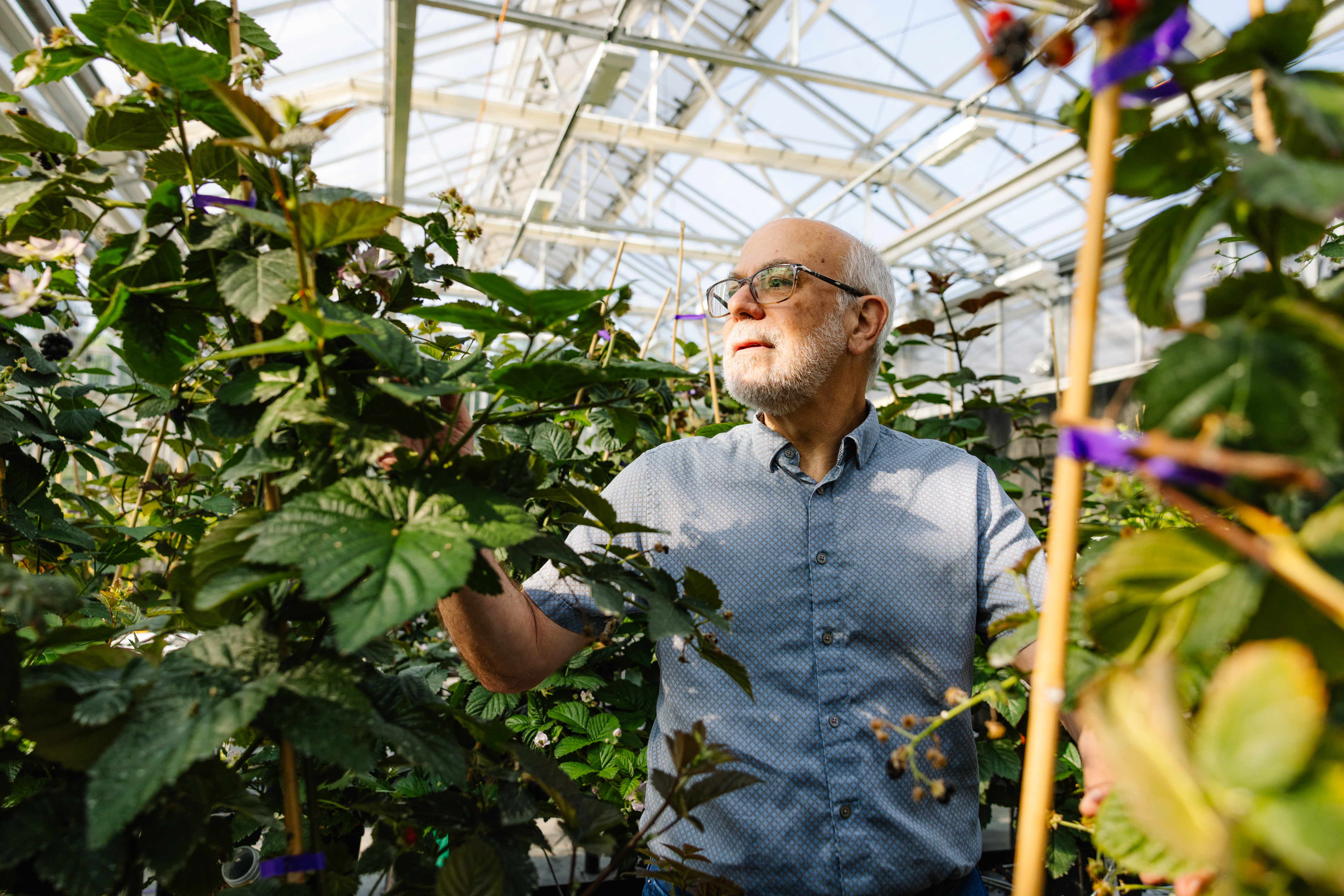
Adams arrived at that greenhouse by a long route. He studied botany and plant pathology at Oregon State University, earned a doctorate in microbiology and plant science at Michigan State University, and joined the biology faculty at Texas A&M. Then came 20 years at Monsanto, where he moved through leadership roles in chemistry technology, genomics, yield and emerging technologies, eventually becoming vice president of global biotechnology.
Around 2013 or 2014, CRISPR began to look less like a clever laboratory instrument and more like a new grammar for plant breeding. Monsanto investigated how it might fit the technology into its pipeline. Adams also looked at startups that could accelerate the work and found no company shaped quite right for the task. His conclusion was both ambitious and oddly domestic: build one, and let it care about foods people meet at lunch.
“We started Pairwise in the early days of CRISPR to accelerate innovation across agriculture.”Tom Adams on the company's original brief
A benefit you can chew
The distinction mattered to him. The benefits of earlier agricultural biotechnology often accrued to farmers, while consumers encountered distant arguments about herbicide tolerance, feed crops and industrial scale. Adams wanted the value to be intimate and obvious. A green that tasted less pungent. A berry without the grit. A cherry without the pit. The grand strategy wore a grocery apron.
Pairwise was founded in 2017 by Adams and agricultural entrepreneur Haven Baker, with genome-editing scientists Feng Zhang, David Liu and J. Keith Joung as scientific co-founders. The name was chosen with a wink. In molecular biology, pairwise comparisons help align DNA sequences and locate changes. In a kitchen, pairwise means tomatoes with basil or berries with cream. Few biotechnology companies manage to put both sequence analysis and pudding in the same word.
Adams became CEO in April 2018. That year brought a $25 million Series A and a five-year collaboration with Bayer valued at $100 million. The arrangement gave the young company room to build editing tools while working across corn, soybean, wheat, canola and cotton. Pairwise later said the first collaboration delivered 27 edited traits into Bayer's testing pipeline. Adams had left a large agricultural company, but he had not mistaken independence for solitude.
The first public answer to his consumer question arrived in 2023. Conscious Greens used editing to soften the wasabi-like bite of mustard greens. Pairwise described it as the first CRISPR food introduced in North America and took it into the food-service market four years after the idea began. The bag proved that edited produce could travel the entire distance from concept to plate.
It did not prove that Pairwise should become a grocery brand. The company discontinued the product in early 2024 and later licensed ten edited green varieties to Bayer. That retreat was useful. Building a scientific platform, breeding commercial plants, creating a consumer label and selling perishable leaves are four separate businesses wearing one raincoat. Pairwise chose the work in which its advantage was clearest: make the tools, develop traits and collaborate with organizations that already know their markets.
The toolbox leaves Durham
Pairwise calls its system Fulcrum. Its basic repertoire can be understood through homely metaphors: scissors that disable a gene, an eraser that changes a genetic letter, and templated methods that rewrite a longer passage. Behind those metaphors sit proprietary enzymes, trait libraries, plant-transformation work and the less photogenic labor of validating that an edit behaves outside a petri dish.
The licensing list makes the new business visible. Corteva paired a 2024 investment with a five-year collaboration. Sun World formed a joint venture in 2025, bringing fruit genetics and commercial reach to Pairwise's work on a pitless cherry. Wild Bioscience is using the platform alongside AI-driven trait discovery. Australia's national science agency, CSIRO, licensed Fulcrum across plants, livestock, aquaculture and microbes. Ball Horticultural took it into ornamentals, from roses to petunias. A system born in crop science had wandered into the flower bed.
This outward movement suits Adams's argument that advanced editing should not remain the property of a few enormous companies. Agriculture contains too many crops, climates, diseases and local preferences for one organization to solve them all. A yam bred for easier cultivation in West Africa presents a different problem from wind-resistant corn in Iowa or a blackberry that can be planted densely in Colombia. The shared element is not the final plant. It is access to a more precise way of asking biology for help.
His founding circle helps explain why partnership became more than a slogan. Baker brought experience moving plant-science products toward a market. Zhang, Liu and Joung brought deep expertise from the early development of genome-editing systems. Bayer supplied scale and row-crop problems; later collaborators brought their own germplasm, field knowledge and routes to customers. Adams's role has been to keep those different clocks synchronized. Academic discovery, a farmer's planting season and a retailer's produce plan do not naturally keep the same time.
The connections also place a useful limit on the founder mythology that gathers around biotechnology. No single scientist invented the platform, bred every plant, managed every trial and found every buyer. Adams is conspicuous because he explains the through-line. The actual work is collective, divided among molecular biologists, breeders, greenhouse crews, regulatory specialists and commercial partners. Pairwise itself advertises that dependency in its name. For a company devoted to precise individual edits, it is emphatically built in the plural.
“This is the crest of a wave that's coming.”Adams on the next generation of edited crops
Speed, measured in seasons
The language around CRISPR is full of acceleration, but Adams's work remains tethered to the stubborn calendar of living things. An edit can be made quickly. A plant must still regenerate, mature, survive the field, face weather, satisfy regulators, scale through nurseries and persuade a retailer. Pairwise's blackberries reached limited commercial sale in Colombia in 2025, yet the company's edited berries are not expected in US groceries before 2030. In software, seven years is an epoch. In perennial fruit, it can feel like haste.
This may explain the aptness of Adams's hobby. Pairwise describes him as a long-time distance runner who competes locally. The relevant talent is not sprinting but holding a pace while the scenery refuses to change. His career has the same rhythm: faculty laboratory, corporate biotechnology, startup greenhouse, field trial, partnership, repeat.
The company has learned to make its claims concrete. Its compact blackberry showed yield gains above 50 percent in greenhouse trials, a promising result that still needs broader field evidence. The seedless fruit is not botanically empty; as with a seedless grape, the seeds are small and soft enough to evade attention. The cherry project is not a supermarket product yet. Precision does not abolish uncertainty. It gives breeders a cleaner experiment.
Adams is also careful about the human experiment. A QR code on blackberry clamshells in Colombia explains the fruit and its technology. The gesture accepts that trust cannot be edited into a genome. People want to know what changed, who benefits and whether the improvement deserves a place at dinner. A smoother mouthful is an opening argument, not the verdict.
The ordinary future
In 2026, the Pairwise greenhouse contains a cherry plant with the proportions of a bush. Shortening the architecture could let fruit arrive earlier, make harvesting easier and place more production on less land. Adams sees the same underlying trait as potentially useful beyond cherries. The spectacle is wonderfully modest: a plant that looks ordinary until somebody explains that orchards have spent centuries looking another way.
That is the Adams method in plain view. Begin with an irritation or constraint that needs no scientific salesmanship. Keep the qualities people already like. Change only what earns its passage. Then find a partner who can carry the result through the remaining seasons.
The blackberry still stains. It remains capricious about ripeness. It has not been bullied into becoming an apple. But the seeds have quieted, the thorns have gone, and the cane has learned some manners. For a technology often explained with revolutions, the better story may be this civilizing sequence of small subtractions. Tom Adams is trying to make gene editing familiar by making fruit less argumentative. The fruit, one suspects, will have the final word.