An eBay drop-off shop is an excellent place to discover how much work hides inside the word “sell.” Somebody must photograph the object, describe it, price it, pack it and persuade a stranger to want it. Tobin Moore began there in 2004, while finishing at Brown University. The business was called eSpot. Its raw material was other people’s unwanted stuff.
Over the following two decades, that small resale operation became the starting point for Optoro, a company helping retailers deal with goods coming back through their doors. Moore’s career followed the merchandise upstream: from finding another buyer for a single object to helping decide the fate of inventory across a retailer’s operations. It was a considerable expansion of the original chore.
There is something pleasingly awkward about his chosen subject. Shopping has display windows and advertising campaigns. Returns have queues, labels and boxes that somebody has already opened. Moore kept working on the part of commerce that comes after the customer has lost interest.
At Brown, Moore studied Business Economics and American History, graduating in 2004. The resale venture began during his final year. There was no long interval between completing an education and trying to make a business work. He left college with a service to operate, customers to find and a friend already involved. The early lesson was immediate: making a sale for someone else meant accepting responsibility for all the little jobs that person would rather avoid.
An education in other people’s belongings
Moore’s early collaborators came from familiar places. Justin Lesher was a friend from St. Albans School in Washington. Adam Vitarello, another school friend who also attended Brown, joined the business in 2005. Before there was an enterprise software platform, there were young founders learning how to make resale pay.
The operation moved from an attic above a garage to a Georgetown storefront. Its early transactions included a 1965 Mustang and a $100,000 Rolex. Such merchandise gives a small shop excellent stories. It also gives the people running it a practical education in how differently objects must be sold.
Paying for that education involved 37 credit cards and $350,000 in debt. Those figures deserve a moment without inspirational music. A credit card statement arrives whether the business model has become convincing or not. The founders were carrying a substantial financial obligation while trying to establish what their company could become.
When financing grew more difficult, Moore went looking for investors. More than 100 meetings preceded a commitment from Nigel Morris, the Capital One co-founder, through QED. Developers then worked on the technology that would help turn the resale operation into a software business. The garage chapter had produced a problem worth pursuing beyond the garage.
The software hiding inside the shop
Optoro dates its founding to 2008; the software business launched in 2010. The distinction captures a period of development rather than a single cinematic unveiling. A service that handled merchandise was becoming a system other businesses could use to handle their own.
The repeated decision was where a product should go next. Restocking might make sense. So might resale through a different channel, a return to the vendor, a donation or recycling. Condition, demand and processing costs could change the answer. Making that decision repeatedly, across many products, gave software something useful to do.
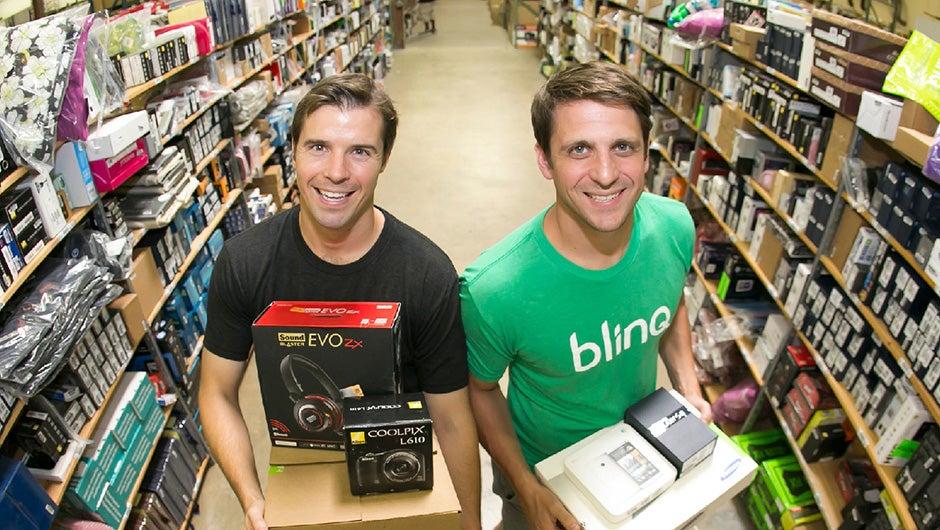
By the time Revolution Growth invested in 2013, Optoro was applying pricing algorithms and predictive analytics to returned and excess inventory. Its OptiTurn platform could help price and list goods across online marketplaces, including Amazon and eBay. Blinq, its consumer shopping site, provided another route to the next customer.
That progression matters to understanding Moore. The software grew out of experience with physical goods. A listing had to attract a buyer. A product had to move. The work imposed a practical test on the technology: did it help something useful reach someone who wanted it?
Illustrative routes, not a measured breakdown.
A business with two ledgers
Moore’s argument connected recovering money with reducing waste. A usable product finding another owner could serve both purposes. The financial incentive gave retailers a reason to examine a process that might otherwise be treated as an inconvenient expense.
In 2014, Optoro announced a $50 million Series C round led by Kleiner Perkins, with Generation Investment Management among the participants. Revolution Growth, Grotech Ventures and SWaN & Legend also participated. The business had moved well beyond its improvised early financing. Institutional investors were backing a software approach to a problem Moore had encountered at shop-counter scale.
The recognition followed. In June 2015, Moore and Vitarello were named winners of EY’s Entrepreneur Of The Year award in Greater Washington. Their names appeared together, a useful detail in a story whose central relationship lasted through repeated changes in what the company actually did.
Moore also talked about what he wanted the workplace to retain from its early years. In 2015, he described a collaborative team encouraged to propose ideas, with the frugality of a company that had spent a long time supporting itself. “We really did whatever we could to save money,” he said. Outside investment had changed the bank balance; he wanted resourcefulness to survive it.
The partnerships also brought the business closer to the equipment and expertise behind retail operations. A strategic investment led by Zebra Technologies in 2021 supported the effort to move goods more efficiently. In 2022, Optoro added Libby Johnson McKee, formerly Amazon’s director of worldwide returns, recommerce and transportation sustainability, to its board. Moore welcomed her experience building returns operations at scale. Recruiting people who understood the work was part of the founder’s job, alongside explaining the opportunity to investors.
Optoro’s public code of conduct put expectations about honesty, fairness and inclusion alongside its waste-reduction mission. It is easy to put a handsome ambition on a website. Setting out how people should work together gives colleagues and partners something more specific to judge.
“Data has the power to transform retail returns”
Tobin Moore, on bringing analytics to the returns process
The warehouse gets another chance
In March 2020, a tornado destroyed Optoro’s Nashville operations center. No one was inside. The founders later described getting a replacement operation established within days. A business built to give goods another destination had abruptly needed another destination itself.
The episode puts some weight behind Moore’s preference for people who solve awkward problems. Processing inventory depends on much more than a software demonstration. Buildings, equipment and working relationships must hold together well enough for the next box to be handled.
During 2020, Optoro worked with Staples on Express Returns and with eBay on the resale of BULQ cases. It also piloted donations of returned products with IKEA. These were different ways to connect the return with what happened afterward: a drop-off, a buyer, an organization able to use the goods.
Its annual impact figures give that work a physical scale. Optoro reported helping divert 3.2 million pounds of waste from landfill in 2020, 3.8 million in 2021 and more than 4.6 million in 2022. These are the company’s reported annual figures. They describe material being redirected, rather than a promise that all returns had become harmless.
Reported waste diverted from landfill
Company-reported annual figures, 2020-2022. Bars start at zero; 2022 shown at the reported 4.6M-pound baseline.
For 2022, the company also reported facilitating $11.9 million in donated goods. Employees contributed 1,890 volunteer hours across more than 90 organizations. Those measures broaden the picture of the company Moore helped lead: its work reached beyond a resale price or a warehouse processing rate.
The founder changes seats
At the end of 2022, Moore’s own job changed. Optoro appointed Amena Ali as CEO on December 30. Moore became principal, while Vitarello became chief strategy officer. Both founders remained on the board at the transition, with responsibilities focused on strategic growth and partnerships.
Ali brought experience leading software companies, including Airside Mobile and VividCortex. Moore publicly welcomed her background in scaling businesses. The handover made a distinction that long company histories eventually demand: founding a business and running its next phase need not remain the same assignment.
Then came the transaction on August 19, 2025. Blue Yonder acquired Optoro, adding its warehouse and store returns capabilities to a broader supply chain business. Financial terms were not disclosed. The combination offered a route for the software to reach more retailers through an existing global customer base.
Moore marked the acquisition with a public note looking back across the business’s successive forms: eBay drop-off store, recommerce operations and returns software. He thanked employees, supporters, Vitarello and Lesher. He also said it was time to begin his next journey. The emphasis fell on years of shared work and the people who had done it together.
Candles in the turkey
The person outside those milestones has rather different measures of a productive day. Moore’s interests include exploring America’s national parks and taking on open-water swims, including routes from Alcatraz toward San Francisco and from the Statue of Liberty toward New York City. A warehouse dashboard presumably offers fewer scenic distractions.
A 2015 personal profile supplied smaller, stranger details. He had gone bungee jumping at three locations in one day. Growing up, his birthday celebrations had featured a turkey with candles instead of a cake. His sisters, Jocelyn Gailliot and Maddy Grayson, co-founded the retailer Tuckernuck. Commerce, apparently, had more than one place at the family table.
Those details are welcome company for the financing rounds and software milestones. Moore spent a substantial part of his working life on goods that people no longer wanted. The task kept changing size, requiring new technology, new partners and eventually a new arrangement for leadership. Through it ran a question simple enough to fit inside the original shop: where could this go next?
Follow the returns
Interviews, company records and further reading.
- Tobin Moore on LinkedIn
- Optoro’s founder biography
- The eSpot years and the software pivot
- Early financing: the Georgetown shop
- Moore on company culture and reuse
- The founders in conversation: The Protagonist
- Revolution Growth’s investment
- The $50 million Series C
- EY’s 2015 Greater Washington winners
- Libby Johnson McKee joins the board
- Optoro’s public code of conduct
- Analytics and returns: the omnichannel report
- 2020 impact report
- 2021 impact report
- 2022 impact report
- Amena Ali’s CEO appointment
- The Blue Yonder acquisition
- Swims, adventures and birthday traditions
- Watch: Where Online Returns Really End Up (CNBC)
- Optoro at Blue Yonder