Tippu Gagguturu trained to build structures. His first professional assignment involved checking whether a year had enough digits. In January 1996, newly out of the Indian Institute of Technology, Kharagpur, he joined Tata Consultancy Services and wrote a tool to inspect insurance software for two-digit dates before the arrival of 2000. It was an introduction to a durable business opportunity: somewhere inside a perfectly respectable organization, a small administrative detail is waiting to become a very expensive surprise.
“I trained as a structural engineer. I have never built a bridge,” he wrote in a September 2026 career reflection. The confession has the economy of a good joke. His subsequent work has involved software development, enterprise technology leadership, and companies concerned with keeping track of who may do what. Today, BankStride lists him as Founder & CEO and describes him as its founding backer. The banking venture extends a question that runs through his work: how can an organization keep its obligations visible while getting on with business?
A handheld device before the boardroom
One early answer fitted in the hand. In 2009, Gagguturu was working on Sterizon, a venture offering wireless customer-data collection and direct marketing tools for businesses with physical premises. The product was called wiZit. A customer could supply information through a portable device instead of leaving it on a paper signup sheet or comment card. The proposition was specific, tangible, and considerably less glamorous than the internet's more fashionable promises.
A March 2009 agreement with Zipit Wireless supplied an underlying hardware platform: Zipit's Z2. Sterizon's announcement identified Gagguturu as vice president of business development and Subba Ayyagari as vice president of strategic partnerships. Software, hardware, and distribution all had to meet before a business could actually use the thing. A clever application still needed a route to the counter.
By November, Sterizon was announcing an affiliate and reseller program. Its potential partners could refer customers or take on sales, implementation, training, and support. Gagguturu, identified there as co-founder, explained the replacement of paper collection with portable wireless devices. The sales channel mattered as much as the device's portability. A product could travel only so far under its own power.
That episode gives his later career an unusually concrete prehistory. Before software for bank covenants and enterprise access reviews, there were comment cards, handhelds, and partners expected to explain the product to a shop owner. The paperwork changed; the challenge of persuading someone to change a working habit remained.
The customer had once been him
Gagguturu went on to become chief information officer of Allconnect, where his tenure included the company’s successful exit. He had earned a master’s degree at IIT Kharagpur. The CIO experience matters to the story because it placed him on the buying side of enterprise software. He had been responsible for an organization's technology before asking other organizations to buy his own.
Former colleagues describe both execution and temperament. Sam Howe, who says he promoted Gagguturu to CIO at Allconnect, recalls him bringing calm to a difficult technology situation while retaining humor and grace. Dan King describes a leader interested in how the business earned money, and credits him with changing the way a 200-person IT department worked. These are colleagues' assessments, with all the personal perspective that implies. They help explain why his founder story includes operations as well as code.
SecurEnds was founded in 2017 by Gagguturu and Deven Reddy. Gagguturu dates his departure from the CIO seat to April 2018. The distinction is useful: forming a company and giving it one's full working attention are separate events. By the time he committed to the venture, he had already encountered the less photogenic requirements of entrepreneurship.
Permission slips acquire a business model
SecurEnds addressed identity governance, the work of establishing and reviewing access to an organization's systems. Its early offering automated user access reviews, entitlement audits, access requests, and segregation of duties. The terms are dry; the underlying decisions are familiar. Who should be allowed in? What should they be allowed to do? Who checks that the answer still makes sense?
In his July 2021 letter announcing the company's Series A, Gagguturu emphasized ease of use and accessibility. He described a product intended to integrate with a customer's existing environment and accommodate its particular requirements. He also thanked early customers for helping establish that the idea worked and continuing to improve it. The first customer implementation had come roughly two years before that letter. The business had needed actual use, followed by revision.
The financing supplied a dated measure of its progress. On July 15, 2021, SecurEnds announced a $21 million Series A led exclusively by Elephant. At the time, the company reported 340 percent year-over-year growth in annual recurring revenue and nearly 100 customers. Those figures belong to that announcement, rather than to the present. They describe a particular moment when a previously bootstrapped company acquired outside capital for its next stage.
The announced plans included product development, expanded operations, and entry into additional European and Asian markets. Elephant partners Jeremiah Daly and Christopher De Souza were to join the board. The round brought new people into the governance of a company selling governance software. Even the business of organizing permissions eventually requires a few more seats at the table.
At BankStride, the file becomes the story
BankStride carries that interest into commercial banking. The venture grew out of experience at SecurEnds: fragmented credit-covenant, compliance, and portfolio processes resembled the manual identity-governance work the earlier company had tackled. Gagguturu's role connects the two businesses, alongside a recurring interest in making institutional responsibilities easier to follow.
The platform groups loan exception tracking, document collection, covenant monitoring, construction-loan oversight, credit-risk reporting, and pipeline management. These functions concern the continuing work around a loan as well as the transaction itself. The useful narrative unit is an obligation: a document that must arrive, a condition that needs checking, an exception that needs attention. A signature gives a deal a date; it does not give every subsequent task an owner.
Gagguturu frames the ambition as helping banks remain ready for audits while serving customers and closing business. It is a practical expression of his position: the work of managing risk should be present in daily operations. Compliance acquires an awkward reputation when it appears only at the moment somebody needs proof. BankStride's chosen territory is the everyday administration that produces that proof.
“the ability to be audit-ready every day”
Tippu Gagguturu, on BankStride
Then the software started calling the software
A second extension appeared in July 2025 with APIDynamics. In explaining why he started it, Gagguturu described conversations with security and technology leaders that exposed a mismatch. Human access had established controls and review practices. Machine identities and the APIs carrying their requests could operate with long-lived tokens and too little attention to context. His next product took that mismatch as its starting point.
The launch announcement described adaptive authentication, real-time risk scoring, and Zero Trust enforcement for API communications. It also scheduled a public debut at Black Hat USA 2025. The intended shift was from observing API traffic to making access decisions as calls occurred. For a founder already occupied with permissions, the growth of machine-to-machine activity expanded the population whose permissions needed examination.
His 2026 writing follows that expansion. In June, he described asking a customer how many AI agents were running and what each was authorized to do. Answering required information from four places. A July article examined the identity problems accompanying Microsoft's enterprise AI infrastructure. These examples explain his interest in AI through a working executive's question: who can account for what the new system is allowed to do?
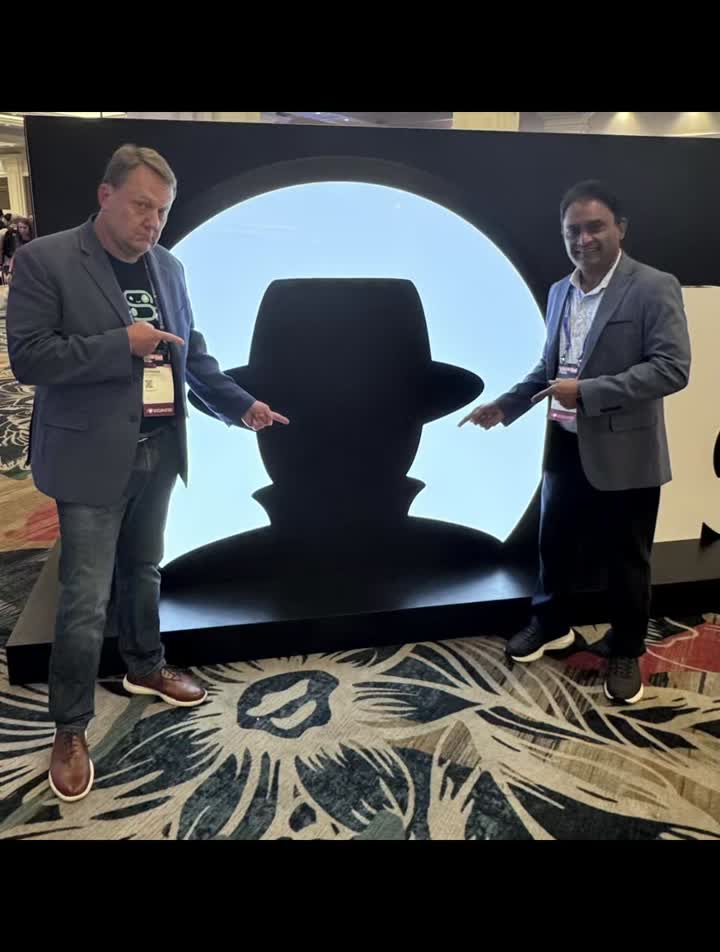
At Black Hat USA 2026, Gagguturu and Rob Kocerha recorded a discussion of IdentityWatch. The distinction they explored was between knowing an identity's access and monitoring its activity. Access reviews would gain context from entitlement use and identity-threat signals. In a separate product demonstration, Gagguturu explained a sequence beginning with connecting applications and establishing who had access, then extending into reviews, access requests, and onboarding or offboarding. His explanations tend to follow the work in order.
A career with room to change direction
His work also includes supporting the construction of an elementary school in India, with financing and approvals, a project dating to December 2005. It gives the structural-engineering background a pleasing footnote. The founder who says he never built a bridge did help a school become a building people could use.
In April 2026, Gagguturu wrote about the responsibility security leaders bear when explaining their organizations' position to boards and regulators. His stated goal was “Replace uncertainty with clarity.” That phrase fits the range of his businesses without requiring them to be identical. A customer record, an access permission, a loan covenant, and an API request each create something that somebody must be able to explain.
The career's continuity lies in that preference for work that can be accounted for. The tools have changed from handheld devices to cloud platforms and machine identities. The founder still returns to the person responsible for the next decision. There is plenty of novelty in software. Gagguturu keeps making a business out of what happens after the novelty has been approved.