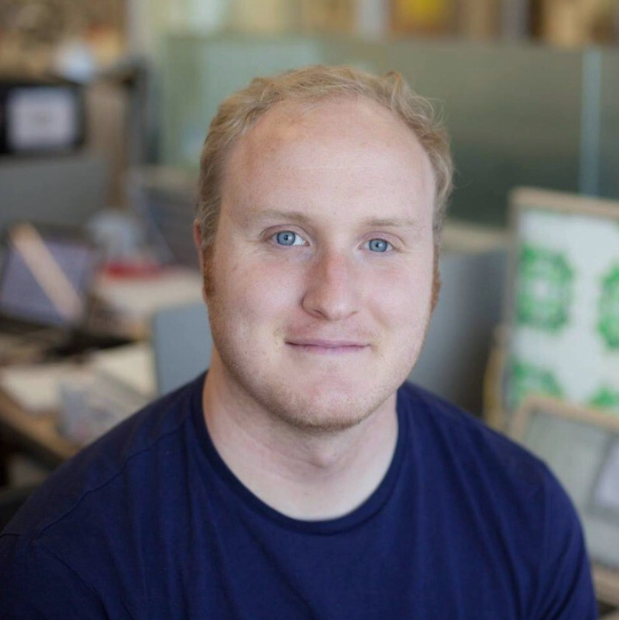
FILED FROM BERKELEY, CALIFORNIA · A YESPRESS PROFILE
The Pitch
A drug you can swallow, for the price of a pill
Antibodies are some of the best medicines ever made. They are also a nuisance. They come in vials, they travel by needle, and they arrive with a price tag that can read like a used car. Timothy Craven looked at that arrangement and asked a stubborn question: why can't this just be a pill?
That question is the whole company. Craven is the co-founder and CEO of Insamo, a biotech that designs macrocyclic peptides - ring-shaped molecules that fold up tight enough to slip across a cell membrane and bind their target with the grip of an antibody. The hard part is not making peptides. The hard part is making peptides the body will actually absorb when you swallow them. Most don't. Insamo's bet is that a machine can learn which ones will.
His framing is refreshingly free of jargon. “Everyone wants a pill, and they want it not to cost $30,000,” he told UC Berkeley's tech news team in 2025. That is the entire value proposition compressed into a single sentence, and it is the kind of plain talk that gets a chemist's idea funded.
Everyone wants a pill, and they want it not to cost $30,000.
Timothy Craven · CEO, Insamo
The Machine
Design first. Find the structure later.
Traditional drug discovery often starts with a known structure and works toward a molecule. Insamo runs the logic in reverse. The platform takes only a small sample of the target, then leans on three things working in concert: machine-learning-driven molecular design, ultra high-throughput molecular biology, and parallel synthetic chemistry. It generates enormous libraries of candidate peptides, tests them at a scale most labs can't approach, and feeds the results back into the model. The company describes a chemical space measured in trillions of proprietary experimental data points.
01 / DESIGN
Machine Learning
Models propose vast libraries of ring-shaped peptides engineered to cross membranes and bind hard.
02 / BUILD
Parallel Chemistry
Synthesize and assemble candidates in parallel, no prior structural blueprint required.
03 / TEST
High-Throughput Biology
Screen at massive scale, then feed trillions of data points back to sharpen the next round.
The company calls it a “turn-key” system. The promise is reach: targets long written off as “undruggable” become approachable, and the resulting molecules are designed from the start to be membrane-permeable and orally available - antibody-grade binding, pill-shaped delivery. It is an audacious thing to claim, which is exactly why the pedigree behind it matters.
The Pedigree
Stars, atoms, regulators, then peptides
Craven did not arrive at peptides in a straight line. He started with a dual undergraduate major in physics and chemistry at The College of New Jersey. From there the resume reads like a tour of American science institutions: research stints at NASA and the National Institute of Standards and Technology, the lab that defines what a kilogram and a second actually are. He picked up a master's in bioinformatics at Georgetown, then worked at the FDA - the agency that would one day judge drugs like the ones he now designs.
The doctorate is where the through-line appears. At New York University he earned a PhD in biology focused on the computational design and synthesis of biomimetic molecular architectures, co-advised by Richard Bonneau and Kent Kirshenbaum. Bonneau later became VP of Machine Learning at Genentech. In 2017, Craven was a co-author on a landmark Science paper, “Comprehensive computational design of ordered peptide macrocycles” - the academic seed of the company he would build.
Then came the lab that made the whole thing credible. As a Washington Research Foundation Innovation Fellow at the University of Washington's Institute for Protein Design, Craven trained alongside David Baker and genomics pioneer Jay Shendure. Baker would go on to win the 2023 Nobel Prize in Chemistry for computational protein design. When you tell investors you can teach software to design medicines, having apprenticed in that workshop tends to end the argument.
Insamo's mission is to transform how we discover drugs for some of the most challenging diseases.
Timothy Craven
The Origin
A grad-school idea and twenty thousand dollars
Insamo did not begin with a term sheet. It began as a graduate-school concept that Craven decided to back with roughly $20,000 of his own money in 2022. He co-founded the company with two other PhD scientists: Toby Passioura, the chief scientific officer, and Glen McIntyre, the chief operating officer. Passioura's expertise traces to the Tokyo lab of Hiroaki Suga, a giant of peptide chemistry, which is part of why Insamo runs as a two-hemisphere operation split between Berkeley and Sydney.
The personal stake grew into something institutional. In February 2024, Insamo emerged from stealth with a $12 million seed round led by deep-tech and life-science investors: Playground Global, venBio, and MRL Ventures Fund, the corporate venture arm of Merck & Co. That a pharma giant's fund wrote a check is its own signal - the people who sell the injectables are betting on the man trying to replace them.
By 2025, Insamo was being profiled as one of the standout AI-driven companies at UC Berkeley's Bakar Bio Labs, the university's flagship biotech incubator. The arc from a $20,000 thesis project to a venture-backed, two-continent drug-discovery engine took about three years.
Why It Matters
The undruggable, made swallowable
Strip away the platform language and the ambition is human-sized. Biologics work, but they are expensive and they require needles. Small-molecule pills are cheap and easy, but they can't reach many of the targets biologics can. Macrocyclic peptides sit in the gap - big enough to grab tough targets, potentially small and stable enough to survive a trip through the gut. The catch has always been finding the rare ones that are both potent and permeable. Insamo's answer is to stop hunting one molecule at a time and instead let a learning system search trillions of possibilities.
If it works, the payoff is the thing Craven keeps coming back to: medicines for hard diseases that arrive as an affordable pill rather than a costly infusion. That is the quiet radicalism underneath the chemistry. Not a new molecule - a new economics of who gets to take one.
For now, Craven is doing what founders do: building libraries, screening candidates, and turning a sentence about a $30,000 pill into a pipeline. The physics major who once worked at NASA and measured constants at NIST has landed on a problem with a very concrete finish line. You will know it worked when the medicine that used to come in a vial shows up in a bottle on a pharmacy shelf.
Quirks & Fun Facts
- His resume includes NASA, NIST, and the FDA - three of the most distinct corners of American science - all before he ever started a company.
- He stacked a physics-and-chemistry bachelor's, a bioinformatics master's, a biology PhD, and an MBA - a rare blend of bench scientist and operator.
- His postdoctoral mentor, David Baker, won the 2023 Nobel Prize in Chemistry the year before Insamo launched publicly.
- His PhD co-advisor, Rich Bonneau, became VP of Machine Learning at Genentech.
- Insamo operates across two hemispheres, splitting work between Berkeley, California and Sydney, Australia.
- The company started with about $20,000 of Craven's own money before a single venture dollar arrived.