On Friday, Timothy Astandu could leave the office and head straight to the airport. By Sunday evening, he would be on his way back, ready for work on Monday. He called these journeys “express trips”. The phrase has the faintly apologetic sound of a commuter explaining a delay. His commute, however, sometimes involved adding another country to a list that would eventually reach 197 countries and territories.
Astandu runs Populix, the Indonesian research business he co-founded in 2018. His working life concerns questions: what consumers prefer, how they behave, what a business ought to understand before making a decision. Outside work, he has pursued another sort of investigation, taking an Indonesian passport through every United Nations member state and then a little further.
The two pursuits make an unusual pair. Research asks for patience and a method. An express trip demands rather a lot from a weekend. Both bring him into contact with people whose answers can complicate an apparently sensible assumption.
The Friday departure
In May 2026, Brazil became the final destination in Astandu’s 197-place itinerary. Two months later, on July 16, Museum Rekor-Dunia Indonesia, known as MURI, recognized the achievement. Its record lists 193 UN member states, the two observer states, the Vatican and Palestine, and Taiwan and Kosovo. The arithmetic matters: “197” describes a particular list of countries and territories, rather than 197 UN members.
His wife and mother accompanied him when he received the award from MURI founder Jaya Suprana in Jakarta. It was a family occasion as well as a travel milestone. His mother had introduced him to travelling as a child; the habit had outlasted childhood by a considerable number of boarding passes.
There is a temptation to treat such a tally as an escape from ordinary responsibilities. Astandu’s account is more crowded. Flights had to fit around a company and a family. The weekend itinerary had an unglamorous final requirement: get back in time to work. A person can be very far from Jakarta and still have Monday hanging over him.
A doctorate, then a different examination
Before Populix, Astandu accumulated the sort of education that makes an introductory biography resemble a university prospectus. He studied at the London School of Economics, took a master’s in Modern Chinese Studies at Oxford, and continued to Cambridge for an MPhil and a doctorate in Management Studies. Leadership was his doctoral research focus.
His academic interests were rooted in how people behave inside organizations. A former founder biography describes his doctoral work as an effort to bridge leadership theory and practice. It also records academic prizes at LSE and Oxford. Later came an external lectureship at WHU in Germany, where his LinkedIn employment history lists a stint from 2017 to 2019.
His research continued to surface after he became a founder. In 2022, Cambridge Judge Business School highlighted a paper he co-authored with Dana Tussing, Andreas Wihler and Jochen Menges. Its subject was workplace envy, examined through employees in Indonesian supermarkets. The study considered why some envious workers withdraw while others remain engaged in achievement.
The findings resisted a convenient single explanation. People’s motivations mattered. A manager could not assume that a public award would produce the same response in everyone watching it being handed over. That is a useful intellectual background for someone whose business depends on understanding an audience without flattening its differences.
There is also a pleasing complication in his career: a scholar of leadership became responsible for a company full of people. An organizational chart is easier to discuss when none of its boxes can ask you what happens next.
First, find someone willing to answer
Populix grew from a partnership between different kinds of research experience. Astandu and Eileen Kamtawijoyo connected in Cambridge, where they discussed bringing a more accessible approach to consumer research back to Indonesia. She knew the client’s side from working in consumer goods; he knew the academic side. Jonathan Benhi became their fellow co-founder and technology lead.
The early work had little of the polish suggested by the term technology company. Astandu later recalled a first project collecting responses manually at a supermarket mall. The team also worked from cafés because they could not yet afford an office. They started by doing the work they hoped technology would improve.
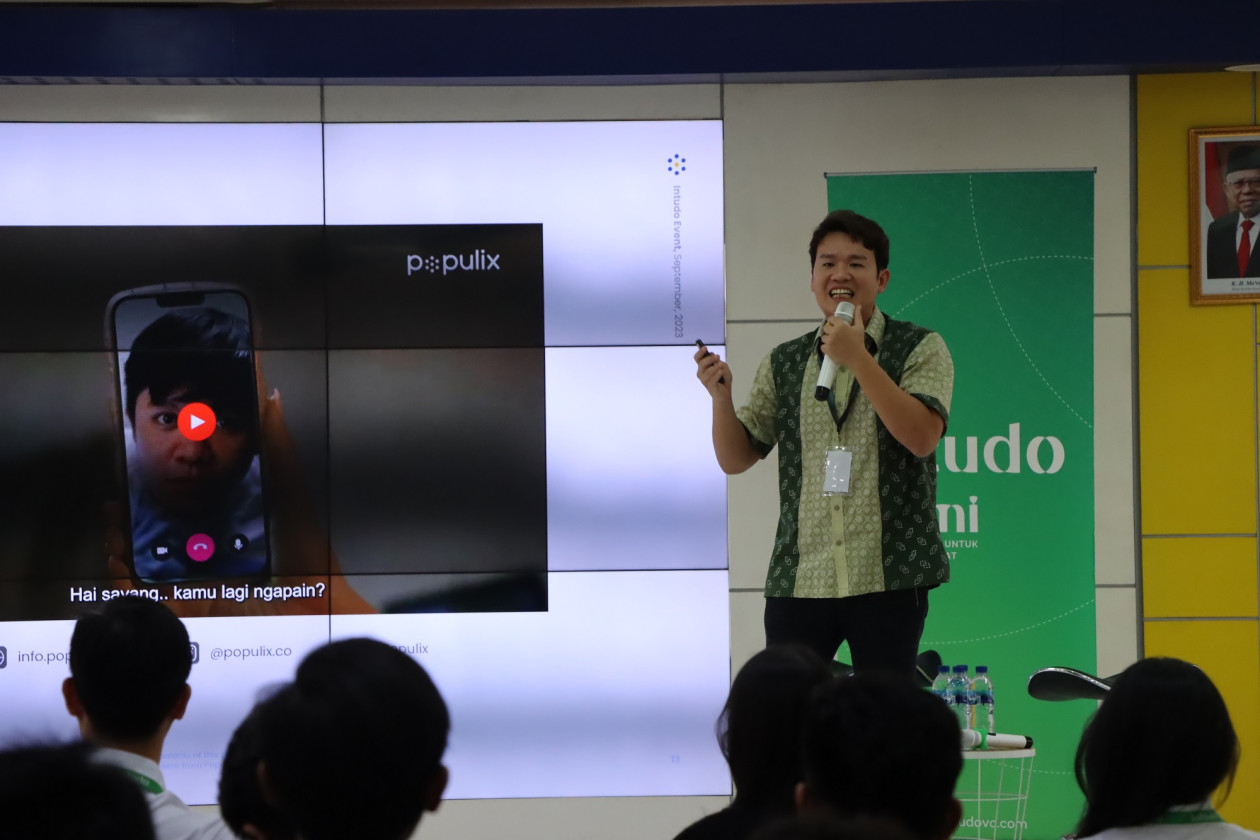
Speaking at Universitas Gadjah Mada in September 2023, he argued for a wider audience for research. “Research shouldn’t just serve the academic world but also benefit SMEs,” he said. For a founder who had come from universities, that ambition involved moving beyond the institutions that had trained him.
The café detail is memorable because it makes the distance travelled visible. A business now associated with digital questionnaires began with people approaching other people. Before there was a platform to demonstrate, there was a practical question: could they collect something useful enough for a customer to act on?
The coffee-shop question
The interesting customer in Astandu’s account is often the smaller one. A large company already understands the habit of commissioning research. Someone planning a coffee shop may have a budget, a location in mind and a strong feeling that the neighbourhood needs another place selling coffee. A strong feeling is wonderfully easy to obtain.
In his 2023 Sidedoor conversation, Astandu described Populix’s mission as helping to “create a world full of good decisions”. His examples were ordinary business questions: whether a menu appealed, where to open a branch, who the competitors were. These were decisions an owner could recognize without first learning the vocabulary of a research department.
He also described a commercial lesson. Smaller businesses responded to an explanation of how research could affect revenue, margins or advertising choices. They needed a connection between a study and a decision. Selling a sophisticated method was less useful if the buyer could not see what to do with its results.
That gives his academic background a practical test. The method must remain sound while the explanation becomes easier to use. A customer should be able to ask a better question without having to retrace his route through three British universities. Otherwise, the admission requirements for opening a coffee shop would become quite unreasonable.
“create a world full of good decisions”
Timothy Astandu, describing Populix’s mission
His work involves two audiences: the businesses asking questions and the people being asked. A useful exchange needs both to see a reason to take part.
The money has a job to do
The financing history provides another way to follow that ambition. In December 2019, Populix announced a US$1 million seed round led by Intudo Ventures. The stated uses were concrete: develop products, increase marketing and recruit staff. Those are familiar categories, but they also describe the work of turning an early service into a repeatable business.
In June 2022, the company raised US$7.7 million in Series A financing, led by Intudo Ventures and Acrew Capital, with Altos Ventures and Quest Ventures participating. Astandu described spending on technology, people and awareness of the brand. The plans included making the data-collection process more digital and developing services for more users.
On April 15, 2025, Populix announced US$4.3 million at the first close of its Series B round. MSW V Asia Fund X led, with existing investors participating. Its plans now included developing AI research tools and exploring a broader Southeast Asian market.
The company described NeXa, a research assistant intended to help with questionnaires, respondent targeting and conclusions. It also outlined work on synthetic respondents. Those plans introduce a demanding question for a business built around listening to people: what can a model contribute, and which answers still require the people themselves? The quality of the distinction will matter as much as the speed of the software.
The map is still unfinished
Astandu’s travel accounts offer a more immediate reminder of why direct encounters matter. In Iraq, he described hospitality that challenged the picture he had carried with him. People welcomed him and sometimes invited him to eat at home. The account is personal observation, with all the limits that implies, but the change in his expectations is the point.
A visitor’s experience cannot stand in for an entire country. It can, however, interrupt a lazy certainty about one. His interest in local conversations and markets suggests why travel holds his attention alongside the business. Both give him opportunities to discover that people have reasons a distant observer has missed.

His lighter public biography has room for another side of him. NomadMania’s envoy page jokes that he has a doctorate in visa applications. The credential is unofficial; the volume of practice is easier to believe. An earlier biography also lists stamp collecting among his interests. Apparently, passports were never his only albums.
After Brazil, he was already discussing fresh lists. In August 2026, he said he wanted to finish visiting Indonesia’s provinces and reach 200 airline brands by the end of the year. These were goals still ahead of him. Completing the international itinerary had given his curiosity another set of appointments.
There is something fitting about the turn toward provinces at home. A long journey can sharpen the question of what remains nearby and overlooked. For Astandu, the next useful answer might come from a new destination, a research participant or a conversation that refuses to follow the expected script. First, he has to make room to hear it. Then, presumably, he has a flight to catch.