A cash machine is an unusually demanding piece of furniture. It must talk to a bank, recognize an account, protect a transaction and produce the correct number of notes. The customer would prefer to think about none of this. Tim Oliver runs a business built around that entirely reasonable lack of interest.
As president and chief executive officer of NCR Atleos, Oliver has been asking financial institutions to reconsider how much of the machinery of cash they want to run themselves. A bank can buy an ATM. It can also hire someone to take responsibility for the hardware, software and continuing work that make the ATM useful. Oliver’s strategy puts more weight on that second conversation.
His route to the job passed through bond trading, industrial automation, banking technology, semiconductor materials, metal recycling and window fashions. It is a résumé with enough changes of scenery to make an airport departure board look settled. The recurring occupation was finance. In October 2023, the finance executive became the person responsible for the whole company.
A CFO with an unusually varied map
Oliver studied economics at Williams College and earned an MBA at New York University’s Stern School of Business. His early career included operational finance at AlliedSignal and bond trading at Bear Stearns. Those jobs placed him on different sides of the same broad question: how money moves through businesses and markets.
At Raytheon, he worked in investor relations and financial planning. From 2005 to 2007, he was vice president and treasurer at Rockwell Automation. He then became CFO of Metavante Technologies, a banking technology processing business, before taking the CFO role at MEMC Electronic Materials from 2009 to 2011.
The sequence matters because an ATM company combines several kinds of work. It has physical equipment, software, financial transactions and customers who cannot simply postpone service until next week. Oliver had worked across businesses with different products and financial structures before he was asked to lead this particular combination.
From 2011 to 2019, he was CFO of the Goldstein Group and president and CFO of its metal recycling subsidiary, Alter Trading. A subsequent move took him to Springs Window Fashions. In July 2020, he became CFO of NCR. By then, his career had accumulated a substantial collection of businesses whose operations extended well beyond a spreadsheet.
- 2007Metavante
Banking technology CFO - 2011Goldstein / Alter
Finance and operating leadership - 2020NCR
Chief financial officer - 2023NCR Atleos
President & CEO
A new company, with the machines still running
In April 2023, Oliver was selected to lead the planned NCR Atleos business. The separation became effective on October 16. Regular trading in Atleos shares began on the New York Stock Exchange the next day, under the symbol NATL. The other company, NCR Voyix, continued with a different focus in digital commerce.
Corporate separations have a tidy appearance when reduced to two names and two stock symbols. In this case, the departing business already had an extensive international operation. At launch, Atleos described 600,000 devices under management and more than 80,000 ATM locations it owned and operated. Its machines supported customers across 140 countries.
Those figures gave Oliver an established business to lead. They also left little room for the leisurely experimentation associated with a new company. Existing customers still expected machines to work, software to run and service calls to be answered. The company’s independence was new; the customer’s withdrawal was due immediately.
In his launch message to customers and partners, Oliver emphasized a service-led approach. The offer brought together remote support, field services, software and hardware. Independence gave that collection of activities its own corporate home and a clearer commercial focus.
A year later, his public anniversary message began, “We’ve turned 1!” He thanked customers, partners, colleagues at NCR Voyix and the global Atleos team. It was a revealing list of acknowledgments for a separation: the people on the other side of the new corporate boundary still received a mention.
Selling the work behind the withdrawal
The central idea is straightforward enough to survive the name ATM as a Service. A financial institution can hand over a broader bundle of operating responsibilities instead of managing each element separately. Atleos already sells hardware and software; the service model gives it more to do after a machine has been installed.
That changes the relationship with the customer. Equipment sales have an obvious moment of completion. Running the equipment produces a continuing obligation. The attraction for the bank is less operational complexity. For Atleos, the model supports a business with revenue that continues through contracts, subscriptions and transactions.
The physical machineSoftware
The transaction toolsOperations
The continuing work
There is another part of Oliver’s business that brings this argument closer to the shopper: Allpoint, the ATM network found in retail locations. It allows participating financial institutions to extend access through a shared network. A customer’s bank need not have its own branch beside every place that customer buys groceries.
For Oliver, cash access and banking technology belong in the same discussion. His November 2023 Bloomberg interview covered the role of cash, self-service access and Atleos’ international presence. The business depends on connecting money held digitally with the physical transactions people continue to make.
The service emphasis has measurable weight. In the second quarter of 2026, 70% of Atleos’ revenue came from recurring streams. That is a revenue measure, rather than a count of machines under a particular contract. It helps explain why an executive with Oliver’s finance background spends so much time discussing how the work is sold.
The colleagues who saw a CEO
At Georgia Tech’s Tech Talks Business event in January 2025, Oliver sat down with business dean Anuj Mehrotra. Alongside the discussion of banking technology, he described his own change of role. Colleagues had supported his move from CFO to CEO because they believed he could do it.
That detail gives a human dimension to an otherwise formal sequence of appointments. The move involved a change in what people expected of him. Financial stewardship remained part of the assignment. Leading the company also meant setting its direction and explaining that direction to people whose work sat far from finance.
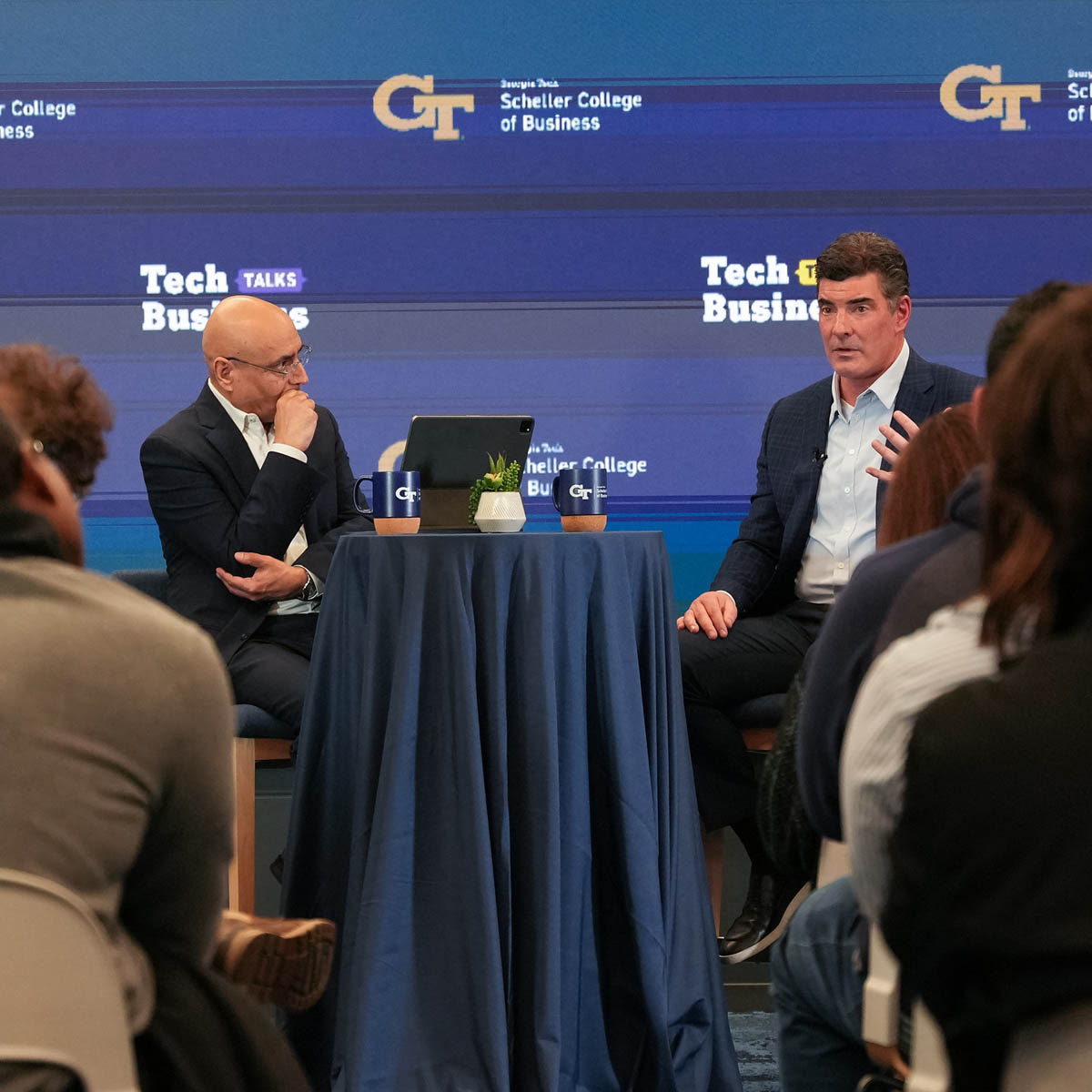
His conversation with Mehrotra looked toward banks outsourcing more cash operations. That ambition fits the service strategy: a bank concentrates on banking while Atleos manages more of the supporting infrastructure. It requires persuading customers to entrust the company with work that remains essential even when it attracts little attention.
Oliver’s public biography also lists a treasurer role with the St. Louis AAA Blues. After all the changes in industry and title, there is something pleasingly consistent about that detail. The setting changes again. Someone still has to attend to the finances.
When the cash route meets the cash machine
On February 26, 2026, Atleos and Brink’s announced an agreement for Brink’s to acquire Atleos. The transaction was valued at approximately $6.6 billion, including assumed debt. For Oliver, the proposed combination brought a new scale of corporate change less than three years after the separation from NCR.
The industrial logic follows the journey of cash. Atleos supplies ATM technology and services; Brink’s brings cash management and logistics. Their activities already touch the same financial institutions and retailers. Combining them would place more of that connected work inside one organization.
“This transaction represents a strategic opportunity for NCR Atleos.”
Tim Oliver, February 2026
The proposal also establishes a boundary around Oliver’s next chapter. Mark Eubanks, Brink’s president and CEO, is designated to lead the combined company. The announcement gives Oliver a substantial task in the meantime: continuing to operate Atleos while preparing for a change in ownership and organizational structure.
Both companies’ shareholders approved the transaction on June 30, 2026. Approval advanced the deal; completion still depended on remaining regulatory approvals and customary closing conditions. On October 8, Brink’s announced that the UK competition regulator had accepted its proposed remedy in principle: divesting NoteMachine/TestLink UK to address competition concerns. A suitable buyer and the divestiture process still lay ahead. Brink’s continued to target closing early in the first quarter of 2027.
Oliver still had an operating business to discuss. Second-quarter revenue was approximately $1.10 billion, flat against the prior year, while net income attributable to Atleos increased to $65 million. The combination of steady revenue and higher income gives the story more texture than a simple growth narrative.
For now, Oliver’s story sits between two corporate events: a completed separation and a proposed combination. Between them is the less ceremonial work of persuading banks to buy a service, helping employees deliver it and making the economics hold together.
The cash machine remains a useful test of that work. A customer approaches, presses a few buttons and expects the right notes to appear. Oliver’s career has brought him to the business behind that small expectation. Its success is easiest to appreciate when the customer has no reason to think about it at all.